Fifty Essentials in Fifty Days 03: Marvel Team-up v1

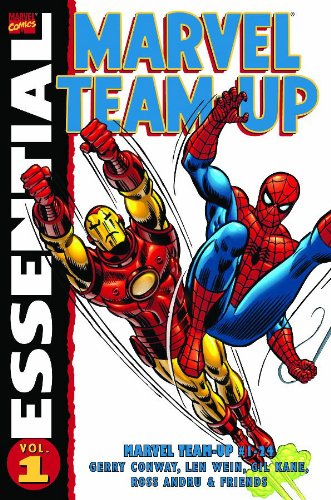
cover of Essential Marvel Teamup vol 1


Essential Marvel Team-Up Vol. 1
Gerry Conway, Len Wein, Gil Kane, Ross Andru, Sal Buscema and friends
Reprints: Marvel Team-up #1-24 (March 1972 — August 1974)
Get this if: you’re in for some Bronze Age nostalgia — Three stars

Essential Marvel Team-Up Vol 1 is the quintessential Marvel Bronze Age collection. If you want to know what a run of the mill Marvel series was like in the seventies, this is the one for you. It took me right back, it did. Not that I’m that old that I’ve read these stories when they first came out, but I did read a lot of them in Dutch translation, when they were published here a decade and a half later or so…

Though it may be heard to imagine now, I remember Christopher Priest mentioning once in an Usenet thread that the very idea of Marvel Team-Up was controversial at the time it first came out. Spider-Man was supposed to be a loner after all, somebody looked at with suspicion by most other heroes. Just look at any Silver Age crossover to see how standoffish they all were to him. If you then create a title that has him palling around with one hero after another it changes Spider-Man’s character. He can’t be mysterious and slightly creepy if he starts welcoming every new hero to the Marvel Universe…

For me that’s one of the greatest differences between Silver Age and Bronze Age Marvel, that degree of interaction between various characters. In the Silver Age, despite crossovers and guest stars titles followed their own path and you could never confuse a Fantastic Four for the Avengers; in the Bronze Age it all started to mesh together. The soap opera takes over and knits the universe together. Since that’s the Marvel I grew up with, it’s also the Marvel I like the best, midway between the Silver Age and the crossovers excesses of the eighties and nineties.

The writers in this volume are Gerry Conway on #1-12, followed by Len Wein on #13-24, with art mostly by Gil Kane but also featuring Ross Andru on early issues and Sal Buscema and Jim Mooney later on. It’s all inked in the dependable Marvel House Style, but both Kane and Buscema are immediately recognisable. On the whole I found the Wein issues to be slightly better than the Conway ones, even if Conway was more ambitious, having several multi-issues storylines going on.

Most of the stories are fairly simple: Spidey (or the Human Torch in one issue) is going his merry way and runs into the guest star du jour, either helping him fight some mooks or more often getting into a fight with them for some contrieved reason or other. Once any misunderstandings are cleared up, the villain of the story reveals themselves, manages to defeat Spidey and co so that the plot can continue, explains their plan to conquer the world|rob the bank|kill all superheroes before being stopped at the last moment. There’s little characterisation other than in references to what’s been going on in Spider-Man’s own title or subplot in these early issues. It’s heroes meet, fight each other, patch up their differences, get defeated by the real villain, escape their death trap and stop the villain reaching his or her goal. It’s all done professionally, but no great art.

Fun though. And the art, especially by Kane, makes up for a lot of deficiencies in the stories.
Fifty Essentials in Fifty Days 02: Man-Thing v1

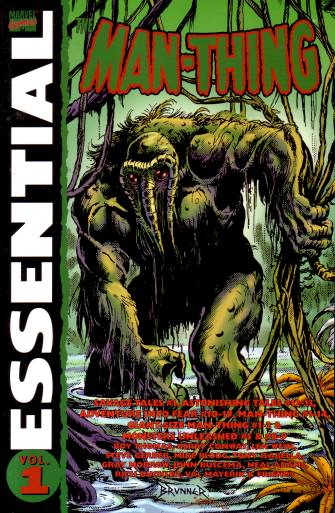
essential Man-Thing Vol. 1


Essential Man-Thing Vol. 1
Steve Gerber, Roy Thomas, Val Mayerik, Mike Ploog and Friends
Reprints: see below
Get this for: Gerber, Gerber, Gerber! — five stars

Right. Day two. Essential Man-Thing Vol 1 collects Savage Tales #1, Astonishing Tales #12-13, Adventure into Fear #10-19, Man-Thing #1-14, Giant-Size Man-Thing #1-2 (don’t snigger) and Monsters Unleashed #5, #8-9. It features writing and art of Roy Thomas, Gerry Conway, Tony Isabella, Mike Ploog, Val Mayerik, Gray Morrow and others, but is dominated by one man: Steve Gerber.

Man-Thing made his debut in May 1971, only two months before that other muck encrusted swamp monster, Swamp Thing over at the Distinguished Competition, more a case of tapping into the same zeitgeist as somebody copying somebody else. Whereas old Swampy still had a human intelligence under all that muck, Manny was less fortunate, with the man he was, Ted Sallis, yet another genius-scientist who became the victim of his own weapons, completely submerged, leaving him to react purely by instinct. In the first few stories this leaves Man-Thing to function as a deus ex machina, to pop up at convenient times to drive the plot. Once Gerber takes over the writing this role doesn’t change much.

The real difference is what kind of stories Gerber has Man-Thing resolve. He mixes in horror, absurdity, superheroes and a generous helping of seventies politics and soulsearching. At its worst this becomes an incoherent mess, but at its best this made Man-Thing one of the best things Marvel had during the seventies, something that was genuinely in touch with the times. This was of course also the series that introduced Howard the Duck to a largely befuddled world and you can see part of what Gerber would perfect with Howard already here.

With Man-Thing, what you have are stories that are only slightly more absurd than what you’d get in a normal Marvel series, with villains who are largely buffoons: a corrupt businessman called F. A. Schist (subtle Gerber ain’t), a Cult worshipping Entropy, a Suicided clown replaying his life using Manny and co as his puppets and so on. They’re not that different from the fools you’d see fighting Spider-Man or the Fantastic Four elsewhere, just slightly more amplified. With Manny himself a mute, mindless observer of what’s going on in his own book, only reacting to what people are doing to him, it’s the normal people in his supporting cast who are the real protagonists, especially one Rich Rory, somebody Gerber would uses elsewhere as well.

Absurdity in superhero comics has a bad reputation, because most writers just go for mindless parody. With Man-Thing, you have the absurd (having a warrior prince from another dimension metamorphose out of a peanut butter jar for example) dealt with matter of factly, without the wink-wink nudge-nudge of lesser titles…

Most of the artwork in this volume is by Val Mayerik, somebody I’ve always liked. Unfortunately the lack of colour seems to have zapped some of the vitality of his art here; it all looks a bit pedestrian. But then Mike Ploog takes over and his slightly cartoony yet slick style works quite well in black and white. There’s some great work by other artists as well, including John Buscema and Gray Morrow.

Fifty Essentials in Fifty days 01: Dr Strange v1


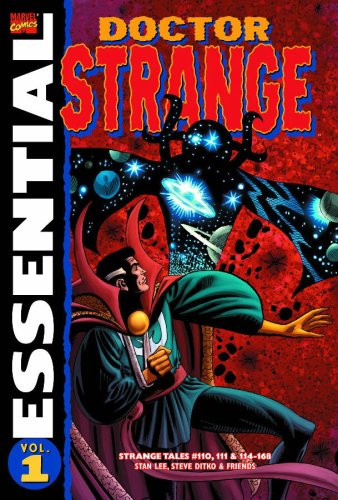
Essential Dr Strange Vol. 1
Stan Lee, Steve Ditko and friends
Reprints Strange Tales #110, #111, #114-168 (August 1963 — May 1968)
Get this for: the complete Ditko-Lee Dr Strange — Five stars

I bought my fiftieth Marvel Essential this week, most of which I’ve bought this year ever since a local remainder shop has been stocking them for less than half of their normal price. It’s been great to be able to buy these huge chunks of Marvel’s Silver Age and Bronze Age history for a price you couldn’t buy two modern comics for. To celebrate I thought I’d do some quick reviews of all of them: Fifty Essentials in Fifty Days. And I’ll start with Doctor Strange.

Essential Doctor Strange vol 1 has the complete run of Doctor Strange in the original Strange Tales, from #111 to #168, including the full run of Steve Ditko. Strange Tales was a split title, with The Human Torch and later Nick Fury, Agent of Shield in the front and Doctor Strange as the backup feature. He started out in a couple of five pages stories, then moved up to eight pagers and by the end of the volume has twelve pages to have his adventures in. A lot happens in these short stories, but there’s much less of the soap opera typical of other Silver Age Marvel titles. In fact, the early Doctor Strange doesn’t feel like a Marvel title at all.

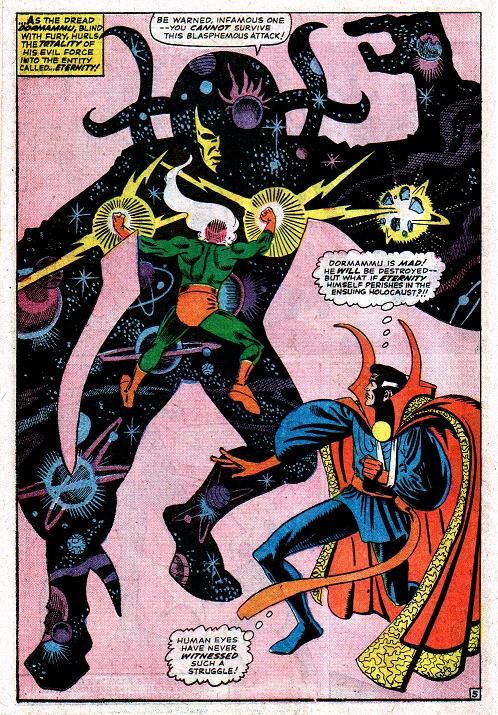
Dormammu takes on Eternity, courtesy of Steve Ditko

Take the first story. It starts with a man suffering from nightmares recalling hearing about how Doctor Strange could help with situations like this. He goes to visiti him, Strange infiltrates his dreams and it turns out Nightmare is behind the guy’s troubles, attempting to lure Strange. into his own realm. While Strange is held off by Nightmare, his pawn wakes up and realises why he was having terrible dreams: he’s been ripping people off in crooked business deals. He decides to kill Doctor Strange, but luckily the latter manages to use his magical amulet to stop him. It ends with Nightmare making threats to get Strange another time, while the good doctor convinces his patsy to turn himself in: “it will be the only way you can ever sleep again”.

Now this is the sort of strange mystery story you could also picture The Phantom Stranger starring in, somewhat of a throwback of what Marvel was doing just before they got into superheroes. It’s also clear that this is far from Doctor Strange’s first case: he’s well known enough that there are rumours about him and people know where to find him to get his help. No origin is given either, which makes him about the only classic Silver Age Marvel hero not to get their origin in their first story. It’s only in the fourth story that we do get the origin story, of how he once was a great surgeon until a car accident, drunk himself into vagrancy and went looking through the Far East to find a mystical solution for his problems but find himself training as a sorceror under the Ancient One instead… Again, not quite fitting in with the science orientated origins of most of Marvel’s other heroes.

What I liked about this volume was seeing Doc Strange being developed by Steve Ditko and Stan Lee, how seemingly throwaway references to e.g. Dormammu gets picked up later, culminating into the sixteen issue epic battle between Strange and Baron Mordo/Dormammu which ends Ditko’s run.

At this point we’re still only twothirds through the volume, with the last, Ditko free-third being much less interesting, much more pedestrian superheroics. If you read through this volume in one sit, it’s clear that whatever Lee’s contribution to things, it was Ditko who was the creative force behind Doc Strange. The art as well, though in the hands of capable artists like Bill Everett, Marie Severin and Dan Adkins is a huge letdown after Ditko.

What Ditko did with Doctor Strange was create the way in which every subsequent artist would depict magic, creating a whole visual language so to speak to depict other dimensions, magical spells, psychic duels and so on. And he does so while staying firmly within normal panel layouts, not resorting to trickery like breaking panel borders, or unusual layouts or even that many splash pages. It’s all there in the usual three-two-two or three-three-three layout. But when he does do a rare splash page, it’s a beauty, as you can see above…

In short: a great volume of which the last third is not very essential.

The High Crusade – Poul Anderson

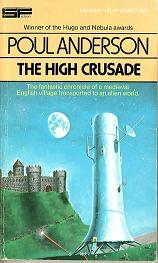
Cover of The High Crusade


The High Crusade
Poul Anderson
167 pages
published in 1960

Poul Anderson has a not undeserved reputation as a deeply pessimistic, even depressing writer, largely based on his later novels which all seemed to share the assumption that human nature is unchangable, that evil will always be amongst us, progress impossible and the future will always end badly. It must have been something to do with his gloomy Danish genes. The High Crusade shows it was not always this way. Once upon a time even Poul Anderson could write a lighthearted science fantasy romp without some great clonking moral to mess it up.

Great fun it is too. It’s the year 1345 and a small town in Lincolnshire is visited by a spaceship belonging to the Wersgorix Empire, while the local baron Sir Roger de Tourneville was busy gathering men to join king Edward III in France. Thinking the landing a French trick, he and his men storm the space ship and overwhelm and kill almost all of the aliens, who have long since grown unused to hand to hand combat. Ordering the remaining alien to take them to France, Sir Roger loads the entire town into the ship, but the alien tricks them and sets course back to the planet it came from. Lots of adventures and misunderstandings follow and it ends with Sir Roger conquering the entire Wersgorix Empire…

Read more and see also the celebrations over at Tor.

Farthing – Jo Walton

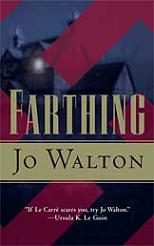
Cover of Farthing


Farthing
Jo Walton
319 pages
published in 2006

At first glance Farthing seems to be a classic English cozy country house mystery, if set in an alternate England. There’s the locked room murder taking place during a weekend party at the Farthing country estate. There are the clues pointing all too neatly at one of the guests. There’s the doughty detective refusing to believe them and there’s the slow deduction of the real killer’s identity and motivations. It all feels like something Agatha Christie or Josephine Tey could’ve written — the latter’s unconscious class snobbery being consciously used here — but in the end Farthing turns out to be something very different from the cozy mystery or even alternate history tale it masquerades as. This is in fact a horror story, with the horror provided not by the plot or the characters, but through the setting. As Ursula Le Guin puts it in her front cover blurb: “If Le Carré scares you, try Jo Walton”.

Farthing grabbed me by the throat from the first page and didn’t let go; one of the very few books to have ever done that. As with any other alternate WWII story, part of that is due to what you know is going on in the background that the characters themselves do not know yet or only suspect. Every such Hitler wins story depends on the tension between what the reader knows happened historically and what the characters in the story know or do not know: sometimes this is done explicit, as in Fatherland, where the whole point of the book is to get the protagonist up to speed on what we as readers already know. In Farthing‘s case though things are kept implicit. What Walton does is let the essential horror of the setting speak for itself, keeping the swastikas and Gestapo goons offstage. What she does in fact is showing that England did not need these props to become a fascist state.

read more