Books read August

Eight books read this month, which is a respectable score but not spectacular. Theme this month was war and science fiction, as you will see.

The battle of Kursk — David M. Glantz & Jonathan M. House
A recentish history of the famous tank battle, making full use of the opening of Soviet state archives since the end of the Cold War.

Omaha Beach: A Flawed Victory — Adrian R. Lewis
At first I thought the author had it in for the British — some American WWII historians do have a chip on their soldier about the way the UK treated the American contribution to the struggle in Europe after all — but in the end it turned out he had a much more valid case to make. What Lewis attempts to do here is to argue that the strategy and tactics developed for the Normandy landing were flawed both in conception and execution, with the methods developed in earlier landings in the Pacific and Italy ignored. I’m not sure how much I should believe him, but it’s a well made argument.

First Among Sequels — Jasper Fforde
Thursday Next is back in the first of a new series. If you like Fforde and Thursday Next, you’ll like this one as much as the earlier books in the series. Fun but slight.

Shades of Grey — Jasper Fforde
Much more ambitious is this book, in which Fforde takes his considerable inventioness and creates something more than just a cheap laugh. In a Britain of after the end everything revolves around colour, as in who can see red colours, or green colours, or yellow and how well you see a specific colour range determines your place in society. A classic sort of coming of age story in which the young hero discovers what his world is really like, it reminded me somewhat of John Christopher’s White Mountain series.

Hitler’s Empire — Mark Mazower
An indepth look at the economic realities of Nazi occupied Europe and how the nazi ideals were in conflict with the need to win the war. It’s a great book on a horrible but fascinating subject, looking at all aspects of the nazi economy, including the Holocaust.

The Dragon Never Sleeps — Glen Cook
Great space opera by an author best known for his dark fantasy, which does share some of the feeling of his fantasy works. I got this as a gift for my birthday, as well as the next book and it’s been great.

Passage at Arms — Glen Cook
Das Boot in space. ‘Nuff said. Very well done.

Spin — Robert Charles Wilson
Suddenly, without any fuzz, the stars went out, as something slid between them and the Earth. And then it turns out that while days go by down below, in the rest of the universe millions of years are passing… Apart from some slight niggles, an excellent grand scale science fiction novel.
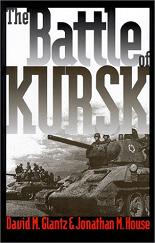
The Battle of Kursk – David M. Glantz & Jonathan M. House

The Battle of Kursk


The Battle of Kursk
David M. Glantz & Jonathan M. House
472 pages including index and notes
published in 1999

Kursk is a name most people probably only know from that Russian submarine that sank some years ago. Much fewer people know what that submarine was named after: one of the bloodiest and most important battles of World War II. The Battle of Kursk was fought in 1943, the largest tank battle of the war and was the last battle in which the Germans had the strategic initiative. After Kursk it was the Russians who held the upper hand and the Germans who had to defend. What’s more it was the first battle in which the Russian forces managed to stop the German blitzkrieg
It’s also a battle loved by war nerds, as it got the German panzer army at its peak taking on endless waves of Russian T-34s and Su-76s on the endless steppes and is so much more interesting than the infantry slog of Stalingrad…

However much of what we used to know about Kursk has come from German sources, as Soviet archives have only come available since the end of the USSR. So it has always been about the heroic deeds of the panzer commanders against the endless Slavic hordes so to speak. The emphasis has largely been on the Germans plans for the battle, on what went wrong for them and especially in the memoirs of those particpated, how it was not their fault that the battle was lost but Hitler’s. The Battle of Kursk is one of the first books on the battle to make full use of Soviet archives as well as German ones, giving a much more complete picture of the battle.

Read more

Books read July

July was somewhat better than June in terms of actually finishing books: eight instead of five, largely because I chose easier books to read, pure junkfood in some cases.

The Naming of the Dead — Ian Rankin
Rebus has to solve the murder of a rapist while the G8 is in town. Cameo appearance by one George Bush crashing his bike in a copper.

The Red Canary — Tim Birkhead
A pop science book about genetics, the quest to breed a true red canary from its normally green stock and why this was impossible without genetical enginering the colour in. Not a subject I’d normally be interested in, but quite readable.

Theater of War Lewis Lapham
I hadn’t heard of Lewis Lapham before, but he’s an American political commentator and this is a collection of his columns during the crucial period of 2000-2003, from the stolen election to the war on Iraq. Looking back at this period seven years later it’s unbelievable that we could’ve ever been bamboozled by the clowns Lapham skewers here. And by we I mean the media and politicians rather than anybody else…

Diamonds Are Forever — Ian Fleming
First time I’ve read a Bond book. They always said that the books were entirely different from the movies and they were right. The bad guys in the book just run a simple diamond smuggling operation instead of whatever convoluted shit the ones in the movie were about.

Moonraker — Ian Fleming
James Bond helps “M” to check out if famed industrialist Hugo Drax is actually cheating at bridge, then becomes the security chief of his Moonraker project vital to the national defence of Britain…

The Man With the Golden Gun — Ian Fleming
This is where that famous quote of Fleming’s of homosexuals not being able to whistle comes from. Just one example of the, shall we say, somewhat dated attitudes towards gender, sexuality and race in these books. Not often overtly malicious, but

Carve the Sky — Alexander Jablokov
Jablokov’s first novel and one of the few cyberpunk novels that seems to have been inspired by Bruce Sterling’s Schismatrix rather than Gibson’s Neuromancer.

The Hour of the Dragon — Robert E. Howard
Howard’s only Conan novel, sort of a greatest hits version of a Conan story, set late in his career. Not bad

Carnacki the Ghost-Finder — William Hope Hodgson
The ghost detective or paranormal investigator genre of fantasy was fairly popular in Edwardian England though almost extinct since. This collection is a good example of the genre, with Carnacki going at his business semi-scientifically, experimenting yet with his knowledge still based on ancient manuscripts as much as on scientific research. Sometimes the mystery investigated is a hoax and one story is just a straightup detective puzzle, but most do feature the supernatural in some way or another, in a very Lovecraftian way.

Why Buildings Fall Down – Matthys Levy and Mario Salvadori

Why Buildings Fall Down


Why Buildings Fall Down
Matthys Levy and Mario Salvadori
334 pages including index
published in 1992

It’s been a real pleasure to read this book. I read a lot of non-fiction, as you may have seen here over the years, but it’s rare that I come across a book that explains a difficult subject as lucidly and understandable as this one. Why Buildings Fall Down, as is obvious from the title, attempts to explain the science behind catastrophical structural collapses by examining various famous and not so famous disasters and tries to find common causes for them. The principle author, Mario Salvadori was a structural engineer with decades of experience in building things that don’t fall down and he and Matthys Levy are very good in translating this experience for the interested layperson like myself.

A great deal of the credit for the clarity of this book however lies also with the illustrator, Kevin Woest. Wherever the technical descriptions in the text get a bit too complicated for me, there was a drawing illustrating it perfectly. Such drawings have an advantage over using photographs, as with photos there’s always too much unimportant detail and often a muddiness in black and white. Woest’s drawings strip away everything that’s not necessary to illustrate a given concept, his art functioning as a plate of clear glass between the reader and the concept. It takes real skill to do this and do this properly.

Read more…

Books read June

Only five books this month — blame the football in the second half of the month, the hot weather and having to take care of my girlfriend coming back from hospital.

As Used on the Famous Nelson Mandela — Mark Thomas
Comedian Mark Thomas looks at the international arms trade.

The Origins of the British — Stephen Oppenheimer
An exhaustive look at the genetic evidence for where the British came from and when they arrived. Surprise, it’s not quite what’s being taught in school…

Fleshmarket Close — Ian Rankin
Sometimes you need a properly depressing police procedural to get you through the day. Rankin’s Rebus stories are always good for that.

Firewall — Henning Mankell
But for a real dose of existentialistic angst with your detective story, go to Henning Mankell.

The Reconstruction of Nations — Timothy Snyder
An interesting if difficult in places case study of the interaction between history, memory and the modern idea of the nation, looking at how Poland, Lithuania, Belarus and the Ukraine evolved from a early modern state based around elite consensus into four separate ethnically basded states build on support from the masses.