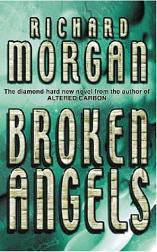
Broken Angels – Richard Morgan

Cover of Broken Angels


Broken Angels
Richard Morgan
490 pages
published in 2003

Richard Morgan is a British science fiction writer, who debuted in 2002 with Altered Carbon, to which Broken Angels is a sequel. It can however be easily read on its own, considering I just did that with no trouble at all. The only thing it has in common with the earlier novel is the protagonist, Takeshi Kovacs. I’d been aware of Morgan as a hot new writer, but hadn’t sampled him yet. Reviews of his work had been mixed and I hadn’t been interested enough to seek his books out. Which may have been a mistake, judging from Broken Angels.

From the reviews I’d read and the remarks made by friends who had read his novels I had gotten the impression that Morgan let his leftwing politics overwhelm his stories, while he was also accused of having a lot of unnecessary violence in his stories. I found neither of these allegations to be true in this case. There is a political undertone to Broken Angels, but certainly no dozen page rants; there’s violence, but it’s not at all reveled in the way John Barnes sometimes does. It reminded me in fact of Neal Asher, another author often accused of excessive use of violence, in that neither shy away from showing the consequences of violence, that being shot hurts and what it exactly does to a body. But where Asher’s descriptions are very organic, dripping with ichor and blood and bodily fluids, Morgan’s is very clean, sharp, bright and clinical but not at all detached. His characters feel their pain. And they get plenty of opportunities to feel this pain.
Books read February

Still not up to speed, due to external factors like work and S.’s stay in hospital. Lots of science fiction read this month.

Altered Carbon — Richard Morgan
Morgan’s first novel, a Chandleresque science fiction thriller.

Good Omens — Terry Pratchett & Neil Gaiman
The Apocalypse was never so funny. Reread for the umpteenth time and still funny.

Tiger Force — Michael Sallah & Mitch Weiss
Proof that US joualists could still do investigative reporting, this is the book version of a series of articles the authors had originally written for the Toledo Blade about the specialised recon unit Tiger Force went on a rampage through Vietnam.

The Quiet War — Paul J. McAuley
McAuley’s first proper science fiction novel in years, as good or better than any of his classic works.

Black Man — Richard Morgan
Another Morgan s.f. detective novel set in a future which though only written in 2006 already feels outdated.

The other Log of Phileas Fogg — Philip José Farmer
The real story behind Jule Verne’s Around the World in Eighty Days.

The Trojans and their Neighbours – Trevor Bryce

The Trojans and their Neighbours


The Trojans and their Neighbours
Trevor Bryce
225 pages including index
published in 2006

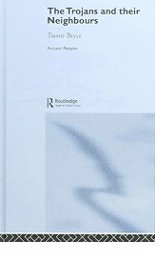
The cover looks like it should belong on the course book of a not particularly interesting IT certification course, but don’t let that fool you. Behind it hides one of the more engaging and interesting history books I’ve read in the past year or so. Which came as no surprise to me, as I had already read one of Trevor Bryce’s other history books, The Kingdom of the Hittites. The cover therefore couldn’t scare me off…

The subject itself helps as well of course. The story of Troy, the city at the heart of Homer’s Iliad, thought to be no more than a myth until Schliemann actually dug it up remains endlessly fascinating to anybody interested in ancient history. As Bryce mentions, even today the question of whether or not the Troy Schliemann dug up was the “real” Troy, Homer’s Troy is still hotly debated. But as Bryce argues, this is also the least interesting question you can ask about the actually existing Troy. Troy existed for several thousand years and was a flourishing community long before and after the Trojan War supposedly happened. With an emphasis on the Bronze Ages, The Trojans and their Neighbours attempts to put straight the real history and position of Troy — was it as important a city state as you would assume from Homer, or just another smallish Bronze Age settlement, and what were its relations with its neighbours?

Read more…

Books read January

My brain was still mostly mush for much of the month, due to the infection of my operation scar. I’d hoped for a nice recovery with lots of book reading, but even daytime television was a bit of a stretch… Few books read in other words, and even fewer was it not for rereading a slew of Pratchetts.

Jingo, The Fifth Elephant, Guards, Guards! and Men at Arms — Terry Pratchett.
I started rereading Jingo for its antiwar message, which at the time seemed over the top but which events have proved right, then wanted to read more of the City Guards subseries. A comfort read.

Mesopotamia: the Invention of the City — Gwendolyn Leick
A very interesting history of some of the oldest cities in the world, ten chapters depicting ten cities, in chronological order from Eridu to Babylon. The oldest were as far away in time from the Roman Empire at its height as it is from us.

The Trojans and their Neighbours — Trevor Bryce
A slim book looking like it should be used in some dull IT course, rather than as a history book. Never judge a book by its cover though, this is a great account of the ancient city we’ve named Troy, what we know of its true history, its association with Homer’s stories and the evidence for this link. It also examines the city’s history beyond the Trojan War.

Transition — Iain Banks
A proper science fiction novel under Bank’s lit-fic pseudonym.

History of the First World War — B. H. Liddel Hart
Originally written in 1929 and extended in 1934, this is the seventies reissue of this classic work of military history. Liddel Hart has his axes to grind and his history is written to showcase the lessons he wants the reader to learn from the war. Interesting but difficult to read and certainly not to be used as the history of WWI.

Books read December

I did not read much this month, being busy getting everything finished at work before going in for our operation, while afterwards I could barely read…

The End of the Bronze Age — Robert Drews
Excellent overview of the reasons why the great Bronze Age civilisations in the Middle East — Hittites, Egypt, Assyria and Mycean Greece — all collapsed or nearly collapsed at the same time.

Wintersmith — Terry Pratchett
The third in the Tiffany Aching series of young adult Discworld novels. The only real difference with normal Discworld novels is that the plot is less manic.

Off with His Head — Ngaio Marsh
An ancient English peasant fertility rite goes wrong as the climatic decapitation turns out to be real…

Enter a Murderer — Ngaio Marsh
Like most of the best of her mysteries, this one is set in the theatre. Ngaoi Marsh was heavily involved in the theatre all her live and her knowledge and love for it shines through.

Grave Mistake — Ngaio Marsh
A middleaged hypochondriac rich widow turns up dead in the rest home she regularly checks in to. Not a natural death of course. Nice and slight and good to read while waiting for things to happen. Reading several of these novels in quick succession does show how much Marsh recycled between novels, like the names of minor characters.