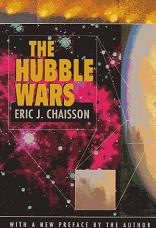
The Hubble Wars – Eric J. Chaisson

Cover of The Hubble Wars


The Hubble Wars
Eric J. Chaisson
386 pages including index
published in 1994/1998

Having worked on a somewhat troubled project for the past few years, it’s a great comfort to know that even big science projects like the Hubble Space Telescope can suffer from similar problems. In Hubble’s case, bad project management and quality control meant it was only discovered after the space telescope had been launched that its main mirror had a serious flaw in its grinding which meant that it couldn’t focus properly. But that was only the most *ahem* visible of the Hubble project’s problems, as Eric J. Chaisson explains. And he should know, as he was a senior staff scientist at the Space Telescope Science Institute when these problems occurred and hence had a first rank seat for them.

The Hubble Wars was originally published in 1994 and based on notes Chaisson made during Hubble’s commisioning period after launch, when the problems with the lens, as well as several others first cropped up. This then was largely written in the heat of the moment, without the benefit of hindsight, even if the edition I got out of the library was the updated 1998 one. This update was largely confined to a new foreword, an attempt to correct some of the misconceptions and hyberbole in the news coverage of Hubble discoveries. The rest of the book was largely left unchanged, though every now and then new developments are alluded to — and they’re not always well integrated. But that’s just a minor quibble. What remains is an important insight in how a big science project can go wrong, as it happened.
Read more.

Books read November

Work and other duties keep eating into my reading time, so once again a month with only a few books read. It didn’t help that one of them was a Steven Erikson 1,000+ pager fantasy brick.

The Bonehunters — Steven Erikson
The sixth installment in the Malazan series, this is Epic Fantasy for advanced students, hideously complicated. In lesser hands this would’ve been an awful mess, but Erikson manages to keep all the plotlines tidy.

Buy Jupiter — Isaac Asimov
One of the first ever science fiction books I’ve read. Still a great collection, especially with all the autobiographical notes Asimove put in between the stories.

Will Eisner: A Spirited Life — Bob Andelman
Authorised by Eisner and his estate, this is a reasonable overview of his life, but light on analysis. Andelman tends to skip ahead and back within chapters with little rhyme or reason and rarely delves deep below the surface of Eisner’s life. Useful as a first look at Eisner, but a much better biography still needs to be written. Had Eisner been a straight novelist of the same qualities and importance, half a dozen would’ve already been published.

Earth Is Room Enough — Isaac Asimov
Another Asimov collection, unfortunately without autobiographical notes. As the title indicates, all stories are set on Earth.

The Hubble Wars — Eric J. Chaisson
Soon after the Hubble Space Telescope was launched in orbit in 1990, after a seven year delay, it became clear that all was not well with it. This book is a firsthand account of what happened in the months and years, what went wrong and why, written by one of the people involved. Interesting if only for the insight it gives in how a great science project can come off the rails.

Grunts — Mary Gentle
“And pass me another elf, Sergeant. This one’s split.” A black humoured, dark fantasy in which orcs, those footsoldiers of Evil, take control of their own destiny to become marines…

Spy Story — Len Deighton
A proper Cold War thriller, in which the main character is as befuddled as the reader for most of the book as to what’s going on and what his role is.

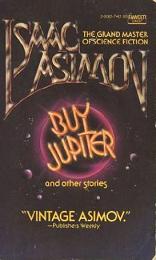
Buy Jupiter – Isaac Asimov

Cover of Buy Jupiter


Buy Jupiter
Isaac Asimov
238 pages
published in 1975

It’s hard to know for sure at this late date, but Buy Jupiter, together with I, Robot, was probably the first science fiction book I’ve ever read. one of the. I must have been seven or eight years old or so and this and the few other adult science fiction books the local library had in its childrens section instilled a lifelong love of the genre. It was therefore with some sense of nostalgia that I reread this book for the first time in years — these stories were like old friends to me. Nostalgia can be a dangerous guide of course, as so many books can turn out to have been visited by the suck fairy since you last time you’ve read them, not to mention the racism or sexism fairy. Luckily none of them have been busy on Buy Jupiter, the stories were just as good as I remembered.

This despite the fact that Buy Jupiter is a bit of a strange collection, filled with twentyfive years of leftover stories. There isn’t any classic in this, no one story you would put in a Best of Asimov collection but this might actually its strength. Because it’s a filler collection, because most of the stories are short or very short, you get a huge variation of stories and subjects, a smorgasbord of Asimov’s fiction. A good introduction to science fiction as well, though even at the time I first read those stories they were already dated — you don’t pick up on that as a child anyway.

Read more…

Books read October

Slightly up from September, but there’s no way I’ll equal last years record of 150 books read.

Northern Shores — Alan Palmer
An attempt to write a comprehensive history of the Baltic, from prehistory to contemporary times. It didn’t entirely succeed, as some parts of the book lose the focus on the Baltic as a whole, instead telling the histories of the countries surrounding it in turn, losing the commonality.

Industrial Evolution — Through the Eighties with Cabaret Voltaire — Mick Fish
Is it just me, or did most of the more interesting music scenes in the late seventies, early eighties in the UK were in dying industrial towns? Liverpool with the Teardrops and Echo and the Bunnymen and such, Manchester with the whole Factory scene and Sheffield, with Cabaret Voltaire and the Human League. Mick Fish was a drug addled, boozed up hanger-on there, having a job in a London council garbage dump, spending his weekends in Sheffield, but he doesn’t half write funny and entertainingly.

Buried Treasure — Victoria Finlay
An interesting idea, to look at nine different sorts of jewels, ranked according to the Mohs scale, but unfortunately it’s all a bit shallow, more about Finlay’s travels to far, exotic places in search of these gems, rather than about the gems themselves.

The Constants of Nature — John D. Barrow
One of the greatest problems is astrophysics is the existence of various physical constants, like the speed of light, the gravitational constant and the fine structure constant, whose values have all been observed but which cannot be predicted from theory. They might just random properties of the universe we live in, something with which physicists are never comfortable with, or they may be something more our current science cannot explain yet. This book tries to explain this problem to a lay audience and did it well, though it is math heavy and sometimes neglects to explain its maths.

The Stars my Destination — Alfred Bester
After a series of disappointing science fiction books, I wanted to read something good. This was just the ticket.

Globalhead — Bruce Sterling
A collection of short stories, most written while the eighties turned into the nineties, the Cold War ended and nobody knew what would happen afterwards yet.

The Extravagant Universe — Robert P. Kirshner
An excellent overview of recent developments (well, 2002) in cosmology, for once written by an astronomer rather than an astrophysicist. The emphasis is on how supernovea have been used to drive research into whether or not we are living in an ever expanding universe, one that is going to rebound eventually or one that’s right on the edge.

Unseem Academicals — Terry Pratchett
The latest Discworld novel, the first one to be dictated, rather than written, after Terry was diagnosed with Alzheimers. It’s good as any of them: this time it’s all about football.

The Instrumentality of Mankind — Cordwainer Smith
Back in the seventies Ballantine/Del Rey collected all of Cordwainer Smith’s fiction in four volumes. This is the last one, collecting all the odds and ends that didn’t fit elsewhere. Luckily, Smith’s odds and ends are better than many a writer’s best stories.

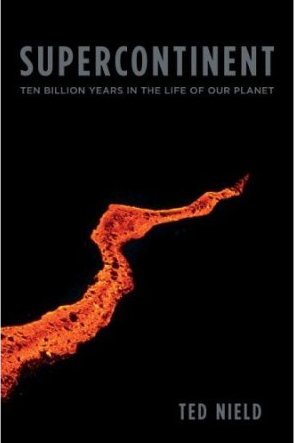
Supercontinent – Ted Nield

Cover of supercontinent


Supercontinent
Ted Nield
288 pages, including index
Published in 2007

I’ve read other good books on geology and the history of the Earth, notably Richard Fortey’s books, but this is the best one volume introduction to the idea of continental drift and the underlying dynamics driving it that I’ve seen. Nield is very good at explaining difficult concepts to a lay reader without simplifying them into incoherence. I took a gamble on Supercontinent when I saw it in the Amsterdam library just because Nield chose to introduce his subject with a short science fiction story about what would be left of us if aliens visited Earth 200 million years from now, when our current continents have all recombined again to form one Supercontinent. A catchy way to get my attention and fully justified by the rest of the book.

Supercontinent is both about the geological history of Earth as expressed through the ways continents have drifted apart, collided and fused together and broken up again and the history of the intellectual discovery of this history. As you might expect from the relative shortness of this book, barely 270 pages not counting index and notes, Nield provides only a broad overview, but he has an eye for the telling detail and manages to pack a lot of explanation into few words. For example, below is how he explains the recurring opening and closing of the “Atlantic Ocean” in the process called introversion and how this leaves parts of mountain chains on different sides of the ocean:

In other words, oceans can open and close, like a carpenter’s vice, more than once. Imagine that you open a vice, put the carpenter’s lunch (cold lasagne) into it and squeeze it tight. The lunch will ooze out and up, forming a mountain chain, which we shall call the Lasagnides. You then leave it until the lasagne has gone hard before opening the vice again. By now agents of erosion — mice — have scoured the once mighty Lasagnides back to bench level; but their roots, within the vice itself, remain. If you now reopen the vice to start the process again, some of hose olde Lasagnide remnants will stick to one jaw and some to the other/ but the vice reopens along the same basic line. That is how you get some parts of the same mountain chain in Europe and others in America.

Read more…