Books read September

Not a good month for reading. Work kept me busy and often too tired to read much.

The Shock Doctrine — Naomi Klein
An excellent overview of how neoliberal capitalism evolved itself over the past thirty years and how much it depended on brute repression to do so.

English History 1914-1945 — A. P. J. Taylor
A huge, traditional history of the UK from the start of the First World War to the end of the Second. Taylor’s emphasis is firmly on the political side of things, both domestic and foreign. This can be dull, but it’s clear to see why A. P. J. Taylor became such a popular historian, as he manages to keep things interesting at all times.

Complicity — Iain Banks
A reread of the first Iain Banks (as opposed to Iain M. Banks) book I ever read. This is a nicely paced thriller that’s now slightly dated.

Soul Music — Terry Pratchett
Another reread, of one of the slighter Discworld books. Fun as always.

An Ocean of Air — Gabrielle Walker
A somewhat disappointing look at our atmosphere, from an author who did far better in Snowball Earth.

The Real-Time World – Christopher Priest

Cover of Real-Time World


Real-Time World
Christopher Priest
158 pages
published in 1974

After finishing Camp Concentration I was in the mood for some New Wave science fiction and since I’d just bought this Christopher Priest collection of short stories this was as good a choice as any to read. Most of this I actually read while at the gym, on the treadmill — short stories being ideal, quickly enough read in a forty minute session and not requiring too much sustained concentration like a novel would. Some of the stories in Real-Time World I’d read before, in Dutch translation, some were new to me. All but one of the stories were published between 1970 and 1974, perhaps the height of the New Wave, and all are very much of their time. As a writer Christopher Priest has always seemed more comfortable to me at novel length than at shorter lengths, which is also notable here.

The reason why I wanted to read these stories was because I knew how seventies they were, but as often when confronted with the reality of what I was looking for, I was disappointed with it. None of the stories were entirely satisfactory and although each was competently written, they were written to formula. You could see they were written to achieve a specific effect and how Priest achieves that effect and as a result most of the effect is lost. The first story for example, “The Head and the Hand”, about automutilation as a form of performance art, with some graphic scenes including a final auto-guillotining which may have been shocking when first published, but certainly aren’t now and without this shock effect the story falls apart.

Read more…

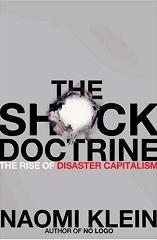
The Shock Doctrine – Naomi Klein

Cover of the Shock Doctrine


The Shock Doctrine
Naomi Klein
558 pages, including index
Published in 2007

Snow Crash was supposed to be a satire, but late in The Shock Doctrine Naomi Klein describes what’s going on in the United States right now that sounds quite a lot like the future Neal Stephenson portrayed in his novel. There’s a hollowed out federal government with all its core functions, especially warfare outsourced, while rich suburbs are seceding from their own cities to become commercialised, privatised towns with security by Blackwater mercenaries to leave the rest of America to rot away as surplus to requirements. The most shocking example that of New Orleans after Katrina, Disneyfied for the rich white tourists, its original, Black population dispersed all over the US, their neighbourhoods bulldozed to make way for more tourist attractions. All this, according to Klein, the logical end result of thirty years of disaster capitalism, pionered in the Latin American dictatorships of the seventies, matured in Eastern Europe in the late eighties/early nineties and reaching its zenith in Iraq in 2003 and New Orleans in 2005.

The Shock Doctrine is Naomi Klein’s second big book about capitalism and globalisation, after No Logo. Both are critical exposes, but The Shock Doctrine is much angrier than No Logo ever was, more brutal, more pessimistic as well. Gone is the fascination and excitement that globalisation still had in the earlier book, when like a lot of anti-globalisation activists Naomi Klein could still admire the energy of it, even if fully aware of the horrendous costs its transformation of the world brought with it. It was the same kind of horrified fascination Karl Marx and Friedrich Engels showed for an earlier phase of globalisation, in the Communist Manifesto. In The Shock Doctrine this fascination has disappeared, replaced by disillusionment and anger.

Read more…

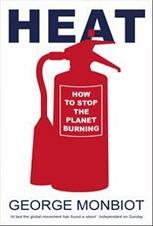
Heat – George Monbiot

Cover of Heat


Heat
George Monbiot
277 pages including index
published in 2006

Thanks to the climate change camp in London held this past week, global warming is back on the news agenda again. Despite the rear guard action fought by the Exxon-Mobile sponsored climate change denial groups, the media has sort of accepted the reality of it over the past two years, but as Alex Harrowell fulminates against, it’s largely treated as a consumerist, lifestyle issue:


As with most British media green pushes, there’s little sign of any interest in anything physical or lasting. Not an inch of rockwool. Everything is about changing your behaviour, and specifically micro-behaviour what you buy, or turning off lights, not how you work or where you live or how society works. Worse, it’s a demand for entirely free-floating behavioural change — nobody seems to be suggesting any way of monitoring or measuring the change, or any incentives. This isn’t going to work. And, again, it’s all consumer guff.

This is not something you can accuse George Monbiot of doing here. In Heat: How to Stop the Planet Burning he quickly dismisses consumer driven solutions like the 10:10 campaign in the introduction. The entire point of the book is that we cannot solve the problem of climate change with lifestyle choices, but only through solutions that apply to everybody, not everybody else, as he puts it. He starts with the assumption that the only way to migate the consequences of global warming, as we cannot prevent it anymore, is to keep runaway climate change from happening and that can only happen if we can keep global temperatures from rising more than 2 degrees celsius (above pre-industrial levels) in 2030. If not, major ecosystems begin collapsing as the ability to absorb excess carbon dioxide is exhausted. To keep this rise from happening we can’t just switch incandencent lightbulbs for LEDs, we need to cut 90 percent of our CO2 output. The challenge Monbiot sets himself in Heat is to show that we can do this without giving up our post-industrial lifestyles, by taking the United Kingdom as his test subject and looking at various aspepcts of our lives to see how CO2 output can be reduced in them. It is not a complete blueprint for change of course and you may not necessarily agree with all his solutions, but it is a genuine attempt at putting together a national plan of action that could be implemented relatively quickly and doesn’t require all of us to piss in hayboxes.

Read more…

Books read August

I read a lot of non-fiction this month, helped by a generous birthday gift from my sweetie. Bit of a mixed bag, quality wise, some disappointments, but also some of the best books I’ve read this year or longer.

The Grain Kings — Keith Roberts
A disappointing collection of short stories by a writer I thought was better than he actually might have been.

Bad Science — Ben Goldacre
An early birthday present. Ben Goldacre explains how all sorts of hustlers, quacks as well as respected mainstream companies are exploiting our ignorance of science and how the media collude in this. He manages to do this with a considerable sense of humour and some sense of perspective.

The Red Hourglass — Gordon Grice
A very entertaining look at some animal predators likely to induce phobias: black widows, rattlesnakes, tarantulas and pigs. Grice is an amateur biologist, a keen observer and an unsentimental describer of the killings he witnesses his animals do. Certain descriptions are gruesome, but not gratuitous.

Belching out the Devil — Mark Thomas
Bloody Mark Thomas forced me to stop drinking Coca Cola with this book. ‘Nuff said. But if you want to know more, it’s all about what lies behind the family friendly image of the Coca Cola company: the murder of trade unionists in Columbia, abuse the drinkwater of waterpoor Indian states, water pollution in Mexico, poor labour relations everywhere.

What’s Going On? — Mark Steel
Steel’s previous autobiography helped convince me to become a socialist; in this one he explains how he went through a midlife crisis as he hit forty while both his marriage and his almost lifelong commitment to the Socialist Workers Party both collapsed. He does that in the context of Blairism, the runup to the War on Iraq and the developments since. Somewhat depressing as what could’ve the most positive development on the left in a generation is squandered, but fortunately Steel’s innate humour comes through.

Vive La Revolution — Mark Steel
Another Mark Steel book, this one about the French revolution, based on the series of comedic radio lectures he did about it. A nice, readable introduction that skewers a lot of the preconceptions about it that are particularly current in the UK. If you ever heard him do one of his standup routines or comedy panel show appearances, you’ll recognise his mannerisms in print as well.

The General Strike — Margaret Morris
An excellent historical overview of the failed general strike of 1926 in Britain, which holds some key lessons for socialists and trade unionists. Morris showed the union leadership was far from radical, unprepared, unwilling to take the measures needed to win the strike, did not realise that they were fighting both the government and business until it was too late and had more invested in safeguarding the system they were part of than actually winning and facing the consequences of their victory.

The Course of the Heart — M. John Harrison
I knew Harrison had a reputation as an excellent but difficult to get into writer but so far the two novels of his (The Centauri Device and The Pastel City) I had read had only been good. This novel however completely blew my expectations. It’s an woefully inadequate description but the best I can do is call this a magic realist love story, in which the protagonist is more of a spectator than a participant in the events he describes .

Signs of Life — M. John Harrison
A much more hard edged novel than the previous one, but the narrator is equally as much a spectator and this is as much a love story.

Supercontinent — Ted Nield
I’ve read other good books on geology and the history of the Earth, notably Richard Fortey’s books, but this is the best one volume introduction to the idea of continental drift and the underlying dynamics driving it that I’ve seen. Nield is very good at explaining difficult concepts to a lay reader without simplifying them into incoherence.

Heat — George Monbiot
Global warming is real, we need to cut ninety percent of our CO2 output by 2030 to make sure we have some chance to safe some of our environment as well as ourselves, how do we do that and not have to become a third world country? That’s the challenge Monbiot sets himself, looking at various parts of our daily lives to see what can be done.

Agent of the Terran Empire — Poul Anderson
Another collection of Dominic Flandry stories. These started as light space opera, but the underlying politics and gloomy worldview Anderson soaks them in takes away a lot of the
pleasure. Pessimistic about the ability of humanity to establish anything better than an empire and even more pessimistic about its ability to keep the empire strong, Anderson bought into a lot of the myths the neocons believe as well.

Old Twentieth — Joe Haldeman
A 2005 novel proving once again that Haldeman probably is the quintessential baby boomer science fiction writer, written as it is around the boomers’ stereotypical twin obsessions of their encrouching morality and the sixties. Not a good novel, but interesting to take apart, so to speak.