The Grain Kings – Keith Roberts

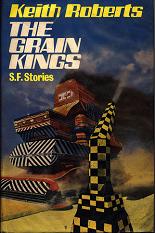
Cover of The Grain Kings


The Grain Kings
Keith Roberts
208 pages
published in 1976

Nothing says seventies science fiction as much as a Fossian cover like this, slapped by Panther and Pan on every book they published regardless of contents. Big, blocky machinery, preferably some sort of spaceship, with brigh colours and no human figures: that’s science fiction and you don’t need anything more. For once, the cover is even justified, showing one of the huge grain combine harvesters from the title story of this collection. Course, you’ll still be disappointed if you get this expecting the sort of cool, clinical, techno-driven stories the cover suggests; Keith Roberts isn’t that kind of writer.

Keith Roberts debuted as a writer in 1964 in New Worlds, involved with, but not a part of, the New Wave. Partially this was due to his personality as he allegedly was quite a difficult character to work with, getting into fights with his editors and publishers. But it was also because he was less interested in the two main obsessions of the New Wave, death & entropy and sex & taboos. Nevertheless if you like Brian Aldiss or Christoper Priest changes are you’ll like Roberts as well. Roberts was more than just a writer; during the sixties he worked both as an editor for the British magazine Science Fantasy/SF Impulse, as well as its artistic director, designing most of the covers for it, as well as for several issues of New Worlds. A shame he didn’t get the chance to design the cover of this book, as the impressionist look he used in his own designs would’ve been much more suited for it. Keith Roberts has always been somewhat of a cult author, best known for his second novel Pavane, a classic alternative history story and one out of two of his books still in print today (the other one is The Furies).

Read more…

Books read in July

Another month, another list of books read. My reading pace has slacked off a bit in the last couple of months, due to all sorts of reasons. Only eleven this month, slipping behind in my goal to read 150 this year. Oh well.

Zootsuit Black — Jon George
I wasn’t sure how to take this novel, until I interpretated it as a credible attempt to create a modern psionics novel. Irritating and engrossing in equal measures, I’m not sure this was a good novel, but it was interesting.

Cold War in a Country Garden — Lindsay Gutteridge
First in a trilogy of novels, of which I bought the third ages ago in a library sale, but which is still somewhere in my parents’ attic. Matthew Dilke has been reduced from six foot to six millimeters in height and now has to survive his own garden, to prove that human beings can survive the microworld insects have ruled so long. Absurd premise, but worked out well and Gutteridge is very good at showing the scale at which Dilke now has to live.

Iron Curtain — From Stage to Cold War — Patrick Wright
Before Churcill popularised the phrase in his famous speech in Fulton in 1946, the “Iron Curtain” as a concept had had a long prehistory already, had been used as a metaphor to describe relationships between Soviet Russia and the west in roughly the same way as Churchill used it. Wright shows how this metaphor may have had its origin in the pacifist movement around the First World War, when it was used to describe what happened when Germany and England went to war.

The Stone that Never Came Down – John Brunner
So far I really had only read Brunner’s “big” novels: Stand on Zanzibar, The Sheep Look Up and so on. Which is why I tried this when I saw it for 2 euros in the secondhand bookshop. It was interesting, a very 1970ties sort of English science fiction novel: economic depression, religious intolerance and moral crusades, racial tension, unconvincing slang.

Dying Planet — Robert Markley
An excellent study of the history of Mars in science and science fiction since the late nineteenth century, how our image of the planet slowly changed, not so much by new revelations as how those revelations were interpreted. A book I needed to read with my full attention to get everything Robert Markley packed into it.

McMafia — Misha Glenny
How the collapse of the Iron Curtain and the liberalisation of trade in the late eighties and nineties meant a triumph not just for capitalism, but for globalised crime. Glenny shows how traditional, controlable crime structures collapsed with the influx of new, globalised gangsters from Eastern Europe, while the shadow economy has become more and more important to the workings of capitalism itself.

The Long Run — Daniel Keys Moran
A novel the old rec.arts.sf.written crowd was always pushing. Best described as a young adult, coming of age cyberpunk adventure, a Slan for the eighties. Dated, but if you can set yourself over the “eighty megabytes of hot RAM” and other horribly wrong computer references, quite fun if not very good.

Killer Pine — Lindsay Gutteridge
The second book in the micromen trilogy, less interesting as the first, as exploring the novelty of the situation is explored less in favour of a fairly dull sabotage plot.

Renaissance Europe 1480-1520 — J. R. Hale
Another entry in the Fontana History of Europe. Written in 1971 this no doubt somewhat outdated, but it was still a fascinating look at an era I know too little about. Hale makes clear how Medieval, how different this era still was from our own, how inward looking despite the huge revolutions in exploration and science made during it.

Camp Concentration — Thomas M. Disch
A cult classic dystopian science fiction novel, which reminded me of nothing so much as of Vonnegut’s Slaughterhouse-Five. They share a sense of disillusionment, the same sort of dissatisfaction with American life of the fifties and sixties but being slightly too old to be truly a part of the generation that would rebel against it, too worldweary to be part of their solutions.

Real-Time World — Christopher Priest
After the Disch, I felt the need for more New Wave science fiction and this collection of early Christopher Priest stories fitted the bill perfectly. No real classics here, Priest has always been a better novelist than a short story writer, but it sustained the low-lkey, emotionally drained mood I was looking for.
In Search of Planet Vulcan – Richard Baum and William Sheehan

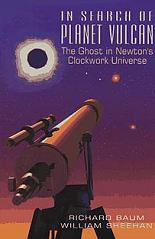
Cover of In Search of Planet Vulcan


In Search of Planet Vulcan
Richard Baum & William Sheehan
310 pages including index
published in 1997

The classic idea of the universe was that it was geocentric: the Earth in the centre, with the planets, moon and the sun circling around it and the fixed stars as background. Over the centuries that central idea had to be modified with increasingly complex epicycles as the theory had to be adjusted to observational evidence. It was only in the sixteenth century that Copernicus, Kepler and Bruno challenged this Ptolemaic model and replaced it with the truth: that all the planets, including Earth revolved around the Sun. Copernicus was the first to propose this, Bruno would die at the stake for his advocacy but it was Kepler who figured out how the planets revolved and what governed their orbits. more than half a century later Isaac Newton formulated his laws of gravity, joining Kepler’s laws with more mundane events on Earth, finally providing a complete model of the workings of the Solar System. From then on, any planetary orbit could be calculated with the right observations and the use of Kepler’s and Newton’s laws.

except for one. The orbit of Mercury remained, as the subtitle of Baum and Sheehan’s book has it, “the ghost in Newton’s clockwork universe”. Time and again, no matter how carefully the observations were made and how intricate the calculations were, the two just would not line up. Even the best astronomers in the world, with the best observations could not make Mercury’s orbit confirm to what it should be according to Newtonian physics. It wasn’t until Einstein reformulated the laws of gravity that the reason why became clear. Newton’s laws break down near massive objects like the Sun and although “good enough” for most situations, Mercury’s orbit was just too close to the Sun and Newtonian physics just wasn’t accurate enough. Of course, until Einstein found the real answer, astronomers sought for other explenations for Mercury’s wrong orbit — and the most likely candidate was an undiscovered planet even closer to the Sun: Vulcan.

Read more…

Pompeii – The Life of a Roman Town – Mary Beard

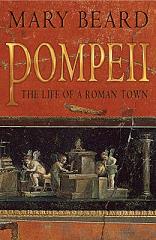
Cover of Pompeii - The Life of a Roman Town


Pompeii – The Life of a Roman Town
Mary Beard
360 pages including index
published in 2008

We think we know Pompeii. An ordinary Roman town like so many others in 79 CE, made extraordinary because it was overwhelmed without warning by the eruption of the Vesuvius, through its death granting us a rare glimpse of what daily life in the Roman Empire really was like. Under a metres thick layer of volcanic ashes Pompeii laid hidden for centuries, only discovered in the eighteenth century, its secrets kept intact, preserved by the very disaster that caused the death of the city. With the slow and careful excavation of the city those secrets are unlocked, giving up definitive answers to all kind of questions about how the Romans lived. This is the view of Pompeii that countless books, magazine articles and television specials have given us. Unfortunately, as Mary Beard explains in Pompeii – The Life of a Roman Town, it’s wrong.

Or at least, not entirely accurate. As she explains, Pompeii wasn’t overwhelmed by an unforeseen catastrophe, as most likely its inhabitants had had at least several days warning before the actual eruption. Quite a few of them therefore had already left the town when it got buried, while many of the dead found under the lava had been overtaken in their flight, or while having sought shelter nearby or within the city itself. What’s more, the city wasn’t immediately abandonded after the disaster either, as all through the city evidence has been found of people coming back to their houses or businesses to rescue possessions – as well as of plunderers looking for easy riches. What’s more, once Pompeii was rediscovered, obviously things gut dug up, damaged, disappeared or just altered through being exposed to the elements again. All of which means that what we can see in Pompeii now is not entirely the city that the inhabitants would’ve known in 79 CE, that if we dig up a largely empty villa it doesn’t necessarily mean the Romans were great minimalists…

Read more…

Books read in June

Another month, another list of books read. Let me know what you read this month?

Polity Agent — Neal Asher
Another fast paced Space Opera from Asher, entertaining if not that memorable.

The Weird Stone of Brisigamen — Alan Garner
A classic children’s fantasy that I’m way too old and well read in fantasy to enjoy fully the way it should. Colin and Susan are sent to their mother’s old nurse living near Alderley Edge in Cheshire when their parents have to be abroad for six months. There they get embroiled in an old legend. Comforting but it has moments with a real edge to them, best read between ages eight and twelve.

Galactic North — Alastair Reynolds
A collection of short stories set in the same universe as Revelation Space and its sequels. This could be thought at as the secret history of the Demarchist/Conjoiner universe. They do not always fit in well with the novels, as Reynolds acknowledges in his afterword.

James Tiptree, Jr: The Double Life of Alice B. Sheldon — Julie Phillips
An excellent biography of an important science fiction author, showcasing the importance of Sheldon/Tiptree beyond the boundaries of the genre.

The City & the City — China Miéville
Restraining his usual tendencies towards the baroque and fantastic, Miéville here has written a proper police procedural in the vein of an Ian Rankin. The story starts with a routine murder in a city on the edge of Europe, which quickly turns more complicated and ultimately involves the city’s much richer neighbour. The two cities exist in an uneasy and wholly unique relationship with each other and it’s this relationship that is at the heart of the book, transforming the mundane, realist experience of the police procedural into something more.

Pompeii – The Life of a Roman Town — Mary Beard
The cliche of Pompeii is that of a town where time stood still, it’s daily routine dramatically disrupted by the eruption of Vesuvius in 79 CE and so ironically preserved for our edification. Mary Beard here shows how little this view has to do with the reality of Pompeii as excavated, how much data we have managed to extract from these excavations but how little we still know about daily life in Pompeii. At the same time it’s an excellent overview of what we do know and since it was only published last year, about as up to date as you can get.

The Kingdom of the Hittites — Trevor Bryce
Excellent and up to date overview of the history of the Hittites, a people we knew nothing about until about a hundred years ago but which for some fivehundred years were one of the Near Eastern superpowers during the Late Bronze Age.

In Search of Planet Vulcan — Richard Baum & William Sheehan
Vulcan was the hypothetical planet proposed to be the cause of why the observations of Mercury’s orbit around the Sun continued to be different from what it was calculated to be based on Newton’s laws of gravity. We know now that these laws were not the entire truth, as Einstein showed; while good enough for daily use, they break down in the presence of a massive object like the Sun. As this had not yet been realised, astronomers proposed there was something else out there influencing Mercury, just as Neptune and Uranus had been discovered because of their influence on other planets…

Armed Struggle – The History of the IRA — Richard English
A recent history of the provisional IRA examing both its active history and the way its politics and ideology evolved over the years since its founding in 1969 up to the Good Friday peace agreements and beyond. Some context is of course provided, but this is not a history of Ireland, the Irish struggle for independence or even the Troubles, just of the pIRA. I found it enlightening.

The Gone-Away World — Nick Harkaway
Wow. I understand now why this was so much talked about last year. One of the best debut novels I’ve ever read; finished it in one go.

Charge! Hurrah! Hurrah! — Donald Thomas
An entertaining biography of Lord Cardigan, (in)famous for having led the charge of the Light Brigade during the Crimean War, which makes clear he was interesting for than that.

The Best of Murray Leinster — Murray Leinster
Read last weekend in honour of Murray Leinster Day in Virginia. Leinster was a pionering sf author, who started writing before the genre had even been established and managed to continue to do so during the Gernsback and Campbellian revolutions.

Dark Star — Alan Furst
An excellent thriller set in the years just before World War II, truly capturing the claustrophobic, threatening atmosphere of the times.

Operation Chaos — Poul Anderson
A fixup novel of three novellas, set in a world in which witchcraft and magic have taken the place of science and in which personal broomsticks are as commonplace as cars here. The first two parts are enjoyable if old fashioned adventure stories, the third is marred by Anderson’s later pessimism and hippie baiting.