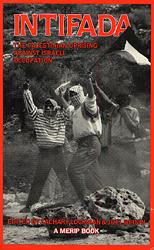
Intifada – Zachary Lockman & Joel Benin

Cover of Intifada


Intifada
Zachary Lockman & Joel Benin
423 pages including index
published in 1989

During Israel’s invasion of Gaza this January there was one of those stupid drummed up controversies that always happen whenever Israel’s engaging in warcrimes again and hence coming under foreign pressure. In this case it was Dutch Socialist Party member of parliament Harry van Bommel who got into trouble after his call for Intifada was twisted from being a call to resistance into not just a call for armed resistance but fullblown terrorism. Various zionist pressure groups were keen to pretend that intifada invariably meant terrorist attacks, including suicide bombings while ignoring that the first Intifada had been characterised by non-violent protests and most socalled Palestinian violence only happened in self defence against IDF aggression. Nobody honest can call boys throwing stones at tanks terrorists, but that didn’t stop our local zionists from pretending it was, helped by conflating the much more violent Second Intifada with the first.

Now I grew up in the eighties and I remember the first Intifada. I was barely in highschool when it started in 1987 and not very politically aware, but I did notice that by late 1988, early 1989 there were quite a lot older students wearing keffiyehs, usually as shawls, as a symbol of their support for the Palestinians; this at a not too leftwing Christian school. The Intifada had the same sort of stature as the ANC’s struggle to end Apartheid had because everybody could see how the Palestinians were being oppressed and how justified they were in their (largely non-violent) resistance despite IDF agression. It was therefore a blatant rewriting of history to equate Intifada with terrorism and to confirm this, I read this collection of essays on the Intifada.

Read more…

Books read March

Lots of science fiction this month, because I bought a lot of it this month.

The Hacker Crackdown — Bruce Sterling
Nostalgia. During the eighties the personal computer, followed slightly later by the first computer networks came of age and with it came the hackers and crackers. Then came Operation Sundevil, the first big nationwide hacker crackdown in the States, which inspired Sterling to write about how this came about, who the players were and what was happening. Cyberpunk had become reality.

To Your Scattered Bodies Go — Philip José Farmer
Read this to honour Farmer’s death. I’ve attempted to read this before but never finished it, but this time tore through it.

AK-47 — Larry Kahaner
A slight and flawed cultural history of the Kalashnikov; parts of it were excellent.

Inventing Ruritania — Vesna Goldsworthy
A study which examines the influence popular fiction and its stereotypical images of the Balkans over the centuries have influenced our views of the region and not just our views, but our politics.

Fugue for a Darkening Island — Christopher Priest
One of Priest’s first novels. Published in 1972, it’s a very uncomfortable echo of the racial fears of white Britain of the early seventies. After a localised nuclear war that devestated most of Africa, refugee laden ships land in Britain. What follows is civil war. Well written and disturbing.

Sweet Silver Blues — Glen Cook
The first Garret P.I. novel. Garret’s a private dick in fantasyland but despite the elves his adventures are just as hardboiled of that of any thirties detective. Great stuff.

The Man Who Japed — Philip K. Dick
Typical early Dick, fun, not too outrageous and slight.

Or All the Seas with Oysters — Avram Davidson
A brilliant short storyteller who deserves a larger audience, Avram Davidson is at his best in this collection. Classic American fantasy, which takes the familiar elements and fairytales from Europe but just can’t take them too seriously anymore. The title story is the origin for that old gag of where all your paperclips disappear to.

Flandry of Terra — Poul Anderson
Three stories starring Dominic Flandry, secret agent of the Terran Empire trying to hold back the long night when inevitably the empire collapses. Despite the gloomy background these are still fun adventure stories, much better than they have to be.

The Universe Against Her — James H. Schmitz
A fixup novel introducing Telzey Amberdon, a fifteen-year-old genius and first-year law student whose psychic powers are triggered during an encounter with big cat-like telepathic aliens; now I know where David Weber got the idea for treecats from… Good fun, like Anderson Schmitz’s stories are much better than they’d need to be.

Time for the Stars — Robert A. Heinlein
Another Heinlein juvenile, about a twin, one of whom went to the stars while the others stayed home. Yes, it’s the classic time dilation thought experiment made into a story, though I still don’t think Heinlein ever really understood relativity…

The Falling Torch — Algis Budrys
Twenty years after Earth was conquered by the Invaders, the son of the president in exile returns from Centaurus to help mount the resistance. As seems to be typical of Budrys, the emphasis lies firmly with the psychological development of the protagonist rather than on the action.

Millennium — John Varley
Once upon a time Varley wrote a great short story, “Air Raid” that was turned into a mediocre movie and a much better novel. This is this novel. Far future humans are traveling back in time to snatch people doomed to die in aircrashes with no survivors. Then something goes wrong and an air crash investigator slowly learns the truth. A very seventies sort of story, even if it was written in 1983.
AK-47 – Larry Kahaner

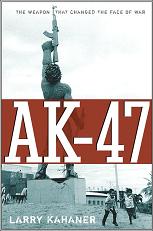
Cover of AK-47


AK-47
Larry Kahaner
258 pages including index
published in 2007

The AK-47 is such an iconic weapon that it’s even present on the flag of Mozambique. As a brand, ít’s as global as Coca Cola, as omnipresent as McDonalds. It’s the prefered weapon of every guerilla or freedom fighter everywhere and is therefore almost always used as the weapon of choice for Hollywood bad guys, just like its heroes used the true blue American M-16. More seriously, the AK-47, because it’s so widespread and cheap has influenced the outcome of more wars in the past sixty years than perhaps any other weapon. In America meanwhile it not only became the symbol of the third world terorist, but also the face of domestic crime, as “the gnagbanger with an AK-47” became the symbol of the evil the gun control lobby was fighting against with the assault rifle ban.

Such an iconic weapon deserves a history that does justice to it, something that goes beyond the usual war nerd recitation of design history and battle use, but which also looks at the cultural and political impact of the AK 47. Larry Kahaner has tried to write such a book with AK-47: The Weapon that Changed the Face of War, but isn’t quite up to the task. Judging from the list of titles mentioned on the inside front cover, his true calling lies more in business management books. AK-47 is too slight and too shallow to do justice to this weapon.

Read more…

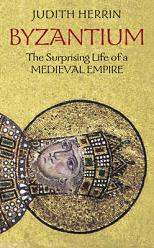
Byzantium — Judith Herrin

Cover of Byzantium


Byzantium
Judith Herrin
392 pages including index
published in 2008

In her introduction Judith Herrin explains she was inspired to write this book by a conversation she had with two workmen knocking on her office door. They had been doing repairs on the building in King’s College where she worked and noticed the sign on her office: “Professor of Byzantine History” and were interested enough to ask what this meant. As she puts it, she found herself “trying to explain briefly what Byzantine history is to two serious builders in hard hats and heavy boots”. From their suggestion that she should write a book explaining Byzantium to people like (or me, for that matter) who knew little if anything about the subject, this book arose. Byzantium — The Surprising Life of a Medieval Empire is an attempt to explain more than a thousand years of Byzantine history, as well as the many facets of this history.

It sounded like the perfect book to read, now that I had temporarily exhausted my library’s stock of interesting looking books on Roman history. Byzantium was after all a clear succesor to Rome, I knew little about it and Herrin’s book easily passed the page 37 test. She isn’t a historian I was aware of before, but with Byzantium she’s become one of the names I’ll pay attention to when looking for new books, no matter the subject. She manages to write a good introduction to a complex subject without talking down to the reader.

Read more…

Books read February

Saturday — Ian McEwan
Sometimes you need to read a book knowing you’ll hate it, just to be able to be more informed in your hatred. Saturday is McEwan’s tedious emulation of James Joyce’s Ulysses taking place on 15th February 2003, the day of the worldwide anti-Iraq war demos, in which he shows how much richer the inner life of his middle class protagonist si than that of the confused muddle going on the London demo…

The Iron Wall — Avi Shlaim
Avi shlaim is one of that generation of revisionist Israeli historians who looked behind their country’s founding myths to record the truth. The Iron Wall examines the development of Israeli policy towards its Arab neighbours and the Palestinians, showing both the differences and the continuity in it.

Intifada — Zachary Lockman & Joel Beinin (editors)
A compilation of essays examing the first Intifada, published in 1989. During Israel’s War on Gaza an astoningly stupid controversy erupted here in Holland when one Dutch Socialist Party MP called for Intifada and this was equated with support for terrorist attacks by local Zionist propagandists. This anthology shows the reality.

The Great War for Civilisation — Robert Fisk
Robert Fisk is one of the best, if not the best journalist reporting on the Middle East. This is his magnus opus, part history, part autobiography, part journalism. Fisk is an engaging writer, but the history of the region does not make for nice reading: betrayal after betrayal, ethnic cleansing following genocide, one futile war after another.

Byzantium — Judith Herrin
On a much lighter note, Judith Herrin’s Byzantium is a sort of sampler course in Byzantine history, an attempt to explain to the curious why Byzantium is worth studying. I’ll certainly read more of her books.

Only Forward — Michael Marshall Smith
My girlfriend has been reading Michael Marshall’s thrillers, so when I saw this, his first science fiction in a secondhand bookshop I took a chance. It reminded me somewhat of Jonathan Lethem’s first novel, which had a similar if more pronounced absurdist feel to it.

The Deep Blue Good-by — John D. MacDonald
Another Travis McGee novel; the first in fact. Interesting to see the formula firmly established already this early.

Creatures of Light and Darkness — Roger Zelazny
My new Zelazny book for the year. He’s a writer I want to read sparingly, because you can only read a new Zelazny for the first time once and he’s obviously not producing anything new anymore…

Gather, Darkness! — Fritz Leiber
A reread of a novel I first read ages ago. In a future oppressed by a technocracy masquerading as a warped Christianity, the only hope for freedom lies with a rebellion based on witchraft…