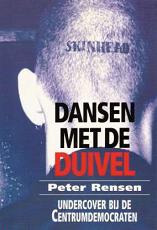
Dansen met de Duivel — Peter Rensen

Cover of Dansen met de Duivel


Dansen met de Duivel
Peter Rensen
167 pages
published in 1994

Geert Wilders is far from the first racial demagogue to appear in Dutch politics; he’s just more succesful than most. His most recent predecessor was Hans Janmaat, who at his best only managed to get three seats in parliament with his party, the socalled Centrumdemocraten. In constrast, Wilders managed to get nine seats in his first election and is currently polling anywhere from fifteen to twenty seats. Of course, Wilders is operating at a time when rightwing radicalism and Islamophobia have almost become respectable and opinions that would’ve gotten him ostracised twenty years ago are now applauded. But, as Dansen met de Duivel (“Dancing with the Devil”) shows, there are other reasons why the Centrumdemocraten never grew very far beyond the real hardcore racist vote of about two percent or so.

Dansen met de Duivel is the story of how its author, Peter Rensen, infiltrated the party and his experiences working for them. Inbetween his personal experiences he also sketches a quick history of Janmaat and his party. What comes across is a party that’s content to stay relatively small, doesn’t really want to move beyond the comfortable limits of the protest pary, as that might entail losing control. Janmaat himself was kicked out of the first racist group he was involved with and got elected for, the Centrumpartij, who remained first competitors and were more openly racists than Janmaat’s party. He wasn’t about to let that happen again.

Read more…

Quoted without comment

How Ian McEwan validates his novels before publication:

Fans of McEwan’s novels will be interested to learn that before he finishes any book he has it read by three friends – Amis firmly not being one of them. “I don’t want a novelist reading my work, thank you very much!” McEwan says.

The three are the Oxford historian and Guardian columnist Timothy Garton Ash, the poet Craig Raine, and the philosopher Galen Strawson. Garton Ash persuaded him to drop the “An” from the title of his novel An Atonement. Raine berates him whenever he slips into cliche, as he once did with the phrase “flickering log fire” – they now have a running joke of marking f.l.f. in the margins of each other’s work.

The spirit of constructive criticism is not always happy. When they met to discuss The Comfort of Strangers, Raine told McEwan: “Listen, love. It’s complete crap, and you should put it in a drawer and forget it.” McEwan refused to speak to him for almost two years.

McEwan is of course the author of Saturday, recently reviewed here.

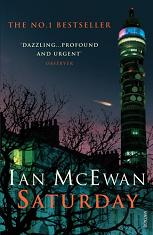
Saturday — Ian McEwan

Cover of Saturday


Saturday
Ian McEwan
278 pages
published in 2005

I’ve been suspicious of Ian McEwan ever since I read his Book prize winning novel Amsterdam and almost threw the book against the wall at the denouncement where McEwan descended into stupid cliches about the Netherlands’ attitude towards euthenasia. That suspicion deepened when it turned out McEwan, like Martin Amis had turned into a permanent bedwetter after the September 11 attacks. He’s been less outspoken than Amis, but he has said enough for me to know I dislike his politics, which seems to be of the Decent Leftist persuasion, being obsessed with the struggle against “Islamism”, the threat of terror attacks and the vulnerability of the western democracies. As with Amis, “9/11” seems to have functioned as McEwan’s midlife crisis, his fear and doubts about his own encrouching mortality being confused for insight into the general condition of the world. It’s this mixture of Decent politics and midlife crisis that’s been poured out into Saturday. I didn’t want to read it at the time when it first came out, being warned off it by various reviews, but four years on I thought it would be interesting to see if it really was as dire as it was made out to be.

It is.

Had I read this in 2005 it would’ve been thrown against the wall, library book or not. Set on the day of the worldwide anti-war protests on 15 February 2003 a month before the invasion of Iraq, with the London march making regular appearances througout the novel. Not that any of the characters in the book actually go on the march, they all have something better to do. Even the protagonist’s son, described as anti-war doesn’t, as “he doesn’t feel much need to go tramping through the streets to make his point”, confusing making a political statement with narcissism. It’s typical for the entire novel, which hammers this point home again and again from the first encounter with the march, with a street cleaner sweeping up garbage left behind by people going to the march to the last, with the same street cleaner still busy cleaning up behind the march. This way the anti-war protest is reduced to something hypocritical, narcisstic and even frivolous. Saturday only pays lip service to the arguments of the antiwar movement, spelled out explicitely just once, in a row between the protagonist and his daughter, who gets to represent the antiwar side. She gets emotional and slightly hysterical while her father gets to stay calm and collected; later it’s revealed she’s pregnant. In such a way the antiwar movement is constantly dismissed, at best shown as shallow people who mean well but who just don’t realise how bad Saddam is.

Read more…

Books read January

I wasn’t sure I was going to continue with the monthly book reports, but I couldn’t resist it. Sixteen books read this month, of which no less than thirteen were detective novels and of those ten were by the same author, Ngaio Marsh. It helped that I was poorly for a week and unable to concentrate on anything more strenuous than formula fiction. Cozy detective novels are the perfect thing to read in that condition: I can read it almost on autopilot and a good detective writer is engrossing enough to still be entertaining.

The Quick Red Fox, Darker Than Amber and The Scarlet Ruse — John D. MacDonald
Three Travis McGee novels read in quick succession at the start of the year. Each has the same plot: a friend of Travis gets into trouble, gets murdered or in another jam and Travis solves the problem. The appeal of these books however is not in the plot but in the execution and the style with which MacDonald writes. These really are the apogee of intelligent formula writing.

Black as He’s Painted, Photo-Finish, Opening Night, Death at the Dolphin, False Scent, Death and the Dancing Footman, Death in a White Tie, The Nursing Home Murder, Artists in Crime, and Overture to Death — Ngaio Marsh
Ngaio Marsh is another writer of intelligent series fiction, one of the four “Queens of Crime fiction” (can you tell me the other three). I never really got her until my girlfriend got me to read Black as He’s Painted and then devoured the rest of these books, picked from her shelves as they appealed to me. Marsh had a long career, her last novel, Photo-Finish, was published in 1980 and it’s interesting to see the cozy detective formula being applied out of its home era (1920s to 1950s at the latest), the way in which Marsh was both contemporary and old fashioned, not quite keeping up with changing mores and styles. In contrast, the pre-war novels are much more in synch with the times, the contemporary cultural and political scene.

The Strange Death of Tory England — Geoffrey Wheatcroft
A chatty, informal history of the Tory party and its strange downfall just after its period of greatest succes, as if its reason for existence had disappeared with it. The author is definately a rightwinger, which caused me some slight irritation and sometimes a bit too chatty for my liking, but on the whole this was quite interesting.

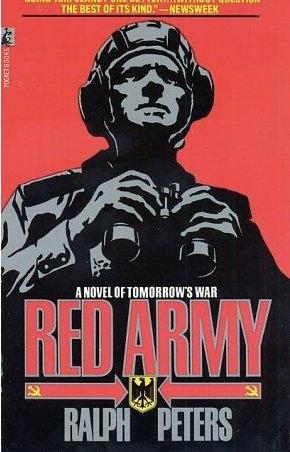
Red Army — Ralph Peters
A WWIII novel written in 1989, just as the USSR started to collapse. Par for the course for infinity star general Ralph “blood n guts” Peters, who these days is trying to sell the existential threat of Islamofascism to the US. It is surprisingly readable though.

Dansen Met De Duivel — Peter Rensen
Peter Rensen spent several months infiltrating the Centrumdemocraten, a party best compared to the BNP, just before the city council elections of 1994. This election turned out to be the high water mark for the party, which afterwards slowly dwindled until it was disbanded in 2002. Rensen sketches a portrait of a deeply racist party many of whose activists are not just racist, but open nazi sympathisers. At the same time, he also shows the party is deeply disorganised and not prone to do much activism other than putting out party political broadcasts.
Red Army — Ralph Peters

Cover of Red Army


Red Army
Ralph Peters
402 pages
published in 1989

Infinity star general Ralph “Blood ‘N Guts” Peters (as seen on Alicublog) is one of the more loonier cheerleaders for the War on Musl^wTerror. He’s a firm believer in both what Matt Yglesias dubbed the Green Lantern Theory of Geopolitics where America just needs the Will to vanquish its enemies and nothing else and in the unlimited threat of the Islamofascist menace, which so far, apart from a few exceptions, has been pretty weak. It’s not an uncommon strain in American conservatism, this doublethink about America being both the strongest and bestest country on Earth and its unique vulnerability to the enemy du jour, which is so much more cleverer, stronger and dedicated than the American people. It’s no surprise then that Peters has written a future war novel about a succesful Soviet invasion of West Germany, in 1989, just as the Berlin Wall fell, the Warsaw Pact countries overthrew their communist leaders and the USSR looked on without firing a shot in their defence. Of course, he’s not the only one to have been surprised by the fall of the Soviet Union; plenty of science fiction writers were embarassed too. Still, it’s typical of the man that he would write a novel warning of the dread Soviet threat at the exact moment it was all revealed to be hollow.

The main reason I bought Red Army then when I saw it at a secondhand bookstore was to have a laugh, to see what Peters would make of it. I expected it would be dreadful, with awful prose and awful writer, but in fact it turned out to be quite readable. His writing is easily on a par with the king of technothrillers, Tom Clancy, which is damning with faint praise, I know. But then you don’t expect good writing with these sorts of novels. Peters writes clearly, is good at describing the nature of war without bogging down into needless details, keeps the story moving quickly and uses immediately recognisable if stock characters: the young conscript with no clue what’s happening, the grizzled Afghanistan veteran airborne captain, the dedicated, toughminded but fair general and so on, and so on. Interestingly enough, unlike other World War III novels, Red Army is written solely from the Russian point of view and they get to win too. One further point in Peters’ favour is that he doesn’t share Clancy’s tendency to geek weapon systems and describe endless details of the weapons used. Peters talks about tanks, “the big guns of the battallion”, the “company’s fighting vehicles” rather than T-72s or BMP-1s.

Read more…