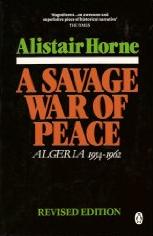
A Savage War of Peace — Alistair Horne

Cover of A Savage War of Peace


A Savage War of Peace
Alistair Horne
604 pages including index
published in 1977

Remember how the White House a few years ago, in one of their periodic attempts at convincing the rest of the world George Bush is not a complete moron, released a list of books supposedly read by him in the past year? One of the books on the list was this, A Savage War of Peace, Alistair Horne’s history of the Algerian struggle for independence from France. What’s more, the same book was also reported to be widely read in the US army occupying Iraq and Afghanistan as part of an attempt to understand the enterprise they were engaging in. This isn’t necessarily a recommendation of course; another much read book in the US army is that piece of pseudoscientific racism, The Arab Mind. A sort of mixed bag of recommendations then: this is clearly an important book in that it seems to have shaped the American strategy in Iraq and Afghanistan, but does this make this a good book?

Fortunately, it does. Had Bush read this book in 2002 before the War on Iraq, and had he been able to actually understand what he read, he may have actually decided against the invasion. Everything that happened in Iraq is described here, every mistake and failed strategy the Americans would use, written down twentyfive years before the war even started. No wonder various army generals studied it so avidly. Colonial wars follow certain patterns it seems and what happened in Algeria in 1954-62 can be used as a guide to Iraq forty years later.

Read more…

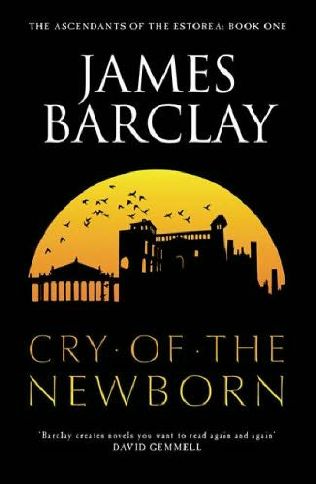
Cry of the Newborn — James Barclay

Cover of Cry of the Newborn


Cry of the Newborn
James Barclay
819 pages
published in 2005

James Barclay is not a writer I had heard of before I got this book out of the library. The backcover blurb sounded interesting and the frontcover sported a quote by Steven Erikson, one of my favourite fantasy writers, so while the first few pages I sampled were a bit dull I thought I’d take a chance. The library also had the sequel, but I didn’t put that one up as this was big enough already; I could always get it next time. But I don’t think I will. Erikson’s blurb said that Cry of the Newborn was “a most extraordinary and impressively ambitious novel”, but in reality it was just a bog standard epic fantasy novel. Not a bad novel by any standards, competently written certainly, but nothing special.

[…]

The second objection is more fundamental. The world Barclay has created is presented as if the Concord is a force for good, described in terms which argue that the Estorian hunger for empire is not driven by base motives, but out of a noble desire to create order and stability. Trouble is, I don’t buy it. Looking at it objectively, the Concord is just not that nice, happily waging wars of conquest only to then suck the conquered countries dry for further conquest, not to mention the enrichment of the Estonian elite. Sure, by author fiat there’s little of the cruelity on display practised by real world empires like the Roman or British Empire and it’s even fairly gender neutral, with the current ruler of the Concord being a woman, and with various viewpoint characters being female soldiers and officers, but this is just window dressing. I just could not see the Concord as the good guys, or help root for the supposed baddies, who after all only wanted to live in peace in their own country. Fantasy is a somewhat conservative, some would even say reactionary genre and I can overlook some of the more …odious… assumptions in a given novel if the story is right, but not this time.

Read more…

Books read December

So we finally come to the grand total of books read this year: 152, or almost three books a week. Yes, I’m quite proud of that.

The Horned Dinosaurs — Peter Dodson
An excellent overview of what we know about Triceratops and its relatives. Dodson doesn’t just tell what we know, but how we got that knowledge and isn’t afraid to show what isn’t known or cannot be known about Triceratops.

A Savage War of Peace — Alistair Horne
George Bush was supposed to have read this. In the unlikely case that he has, he may have noted the resemblance between the French experience in Algeria and what American troops were dealing with in Iraq.

Psychohistorical Crisis — Donald Kingsbury
A reworking of/semi-sequel to Isaac Asimov’s classic Foundation series that’s much better than Asimov’s own sequels.

Web of Angels — John M. Ford
A proto-cyberpunk novel by a vastly underrated author, with a style of storytelling that reminded me in equal parts of Zelazny and Delany.

Candle — John Barnes
A Barnes novel that actually ends on an optimistic note and with a protagonist that isn’t some masochist? Miracles still happen it seems.

War for the Oaks — Emma Bull
I don’t particularly like urban fantasy as a genre, but this is one of the novels that defined the genre.

The Perspective of the World — Fernand Braudel
The third and last volume in Braudel’s Civilisation and Capitalism series, taking a global look at the development of capitalism between the fifteenth and eighteenth centuries.

The Prince — Niccolo Macchiavelli
The book which gave us the adjective “macchiavelian”, it has a mostly undeserved reputation as an amoral treatise on how to stay in power as an autocrat.

KV – 1 & 2 — Steven Zaloga & Jim Kinnear
Another Osprey war nerd volume, on a Soviet World War II tank series not so well known as the T-34, but almost as important in the first stages of the Great Patriotic War. Heavily armoured and armed with the same 76 mm gun as the T-34, when these tanks first appeared the Germans had nothing to stop them with…

Bagration 1944 – The Destruction of Army Group Centre — Steven Zaloga
One of the most important campaigns of World War II, overshadowed by the Anglo-American invasion of Normandy in the same month. The speed and efficiency with which the Russians destroyed a German force much larger even than that during the battle for Stalingrad was a major reason for the almost complete collapse of the Eastern Front in 1944.

Anathem — Neal Stephenson
As is almost always the case with Stephenson, don’t read this novel for the plot, but read it for the various ideas he chews through on the way.

The Dutch Republic — Its Rise, Greatness, and Fall — Jonathan I. Israel
A very thorough if somewhat exhausting and occasional tedious history of the United Provinces, from its earliest roots in Burgundian times to its ultimate dissolution by Napoleon. It cost me a year to read this.

The Dragon’s Waiting — John M. Ford
A fantasy novel set ib a world in which Christianity didn’t break through, the Byzantium empire managed to restore much of the old Roman empire and some kinds of magic are real. This reminded me of some of Mary Gentle’s stories, especially the White Crow series.

The 2006 Lebanon Campaign — Stephen Biddle & Jeffrey A. Friedman
A US Army sponsored inquiry into the tactics and strategy employed by Hezbollah in the defence of Lebanon against Israeli attack in 2006. Was Hezbollah behaving as a typical guerilla movement or more like a proper army and what are the implications for US army policy?

Saturn’s Children — Charlie Stross
The last book I finished in 2008. A typical Stross novel, fastpaced, fun and smart. Awful cover on the American edition, but it is actually quite faithful to the description of the protagonist, who is in fact a redhaired sexbot whose nipples go spung. Yes, this is Stross doing Late Heinlein, warts and all, making it work.
Books read November

Bleak Seasons — Glen Cook
The sixth book in the Black Company and the first to star Murgen rather than Croaker or the Lady. Grim and gritty in a good way.

The Road to Verdun — Ian Ousby
I hadn’t heard of the author before, but this turned to be an immensily interesting book on not just the military history that led to the battle of Verdun in World War I, but which also explains the cultural and historucal background of this battle, of how the War of 1870 was echoed in Verdun.

Voice of the Whirlwind — Walter Jon Williams
Not his most famous cyberpunk novel (that’s Hardwired but still an excellent example of a second generation cyberpunk novel.

The Situation — Jeff Vandermeer
This was given away as a free e-book by Wired and PS Publishing. I had heard of Vandermeer but not yet read anything by him and this was a good introduction, as it was a chapbook less then fifty pages long. A fairy tale of office politics and the post-singulary (I think).

Kingtiger Heavy Tank 1942 – 1945 — Tom Jentz, Hilary Doyle, Peter Sarson
The first entry in Osprey’s New Vanguard series of short books aimed at serious tankheads. A reasonable overview of the development history of this tanl, but with little attention paid to the operational history. Yes, this is me indulging my war nerd side.

Driftglass — Samuel R. Delany
I’ve been looking for this collection of short stories for a long time. Delany isn’t much of a short story writer, more a novelist and hasn’t written many; the ones here were all written between 1965 and 1968. Reading them in sequence gives a good overview of recurrent themes and images in his work.

Attack of the Unsinkable Rubber Ducks — Christopher Brookmyre
If Richard Dawkins wrote thrillers and had a sense of humour this would be the book he’d write. Brookmyre’s hero Jack Parlabane gets involved in a suppsoedly scientific experiment to prove the psychic powers of an American medium, only to get involved in a much larger complot. Religion and mysticism do not quite get a fair hearing here.

Plagues and Peoples — William H. McNeill
Here’s a book written some two decades before Jared Diamond’s Gun, Germs and Steel which covers much of the same terrain: the way in which diseases and plagues shaped human history.

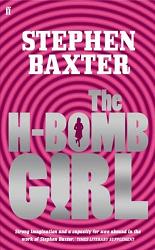
H-Bomb Girl — Stephen Baxter
I’m not a great Stephen Baxter fan, but this was quite good. Written as a young adult novel, this will give some bright twelve year old nightmares for years –in a good way.

Cry of the Newborn — James Barclay
It was only because Steve Erickson provided the cover blurb that I picked this book up. Unfortunately it turned out to be just another middle of the road epic fantasy. What’s more, I found the side the author wants us to cheer for — the hegemonising faux-Roman Empire attempting to conquer the world to bring peace and prosperity — morally repulsive.

Kingdom of Shadows — Alan Furst
Alan Furst specialises in writing interbellum thrillers, set in the late thirties with world War II looming in the background. Even when his protagonists win their battles, you know their victories are ultimately futile when Europe gets swept up in a new world war. It makes for sombre, slightly depressing reading which works well in small doses.

Peace & its Discontents — Edward W. Said
A collection of Said’s columns written during 1993-1995 for various Arabic newspapers, explaining how the Oslo peace process had let down the Palestinian people.

Life on a Young Planet — Andrew H. Knoll
Excellent overview of what we know of what life looked like and evolved in the billions of years before the socalled Cambrian Explosion.

Hons and Rebels — Jessica Mitford
An autobiography of the communist member of the Mitford sisters. Understated humour.

Have Space Suit – Will Travel — Robert A. Heinlein
Another of Heinlein’s juveniles ticked off. Good entertainment as always, but better read if you’re twelve.

The H-Bomb Girl — Stephen Baxter

Cover of The H-Bomb Girl


The H-Bomb Girl
Stephen Baxter
265 pages
published in 2007

This is a book that’s going to give me nightmares, I can tell. Because I grew up as a kid in the Second Cold War, the last kids to grow up in the shadow of Nuclear Holocaust, when one side was ruled by a succesion of doddering paranoid old men who had gotten their job training under Uncle Stalin and the other was governed by a cowboy actor who half the time seem to believed he had been the war hero his b-movie career had portrayed him, I’ve always been fascinated and horrified by nuclear war. I remember having h-bomb nightmares almost every night when I was eight or ten. Even now, just reading the Wikipedia description of Threads is enough to give me bad dreams, let alone reading a novel the centrepiece of which is an all too realistic description of what could’ve happened to Britain if the Cuban Missile Crisis had not been defused in time. I can only imagine what the intended young adult audience for The H-Bomb Girl will think of it, having grown up with very different nightmares.

So far Stephen Baxter had never impressed me with his writing. I’ve read and enjoyed several of his short stories scattered through various anthologies, but bounced hard of his awful Mammoth novels while the other work of his I’ve come across never appealed to me. The only reason I picked up The H-Bomb Girl in the library was because it got talked about over at Torque Control during the runup to the Clarke Awards. Reading the first few pages intrigued me enough to take it home. Once I started reading it in earnest today I got sucked in and didn’t stop until it was finished. There’s not many books that I do that with these days. Score one for Baxter.

Read more…