Driftglass — Samuel R. Delany

Cover of Driftglass


Driftglass
Samuel R. Delany
318 pages
published in 1971

Samuel Delany is one of my favourite science fiction writers and in my opinion one of the best science fiction writers ever. Considering the cover blurb on this collection of short stories, I’m not alone in that opinion. According to Frederick Pohl, not a bad writer himself, “Delany may be the only authentic genius among us”. High praise indeed, but Delany deserves it. Everything I’ve read of his, including his earliest novels, displayed a mastery of both language and story, a lively imagination and ability to create novel but believable world and most importantly a grasp of the importance of culture that’s rare in science fiction, especially when he first started writing.

He is however more of a novelist than a short story writer, having written not nearly as many short stories as his contemporaries. in fact, Delany debuted with a novel at a time when science fiction was still largely a magazine driven field. It was only after he had established himself as a writer that he started publishing some of his short stories. Driftglass was his first collection, containing work written between ’65 and ’68 and published between 1967 and 1970. It’s a great collection, with two absolute classics in it: the Nebula winning “Aye, and Gomorrah…” as well as “Time Considered as a Helix of Semi-Precious Stones”, which won both the Hugo and the Nebula awards. Not to mention several other excellent stories.

Read more…

Books read in October

Here are the books I’ve read last month. Less than I wanted to read to keep on track for my goal of 150 books read this year. Oh well, guess I have to read more in November and December…

Europe unfolding: 1648-1688 — John Stoye
Excellent narrative history about one of those interludes in European history that don’t really fit a period. As this is an English history, Europe means the continent, but it’s very good at covering the whole of Europe and not just western Europe.

Dreams of Steel — Glen Cook
The fifth Black Company novel (not counting The Silver Spike) and the first not narrated by Croaker. Gripping as always.

The Witches of Karres — James H. Schmitz
Schmitz is not an author I had heard much of, until ten years or so ago, when Baen started to reprint his work, but in an “updated” version. I got this book as an indirect result of the controversy this update caused in rec.arts.sf.written, as Jo Walton handed it out as a wedding present, echoing the old Hobbit tradition of giving away presents on your birthday. An entertaining read, which means I will search out more Schmitz.

Slan — A. E. Van Vogt
First time in decades I actually read some van Vogt. Slan is one of those stories that had an influence on science fiction all out of proportion to its qualities, just because the idea is so good. The first chapter especially is so good in establishing the emotional truth of poor old Jommy Cross’ situation, twelve years old, a superhuman mutant with intelligence and strength far above normal people but all alone in a world that fears and hates him and his kind.

1491 – New Revelations of the Americas Before Columbus — Charles C. Mann
I got this on a recommendation by Teresa Nielsen Hayden. Mann is one of those people who’s able to take what the experts known on pre-Columbian America and make it available to the general public. The revelations here -that America was much more populated, had a much longer history and was much less wild than recieved wisdom would have it- are not new to those in the field, but have so far not quite penetrated public consciousness yet. 1491 might just be the book to do it.

Time Patrolman — Poul Anderson
Two long stories about the Time Patrol, as also seen in The Guardians of Time. A nice study of contrast, as the first story is one of cheerful high adventure, the kind of sotry which got Anderson his fame in the first place, while the second confirms his reputation of Gloomy Dane he got later in his life.

The Final Programme — Michael Moorcock
The first Jerry Cornelius novel, almost a word for word rewrite of the first Elric novella, the Dreaming City. Setting Elric’s story in a near contemporary England makes clear the banality of it all.

A Cure for Cancer — Michael Moorcock
The second novel in the Cornelius Quartet, more ambitious than the first, flawed but interesting.

The English Assassin — Michael Moorcock
A return to a more conventional structure but with a much less coherent (deliberately) storyline.

The Condition of Muzak — Michael Moorcock
In this one everything has degenerated, given in to entropy.

Wall Street — Doug Henwood
A somewhat dated (published in 1997) but still relevant examination of the financial industry from a leftwing, marxistoid point of view.

Tales — H. P. Lovecraft

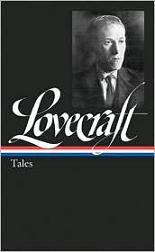
Cover of Tales


Tales
H. P. Lovecraft
838 pages
published in 2005

This deceptively slim volume, much slimmer than the similarly titled 1997 Jocye Carol Oates edited collection of Lovecraft stories, turned out to be printed on the kind of paper they use to print those teeny tiny complete bibles with. So what I thought would be a week’s worth of reading actually needed two long train journeys to finish, by the time I was somewhat bored with Lovecraft’s eldritch obsessions. After a while all the lurking horrors and dwellers in the darkness start to blur into each other and the descriptions turn from atmospheric into mildly ridiculous. Lovecraft is not a writer you should over indulge in; it’s better to read him sparingly story by story.

As a collection this is an impressive book, part of the prestigious Library of America series set up to safeguard America’s literary heritage. That H. P. Lovecraft, as first science fiction, horror or fantasy writer is allowed in these hallowed pages as a genre writer, not ust an established literary figure dabbling in these genres, is a good sign of how far these genres have penetrated literary
consciousness. You may quibble about Lovecraft as a first choice, but he has slowly evolved from a cult writer into one appreciated as much for his literary qualities as his ability to scare his readers so he’s certainly not an undefensible choice.

Read more…

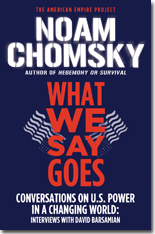
What We Say Goes — Noam Chomsky

Cover of What We Say Goes


What We Say Goes
Noam Chomsky
223 pages including index
published in 2007

Noam Chomsky has been one of the most consistent critics of American hegemony and empire of the past four decades, maintaining a prodigious rate of output over the years as one of the few socalled public intellectuals who does not see his role as parroting received wisdom. His books, articles and interviews have always managed to explain in clear, understandable language how America and its ruling class keeps its power both domestically and abroad and particularly how it dictactes the boundaries of acceptable discourse. A measure of his importance as a critic of American power can be found in the vehemence of the criticism aimed at him by both conservative and liberal commentators. Despite their differences, both groups believe in American exceptionalism, the idea that America has a right, or even a duty to shape the rest of the world according to its own desires. What Chomsky has done for so long has been to show the reality behind “defending democracy” and “humanitarian intervention” and neither liberals nor conservatives like this.

What We Say Goes is his latest book, a collection of interviews he gave to David Barsamian about “U.S. power in a changing world”. It’s fair to say that there are few surprises here for those who’ve read his previous books, with the interview format used here precluding much indepth analysis. However, if you look at this book as an introduction to Chomsky and his concerns, What We Say Goes works fine. It’s short and to the point and as per usual Chomsky manages to cut to the heart of things quickly. He talks about all his usual obsessions — the way in which democracy and human rights are used against official enemies, the role of the US in the Middle East and South America, the role of the socalled free press in determining the boundaries of criticism allowed — and ties them together, with the interview format helping in keeping things rolling along.

Read more…

Books read in September

Here are the books I’ve read last month. Not as many as usual, as I struggled with a couple of books.

Red Planet — Robert A. Heinlein
Another Heinlein juvenile, showing how one boy and his Martian pet cause the planet to succesfully rebel against an ever oppressive Earth.

Goths and Romans 332-489 — Peter Heather
I enjoyed Peter Heather’s The Fall of the Roman Empire and this is an earlier book of his, on a related subject, the relationship between the Goths and the Eastern Roman Empire during the period of the fall of the western Empire.

Spycatcher — Peter Wright
The autobiography of one of a former assistant directors of MI5, which caused a huge controversy when first published, to the point of being banned from publication in the UK itself. Particularly the revelation that Labour prime minister Harold Wilson had been spied upon by MI5 under suspicion of being a Soviet mole caused a lot of interest.

Tales — H. P. Lovecraft
Huge collection of Lovecraft stories edited by Peter Straub for the Library of America series. At roughly one story per quarrter hour commute, as well as two long train journeys, it still took me over a week to plow through this. Reading more than a few of these stories in one sitting isn’t recommended either, as the simularities and stylistic tics shared by them become increasingly visible.

De Wet op Internet — Arnoud Engelfriet
Arnoud is a Dutch blogger specialised in the intersection of the internet with the law. He has now written a clear, easy to understand book on the fundamentals of internet law in the Netherlands.

The Haunter of the Ring & Other Tales — Robert E. Howard
A collection of horror and weird mystery stories by the creator of Conan the Barbarian. More variety than the similar Lovecraft collection, but with the same undertone of racism, where race determines character and there’s nothing better than somebody from clean, Anglo Saxon stock.

Civilisation and Capitalism – The Wheels of Commerce — Fernand Braudel
The second volume in Braudel’s massive history of the early days of modern capitalism between the fifteenth and eighteenth centuries. This one looks at how commerce and capitalism developed in these centuries.

An Army at Dawn — Rick Atkinson
The story of the North African campaign from Operation Torch to the liberation of Tunis, from an American point of view. Well told and engrossing, a good book to get an idea from of how this campaign went for the Americans. Supposedly this is the first of a series, with the next volumes detailing the rest of the war in Europe.

Too Many Women — Rex Stout
A post-war Nero Wolfe mystery. Fun, dated and somewhat sexist.

CauseWired — Tom Watson
Tom Watson is a journalist and onlive activist who believes the future of social activism is online and attempts to sketch out this future here. Sounds trite at first, but he means more than just charities discovering the power of facebook or twitter. Once you get through the silicon snakeoil and marketing speech, there is a kernel of truth here.