Bad Monkeys — Matt Ruff
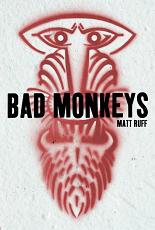
Bad Monkeys
Matt Ruff
230 pages
published in 2007
When your local library’s automated lending system refuses to recognise a book you’re attempting to borrow when it’s clearly there in front of you, it’s enough to make you a little bit paranoid, but when that book is Bad Monkeys, an example of American Paranoia at its finest, with a Christopher Moore quote on the cover saying “Buy it, read it, memorise then destroy it. There are eyes everywhere.“, you become more than a bit paranoid. Little did I know then how appropriate that little incident was. Bad Monkeys is one of those books that makes you look twice at every CCTV camera on your daily commute, not to mention much more innocent examples of street furniture for signs of hidden cameras.
You might know Matt Ruff from Sewer, Gas & Electric, his brilliant and hilarious parody-slash-update-slash-mixup of the stoner paranoia classic Illuminantus! trilogy, not to mention that bible of teenage libertarianism, Atlas Shrugged. If that novel showed Ruff’s absurdistic, bombastic side, Bad Monkeys is toned down, sleek and effortlessly cool. It still taps into that vein of essential American paranoia that also drove Sewer, Gas & Electric, but this time it’s more refined, less consciously wacky.
Books read in June
Yup, you guessed it: time for another list of books read. We’re now exactly six months into 2008 and I’ve read exactly seventyfive books. Fortysix of these were fiction (of which thirtyone were science fiction even), twentynine non-fiction, with history taking hte lion’s share of that with nine books. Of last month’s crop, I was most impressed with Hal Duncan’s second novel, Ink, as well as Paul Cornell’s British Summer Time which I started with low expectations but which turned out to be pretty good.
Ink — Hal Duncan
The sequel to Vellum. Less coherent, slightly disappointing in the end but a worthy followup to Duncan’s first novel.
The Later Roman Empire — Averil Cameron
I’ve become somewhat obsessed by Late Antiquity and the later Roman Empire this year and this is another book on this subject, focusing on the fourth century in particular.
Whose Body? — Dorothy L. Sayers
The first novel in the Lord Peter Wimsey series. It’s not as good as a her later works of course, but still entertaining and with hints at greatness, though oddly defensive about being a detective novel.
Clouds of Witness — Dorothy L. Sayers
I thought I reread the entire Lord Peter series –or at least the novels, not being too fond of the short stories– in order of publication. This is the second in the series, in which Lord Peter has to save his brother, the Duke of Denver, from the hangman’s gallow.
Swiftly — Adam Roberts
This is Adam Roberts’ latest novel, not to be confused with his 2002 collection of the same name, several stories of which have been reworked here. Sort of a continuation of Swift’s novel, Gulliver Travels, it shows the world roughly a century after Gulliver’s discovery of the Lilliputians and Brobdingnagians. I came to this prejudiced against Roberts, due to my experience with several of his earlier works and I can’t say this prejudice has been overcome.
Unnatural Death — Dorothy L. Sayers
The third novel in the Lord Peter series. Somewhat of a slog to get through, compared to the first two and more interesting for its oblique look at certain aspects of pre-war England than for the story itself.
British Summer Time — Paul Cornell
A surprisingly engaging science fiction novel that takes Christianity seriously without being preachy or zealous. It’s a rarity in science fiction to even mention religion, let alone Christianity and usually when it is mentioned, the author has a hidden agenda for doing so (Orson Scott Card is one persistent offender). Paul Cornell however manages to created characters who are Christians and have it be just one piece of their background, which is refreshing.
On Late Style — Edward Said
Said’s very last book, completed by one of his students, fittingly examining the way in which late works of artists and philosophers like Beethoven, Adorno and Jean Genet share a common philosophy, despite their differences. Slightly incoherent due to the circumstances under which it was published.
Europe of the Ancien Regime 1715-1783 — David Ogg
An old-fashioned, somewhat dated overview of Eighteenth century Europe between the last spasms of the religious wars of the previous centuries and the start of the age of revolution.
The Big Sleep — Raymond Chandler
I’ve never read any Chandler before this, but it was odd to read this, because so much of it has been reworked into cliche by lesser writers.
Righting English That’s Gone Dutch — Joy Burrough – Boenisch
A slim little volume dedicated to show all the common errors and pecularities of style us Dutch make when we write in English. For the most part it’s sensible advice for people who do speak and read English well, but who have less experience writing it, but in some cases the advice given is dubious or slightly too business orientated to be useful for e.g. blog writing… Nevertheless, no doubt you can find examples of most the errors listed in this book on this website.
The Testament of Andros – James Blish
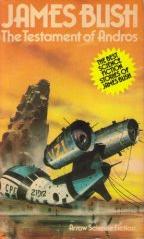
The Testament of Andros
James Blish
216 pages
published in 1973
James Blish was a science fiction writer of the same generation as Isaac Asimov, the first science fiction writers to have grown up with science fiction as a separate genre, to have become science fiction fans before they became science fiction writers. Blish’s first short stories were written in the early forties, before World War II interfered, so it was only in the fifties that he made his reputation. During that decade he wrote quite a few classic short stories and novels, including the Cities in Flight series, with its vision of New York flying off
amongst the stars and A Case of Conscience, in which a young Jesuit wrestles with the question whether or not the aliens he lives amongst posses souls. At the same time, writing under the pseudonym of William Atheling, Jr., he was one of the pioneers in applying literary criticism to science fiction. His later work is less interesting, being spend mostly on writing Star Trek novels.
Though Blish is an important early science fiction writer, one who has written several excellent novels and short stories, I’ve always found myself a bit lukewarm about him. I’ve read the novels I’ve mentioned above, attempted some other, later works of his, as well as most of his better known short stories; they were alright, but no more than that. Part of the trouble I had with him is that he, for a science fiction writer, had quite a conservative pessimistic atttitute towards the future, adhering to a Spenglerian, cyclical view of history, most notably in the Cities in Flight series. I got nothing against a bit of conservatism or pesssimism in my science fiction perse, even if I don’t share it, but Blish’s philosophy is a particularly dreary one.
Mediterranean: Portrait of a Sea
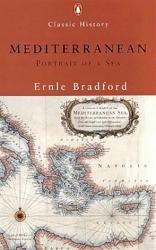
Mediterranean: Portrait of a Sea
Ernle Bradford
574 pages including index
published in 1971
I read Ernle Bradford’s book on the 1565 Ottoman siege of Malta, The Great Siege, some four years ago and enjoyed Bradford’s obvious enthusiasm and interest in the subject, though at times he made the siege sound a bit too much like a boy’s adventure. Other people seem to like it too, as not a week goes by without recieving hits on the review of it I did back. Apart from The Great Siege however I’ve never seen any other Ernle Bradford book, until Mediterranean: Portrait of a Sea caught my eye on the Amsterdam library’s shelves two weeks ago. Bradford did a great job with his book on the siege of Malta, so I thought it would be interesting to see how he would do with a slightly bigger subject.
And subjects don’t come much bigger than this: the complete story of the Mediterranean, one of the most important areas in human history, from the earliest beginning to the present day. As the subtitle indicates, Bradford isn’t interested as much in the history of the various countries
and empires that have bordered the Mediterranean, as he is in the sea itself. He focuses therefore on the ebb and flow of human exploration of the Mediterranean, on how the traderoutes through it were established and fought over, on the maritine empires that were established on it, on how their domination of the sea led succesive empires to rule the countries surrounding it.
Books read in May
Yup, you guessed it: time for another list of books read.
Dark Side of Democracy — Michael Mann
S. says this made me depressive and angry, but it was worth it. Mann attempts to find out how genocide happens, what pushes a country from largely ordinary racial/ethnical tension into aggressive ethnical cleansing and mass murder. As the title says, the danger zone is when a country becomes democratic and confuses demos with ethnos.
Evolution’s Workshop — Edward J. Larson
A history of the Galapalos islands in the context of the development of the theory of evolution, from Darwin’s visit to the present day. Worthy but dull in places.
The Case of the Late Pig — Margery Allingham
A cozy mystery starring Albert Champion. There’s no better word for this than amusing.
The Best of Fredric Brown — Fredric Brown
A great collection of short stories by a writer these days unfairly forgotten. Brown specialised in short, sharp satirical stories, and most of the stories here are still fresh, even though written over half a century ago.
Pale Gray for Guilt — John D. MacDonald
A Travis McGee adventure in which McGee avenges the murder of an old friend by swindling those responsible out of the money his widow will need to make sure their kids are taken care off. Yes, this is roughly the plot of every McGee novel, or at least half of them.
Doorways in the Sand — Roger Zelazny
I try to ration my Zelazny, as for obvious reasons he isn’t writing anymore so once I’ve read all his books I’ll never again have the thrill of a new Zelazny novel. Had been wanting to read this one, one of his classics for a long time but had never come across it yet. Read it on the way back from a birthday party, finished the last part next to my bike before cycling home from the station. That’s my Zelazny fix for this year.
Template — Matt Hughes
Matt Hughes offered the possibility to any blogger who asked to read the manuscript of his latest novel. Not something I would’ve read of my own accord, but it was worth the (admittingly small) investment.
Kaleidoscope Century — John Barnes
Nicely dark science fiction story of a 21st century much much worse than our own.
A Crack in the Edge of the World — Simon Winchester
The story of the San Francisco earthquake of 1906, with digressions.
Bad Monkeys — Matt Ruff
Effortlessly cool grand old American paranoia.
The Best of C. L. Moore — C. L. Moore
Back when women didn’t write science fiction, C. L. Moore was one of the best, like Leigh Brackett writing lurid but literate pulp tales. This is a late seventies collection of her best work, including the two stories that introduced her best known characters, Northwest Smith (“Shambleau”) and Jirel of Joiry (“Black God’s Kiss”). Apart from that, there’s no overlap with the C. L. Moore collection in the Fantasy Masterworks series.
The Mediterranean — Ernle Bradford
An oldfashioned history of the Mediterranean by the author of The Great Siege of Malta, a bit longwinded at the end and of course somewhat on the conservative side.
There Will Be Time — Poul Anderson
A fairly upbeat story about time travel, upbeat by Anderson’s standards that is. Twentieth century society will still disappear in an orgy of environmental destruction and war, but afterwards there may be something better, if Jack Havig wins his battles against the other timetravellers.
Cowboy Angels — Paul McAuley
McAuley is one of my favourite science fiction writers, but lately he’s been mostly writing technothrillers with nary a hint of science fiction in them. Cowboy Angels is still a technothriller, but it’s also firmly science fiction. With the invention of Turing gates back in the late sixties, the Company gets a new mission: to infiltrate alternate Americas and liberate them from communist or nazi oppression if necessary, to bring them together as one country under many skies.