Short SF Marathon Week 3

Richly late, halfway through week 4, but here are the short stories reviewed in week 3 of my Short SF Marathon:

  • Day 15: Yoon Ha Lee, Rose Lemberg
  • Day 16: Kelly Link, Ken Liu
  • Day 17: Carmen Maria Machado, Usman T. Malik
  • Day 18: Usman T. Malik,Tim Maughan, Sandra McDonald
  • Day 19: Sam J. Miller, Mary Anne Mohanraj, Sunny Moraine
  • Day 20: Sunny Moraine, John P. Murphy, Anna Noyes
  • Day 21: An Owomoyela, Susan Palwick, K. J. Parker

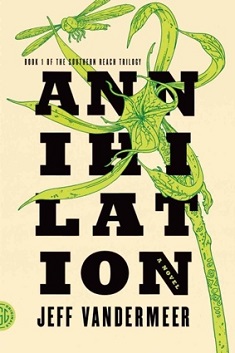
Annihilation — Jeff VanderMeer

Cover of Annihilation


Annihilation
Jeff VanderMeer
208 pages
published in 2014

Last year Jeff VanderMeer (or rather his publisher) did something rarely done, releasing an entire trilogy in one year. Annihilation is the first of this Southern Reach trilogy and has gotten steady buzz as one of the shoe-ins for Hugo and Nebula nominations; it already managed the latter, in fact. VanderMeer is arguably the father of the American New Weird, that mid-noughties movement that came bubbling up from England and got codified across the pond, mainly through his and Ann VanderMeer’s contributions. I’ve only read one story of his before this, the deliberately confusing The Situation.

Annihilation is a much more straightforward story, of a four woman expedition into Area X, as told by the biologist through her field journal; the other three members are the anthropologist, the surveyor and the psychologist. Their names are never told: “names belonged to where we had come from, not to who we were while embedded in Area X”. They’re the twelfth such expedition into the Area; the previous eleven all came to grief one way or another. What they’re setting out to discover is left vague; they themselves only know in general terms what they’re doing or what they can expect, though the psychologist seems to know more than she lets show.

Read more…

Books read January

That’s the first month of 2015 done and dusted. Eleven books read, ten more reviewed over at the booklog. Which puts me on track for reading a hundred plus books this year, which would be nice. Four fantasy novels, three science fiction, two history books and one disappointing book on steampunk.

A Natural History of Dragons — Marie Brennan
The first in a series about a natural explorer obsessed by dragons in a mock-Georgian fantasy world. Excellently done.

Half Life — SL Huang
The sequel to Zero Sum Game, in which math savant Cas Russell learns how to fake friendship like a normal human being.

Everybody Was Kung Fu Fighting — Vijay Prashad
Excellent overview of the history of intersectionality between the South Asian and Black experiences, largely in the context of US history.

A Wizard Abroad — Diane Duane
The YA wizards series goes to Ireland, the country its author also moved to. Coincidence? Luckily not at all as Oirish as you may expect from an American author dabbling in Celtic myths.

The Golem and the Djinni — Helene Wecker
At the American Book Center they compared this to Jonathan Strange and Mr Norrell and I can see why. They share the same sensibility and willingness to let the story breathe.

The Rise of Cities in North-West Europe — Adriaan Verhulst
A bit of a misnomer as it only looks at roughly fifteen cities in the southern Netherlands between the Somme and the Meuse. Somewhat more worthy than I’d expected.

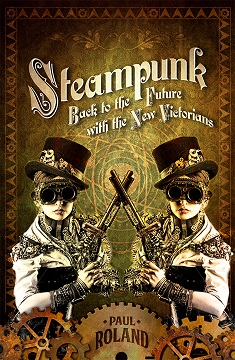
Steampunk — Paul Roland
A disappointing overview of the steampunk subculture.

Pandora’s Planet — Christopher Anvil
Light hearted semi-libertarian fun about humans outsmarting alien invaders — written from the point of view of the invaders.

The Lion Game — James H. Schmitz
Fifteen year old psionic wonderkind Telzey Amberdon outsmarts a hidden invasion of the Hub. Fun adventure science fiction.

Spies of the Balkans — Alan Furst
Another of Furst’s usually quite depressing spy thrillers set just before and during World War II, this one has what you might call a happy ending.

Wolfhound Century — Peter Higgins
Epic fantasy set in a sort of steampunk fantasy Soviet Russia.
Steampunk — Paul Roland

Cover of Steampunk


Steampunk
Paul Roland
191 pages including index
published in 2014

If I felt more nasty Reginald Pikedevant’s excellent cri de coeur against steampunk fakery would be my whole review. I spotted Steampunk: Back to the Future with the New Victorians in the library among the new books and thought “great, just the sort of field guide I need to come to grips with this newfangled steampunk nonsense”. Sadly though this turned out to be just a shallow cash in which told me little I didn’t know written in an irritating manner that had my hackles up halfway through the first chapter.

Read more…

The Handmaid’s Tale — Margaret Atwood

Cover of The Handmaid's Tale


The Handmaid’s Tale
Margaret Atwood
308 pages
published in 1985

About a decade ago, when promoting her book Oryx and Crake, Margaret Atwood said some dumb things while distancing it and herself from science fiction, insising it was “speculative fiction” (ironically a term invented by that most hardcore of sf writers, Robert Heinlein when he tried to make sf respectable half a century before Atwood) and being dismissive about “talking squid in space”. Science fiction fandom has a long history for (imagined) sleights and while Atwood has long since walked back her remarks, sf fans tend to still be a bit grumpy about it. Yet Atwood does have a point that she isn’t writing for science fiction readers and therefore her books shouldn’t be judged by science fiction standards.

Which is fair enough. If you read the Handmaid’s Tale it soon becomes clear that though it is science fiction, it’s science fiction in the dystopian tradition of Orwell and Huxley rather than in the tradition of e.g. Heinlein’s If This Goes On…, another story of religious oppression in a future America. That has flying cars and blaster guns and other sfnal paraphernalia though no space squid, while Atwood’s story is set in what are still recognisable eighties suburbs.

Read more…