LonCon3: finding and talking to people

Well, LonCon3, the 72nd WorldCon is well and truly over, the last dregs of it drunk Tuesday morning, when I spent a couple of hours before I had to get my train helping out with the cleanup. It had been a long weekend of drinking of the firehose of fandom, so much stuff and especially people to see that whatever you were doing, there were always two to five more interesting things to do. I had an absolute blast.

What remains now is the inevitable summing up and recounting. If you’re not all that interested in science fiction and fandom, you may want to skip the rest of the week here or so…

the queue for registration on Thursday. A much longer queue to join the queue was upstairs

This was my first Worldcon as well as my first convention in a decade, the last having been the 2004 Discworld con. I can’t say it wasn’t a bit scary getting back after so long, at what promised to be a huge con (the largest Worldcon ever!). Cons can be cliquey and lonely if you’re going to them on your own, when everbody else seems to have come with friends and is having fun with them.

What I also found coming back to my friends from alt.fan.pratchett for example is that it’s harder to talk to people you haven’t seen in some years than it is when you’ve met regularly. Our lifes have moved out of synch, people have gotten older, established relationships, had kids and such. It can all be a bit awkward.

But I worried for nothing. What I should’ve realised is that because of its size, most people would be strangers to each other and that there always would be people willing to talk to you if you were open to it. I had a lovely long conversation with a woman in the fan village on Sunday, for whom it was also her first Worldcon and she’d gotten a membership as a birthday gift. There were similar conversations with other fans, especially during the parties at night, when alcohol and general cheer made it easier to talk.

Apart from meeting new and interesting people what I was also looking for was meeting old friends and online acquintances; I’d made a list of people I was on the lookout for, but with on average some 6,000 attendees present each day, it was hard to find them. And then when I did, there wasn’t always time to chat long, either because I was going to a panel or doing some voluntering or because they were. So e.g. on Thursday I was playing hall monitor for the fan village when Deidre Saoirse Moen walked past (not to mention Robert Silverberg) and a little bit later I ran into Nicholas Whyte at the press stand when I was running an errand. At least I got to say hi to him…

I learned a lesson through this: when you run into people, say hi, because you never know when you’ll see them again at the con. I managed to have several quick conversations with various sf bloggers that way, as well as got several people coming up to me who knew me from various online haunts, including several who knew me from back in the day in the rec.arts.sf.* groups. I also got to talk to some of my favourite authors after panels, or like Paul McAuley, browsing in the dealers’ room. Also met Kev Mcveigh that way browsing through the same stack of DAW paperbacks and who kindly gave up a Doris Piserchia novel I had my eye on. Many others though I never met; never got a chance to talk to Elise Mathesen frex, though we tweeted at each other from the same panel…
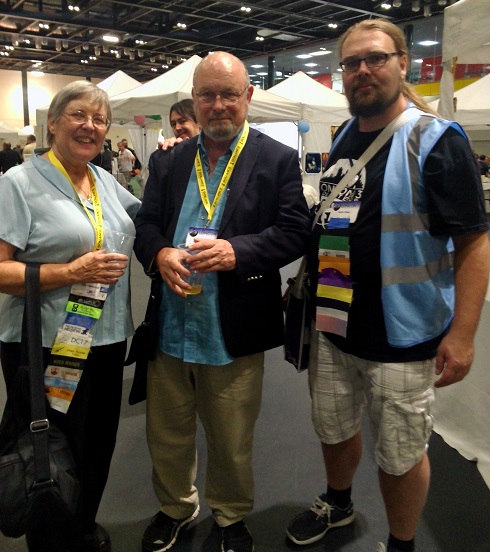
me posing with Gay and Joe Haldeman

One meeting happened entirely by chance late at night on the very last day of the con, as some Polish bloke asked me to take a picture of him and his two friends and then the friends turned out to be Gay and Joe Haldeman, who were some of the nicest people you could hope to meet.

So yeah, seize the day, talk to people whose badge names you recognise.
Should the WFA use Butler instead of Lovecraft?

I understand the impulse behind this petition, but I don’t understand the need to replace H. P. Lovecraft with Octavia Butler:

Octavia Butler contributed a rich, nuanced, complex body of work during her lifetime. Her novels, essays and short stories changed the entire genre of speculative fiction by complicating our notions of power, race and gender. Her characters were vivid and deeply human and her prose was sharp. She wrote masterfully across the imaginative genres, from science fiction to historical fantasy to horror.

While HP Lovecraft, whose head the current award is modeled after, did leave a lasting mark on speculative fiction, he was also an avowed racist and a terrible wordsmith. Many writers have spoken out about their discomfort with winning an award that lauds someone with such hideous opinions, most notably Nnedi Okorafor. It’s time to stop co-signing his bigotry and move sci-fi/fantasy out of the past.

What strikes me here, as it did Nick Mamatas, who spent some time refuting it, is the gratitious dig at Lovecraft’s writing, which is irrelevant to the purpose of the petition. That Lovecraft was a racist and that his racism was often integral to his stories should be enough; his writing qualities do not enter into it.

It also strikes me as odd to propose Octavia Butler as a replacement. She was a science fiction writer, not a fantasy writer. Just because she’s about the only deceased, prominent black science fiction or fantasy writer people actually know doesn’t make her suitable as figurehead for this particular award. It’s not as if science fiction has no awards named after horrible racists that could do with a bit of a cleanup, frex both the Campbell awards, named after an editior whose racism shaped science fiction far more and for far longer than Lovecraft’s ever did.

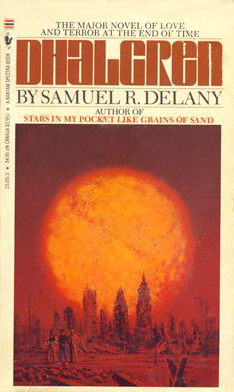
Dhalgren — Samuel R. Delany

Cover of Dhalgren


Dhalgren
Samuel R. Delany
879 pages
published in 1975

Question: what are the two places man will never reach? Answer: the heart of the sun and page 100 of Dhalgren.

A corny old joke, with a kernel of truth because Dhalgren is not an easy book to read. Almost 900 pages long it’s a monster of a book, even more so when you remember it was published at a time when any science fiction novels over 200 pages was a bit on the long side. And unlike certain modern novels of that length, Dhalgren demands your attention on every page; you can’t get through it on the autopilot. It’s therefore no wonder that it took me most of February to read it, with no time for other books. But it was worth it as even almost forty years later this still is one of the most ambitious and challenging science fiction novels ever written.

Some people think it’s the symbol of everything that went wrong with science fiction. That “joke” I opened is less a joke than a sneer, repeated by people still mad at what the New Wave did to science fiction though they were born long after it. According to them Dhalgren is dense, impenetrable and unreadable, elitist fodder for literary snobs. What really sticks in their craw though is that Dhalgren was one of the biggest science fiction bestsellers of the seventies, going through fifteen printings between 1975 and 1980. Somebody must’ve liked it; in fact, like Dune or Stranger in A Strange Land, much more palatable bestsellers to these embittered fans, it must’ve appealed to people outside science fiction’s core readership.

Read more:

Liking problematic writers

I don’t know when I first started reading science fiction, but it must’ve been no older than seven or eight years old, going to the library on friday evenings with my mum and browsing the children’s bookshelves (that is until, inevitably and like so many others, I’d read everything in them and went on to the adult stacks). The first books I can remember reading were by Isaac Asimov: Buy Jupiter, I, Robot and a bit later the Foundation trilogy. One of the first books I bought for myself was The End of Eternity. I read everything of Asimov I could get my hands on and thanks to his writer, got to discover Clarke and Heinlein and Bradbury and all those other sf writers I’ve read since.

One of the things that made his collections so great was how chatty he was in them, writing introductions to each story, talking about how his life was going at that time, how he got to write those stories etc. From those, especially those in his later books, I slowly got the impression he was a bit of, as he would also call himself, a dirty old man, a lecher, somebody who had an eye for the women, all those other things we’d used to call men who were a bit dodgy regarding women, a bit too randy but harmless, and really, what’s the harm in being hold down by two strangers so dear old Isaac can grab your breasts?

Now of course you always hear that you shouldn’t judge the work by the person, but the more I hear about how much of a serial harasser Asimov was, the less comfortable I become keeping his books on my shelves. Fortunately for me I can justify it for myself because a) he’s dead and b) every one of those had been bought secondhand, so it’s not like I’ve been directly given money to a harasser…

A more difficult example is Elizabeth Moon, who back in 2010 said dumb, xenophobic things about Muslims. Which was one of those things I didn’t pay a lot of attention about at the time, but since then I’ve been reading a lot of Elizabeth Moon and it worries me now. Partially because, you know, I’d rather not give money to wingnuts if I can avoid it but also because that sort of politics has a tendency to bleed into a writer’s novels. Case in point: Dan Simmons.

Luckily again, Moon seems to have behaved since that outburst and so far her politics, as far as they appear in her novels may be on the conservative side, but nowhere near wingnut territory. Therefore I can justify keeping her books, which is a good thing, as I like them. unlike say Orson Scott Card, who has awful politics and who doesn’t write books anymore I like anyway. For the most part I’ve been lucky that the writers I like aren’t arseholes and those that are I don’t like.

Hugo Awards: Editors and Retro Hugos

So I’ve said before that I wasn’t sure if I was going to vote for the editor awards. I’ve ended up not doing so for a couple of reasons, mainly because I haven’t the faintest what makes for a good editor and I would mean largely voting by name recognition. Even with the stories/novels provided in the voters package it’s hard to say how much or how little the editor mattered for the success of them.

The Retro Hugos on the other hand I did vote in, though only in the fiction and artist categories.I know too little about the fan categories to make an educated choice there:

Best novel:

  1. The Sword in the Stone by T. H. White (Collins)
  2. The Legion of Time by Jack Williamson (Astounding Science-Fiction, July 1938)
  3. Galactic Patrol by E. E. Smith (Astounding Stories, February 1938)
  4. Carson of Venus by Edgar Rice Burroughs (Argosy, February 1938)
  5. Out of the Silent Planet by C. S. Lewis (The Bodley Head)

Best novella:

  1. “Who Goes There?” by Don A Stuart [John W. Campbell] (Astounding Science-Fiction, August 1938)
  2. “The Time Trap” by Henry Kuttner (Marvel Science Stories, November 1938)
  3. “A Matter of Form” by H. L. Gold (Astounding Science-Fiction, December 1938)
  4. “Sleepers of Mars” by John Beynon [John Wyndham] (Tales of Wonder, March 1938)
  5. No Award

Best novelette:

  1. “Werewoman” by C. L. Moore (Leaves #2, Winter 1938)
  2. “Pigeons From Hell” by Robert E. Howard (Weird Tales, May 1938)
  3. “Hollywood on the Moon” by Henry Kuttner (Thrilling Wonder Stories, April 1938)
  4. “Dead Knowledge” by Don A. Stuart [John W. Campbell] (Astounding Stories, January 1938)
  5. “Rule 18” by Clifford D. Simak (Astounding Science-Fiction, July 1938)

Best short story:

  1. “How We Went to Mars” by Arthur C. Clarke (Amateur Science Stories, March 1938)
  2. “Hyperpilosity” by L. Sprague de Camp (Astounding Science-Fiction, April 1938)
  3. “Hollerbochen’s Dilemma” by Ray Bradbury (Imagination!, January 1938)
  4. “The Faithful” by Lester del Rey (Astounding Science-Fiction, April 1938)
  5. “Helen O’Loy” by Lester del Rey (Astounding Science-Fiction, December 1938)

Ubermawkish, sexist “Helen O’Loy” better not win.

Best Professional Artist

  1. Virgil Finlay
  2. Alex Schomburg
  3. Frank R. Paul
  4. Margaret Brundage
  5. H. W. Wesso

Damn, there were some great artists doing sf and fantasy illustrion back then. Any of them is a worthy winner.