Hugo Awards: Best Novella

The last major fiction award I still need to talk about: the best novella. A bit of a mixed bag this category, with stories that are in that awkward stage halfway between novel and short story. Indeed, at least one could’ve been published as a short novel in its own right. As with some other categories, the two struck through candidates I haven’t considered due to reasons described in my first post.

To be honest, the remaining three stories were good but not spectacularly so, not nearly as good as some of the entries in the short story and novelette categories.

  1. Six-Gun Snow White by Catherynne M. Valente (Subterranean Press)
    As the title indicates, this is a Wild West retelling of the Snow White fairy tale. Well done.
  2. “Wakulla Springs” by Andy Duncan and Ellen Klages (Tor.com, 10-2013)
    This is a great story about several generations of an African-American family living near the lake used to film Tarzan movies and the Creature from the Black Lagoon, but the fantastical element is minimal.
  3. “Equoid” by Charles Stross (Tor.com, 09-2013)
    A typically fun, manic Laundry story about unicorns.
  4. The Butcher of Khardov by Dan Wells (Privateer Press)
  5. “The Chaplain’s Legacy” by Brad Torgersen (Analog, Jul-Aug 2013)
Hugo Awards: Best related work

This was a relatively easy category to decide upon, though since it contains one blog post/essay, a podcast and three books, also one of the more confusing ones. My final vote was as follows:

  1. “We Have Always Fought: Challenging the Women, Cattle and Slaves Narrative” by Kameron Hurley (A Dribble of Ink): a great essay and an important essay, which is why it gets the nod over everything else.
  2. Queers Dig Time Lords: A Celebration of Doctor Who by the LGBTQ Fans Who Love It Edited by Sigrid Ellis & Michael Damian Thomas (Mad Norwegian Press): I’m not that interested in Doctor Who or its fandom, but this is a good book to show that at least some corners of speculative fiction indeed can be and are of special interest to queer people.
  3. Speculative Fiction 2012: The Best Online Reviews, Essays and Commentary by Justin Landon & Jared Shurin (Jurassic London): would’ve finished higher if they’d asked me to contribute, but they didn’t, so feck them.
  4. Writing Excuses Season 8 by Brandon Sanderson, Dan Wells, Mary Robinette Kowal, Howard Tayler, and Jordan Sanderson: a decent enough podcast but no more than that.
  5. Wonderbook: The Illustrated Guide to Creating Imaginative Fiction by Jeff VanderMeer, with Jeremy Zerfoss (Abrams Image): This was not for me.

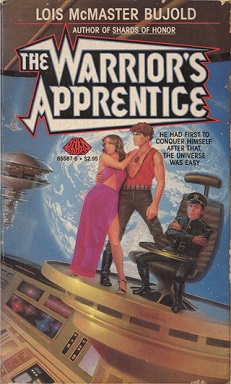
The Warrior’s Apprentice — Lois McMaster Bujold

Cover of The Warrior's Apprentice


The Warrior’s Apprentice
Lois McMaster Bujold
315 pages
published in 1986

As you probably know, Bob, The Warrior’s Apprentice is the second novel in the Vorkosigan Saga series of mil-sf adventures and came out in the same year as the first, Shards of Honor. Whereas that book starred Miles parents, this is the introduction of Miles Vorkosigan, the just under five foot crippled before birth by a neurotoxin attack on his mother, insanely charismatic, insanely hyperactive military genius who, at the start of the novel is trying to make it through the eliminations for officer candidacy in the Barrayaran Imperial Military Service. The written exam is no problem; it’s the physical tests that are a challenge for somebody who could break his bones just by sitting down hard.

His strategy is to take it slow and careful, but being seventeen he lets himself get goaded by one of his fellow candidates, takes an unnecessary risk and breaks his legs, with it shattering his chances to get into the military. Worse than his own disappointment is his grandfather’s, the liberator of Barrayar of the Cetegendans, who dies the next night — Miles convinced he killed him by breaking his heart. In his despair and sorry he’s glad to get away from Barrayar and, because of the political situation his father too would like to see him visit his mother’s family on Beta Colony, a nicely civilised part of the galaxy where aristocratic notions of honour are held for the anachronisms they are. He doesn’t travel alone; his bodyguard, sergeant Bothari, of course has to travel with him and he manages to persuade his mother to ask Bothari’s daughter, Elena, to come with him as well. He’s of course half in love with her and thinks a trip to another planet and perhaps the chance to learn more of Elena’s long dead mother, would get him into her good graces. Yes, Miles is somewhat of a nice guy but trust me, he grows out of it.

Read more…

Hugo Awards: Best semiprozine and Best fanzine

The next two Hugo Awards categories are Best semiprozine and Best fanzine. The differences between these two categories are slight, especially in the day of the internet zine; of the titles nominated iirc only Interzone was originally a paper zine. The main difference is whether or not your zine contributes to your income and either has to be paid for to read or pay its contributors, or both.

Because I don’t follow magazine science fiction and because there has been such an explosion of them in the past couple of years, I find it difficult to judge the candidates here. What I’ve decided upon was to look at a) which writers they publish, b) what sort of stories and non-fiction, c) diversity and d) just general online presence. To be honest, any of these magazines would be a worthy winner.

  1. Apex Magazine edited by Lynne M. Thomas, Jason Sizemore, and Michael Damian Thomas
    This is the most diversive of the candidates, looks great and has published some great stories, including Hugo candidate “If You Were a Dinosaur, My Love” by Rachel Swirsky.
  2. Lightspeed Magazine edited by John Joseph Adams, Rich Horton, and Stefan Rudnicki
    Lighspeed publishes both science fiction and fantasy, new and reprint, with some very well known authors contributing.
  3. Strange Horizons edited by Niall Harrison, Brit Mandelo, An Owomoyela, Julia Rios, Sonya Taaffe, Abigail Nussbaum, Rebecca Cross, Anaea Lay, and Shane Gavin
    Strange Horizons is the one semiprozine I do read regularly, mostly for their reviews as well as their features about diversity in science fiction, like the annual SF count. I’ve always seen it as more a blog than a magazine though; they don’t do issues as such.
  4. Beneath Ceaseless Skies edited by Scott H. Andrews
    According to their mission statement, “Beneath Ceaseless Skies will feature exciting stories set in awe-inspiring places that are told with all the skill and impact of modern literary-influenced fantasy.” Not entirely my cup of tea, or at least not as a biweekly magazine, but I like that everything they’ve published seems to be made available with the appropriate Creative Commons license. The magazine itself is basic: you got a cover, two stories, that’s it.
  5. Interzone edited by Andy Cox

    I’m sorry to say that this is currently the most boring of the candidates, as it used to be a hugely influential magazine back in the nineties and eighties.

Onto the fanzine nominations. I won’t be considering Elitist Book Reviews, for reasons described in my first post, leaving me with a strong field to consider. Because most of the nominees are blogs rather than paper fanzines, I know Pornokitsch, The Book Smuggles and A Dribble of Ink already even when I don’t read them regularly. Journey Planet I didn’t know and turned out to actually be an oldfashioned fanzine and just as good as the other candidates. Again, any of these would make a worthy winner.

  1. A Dribble of Ink edited by Aidan Moher
    Worth the nomination just for having published We Have Always Fought, but this is one of the best sf orientated blogs I know anyway.
  2. Journey Planet edited by James Bacon, Christopher J. Garcia, Lynda E. Rucker, Pete Young, Colin Harris, and Helen J. Montgomery
    An old skool paper zine only available in PDF online, but the articles published make up for that annoyance. They don’t seem to have published anything since last December though.
  3. Pornokitsch edited by Anne C. Perry and Jared Shurin
    Pornokitsch looks at geek culture in the broadest sense, is a well written chatty blog.
  4. The Book Smugglers edited by Ana Grilo and Thea James
    Review orientated, they do what they do well but it’s not a blog I regularly read or want to read.

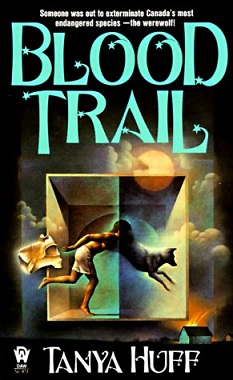
Blood Trail — Tanya Huff

Cover of Blood Trail


Blood Trail
Tanya Huff
304 pages
published in 1992

What do you call urban fantasy when it moves to the countryside? Because that’s what happens in Blood Trail as Vicky Nelson, ex police officer turned private dick and her vampire partner Henry Fitzroy trade the familiarity of Toronto for the charming wonders of the Canadian countryside. Vicky had met Fitzroy in the first novel of the Blood series, Blood Price, now in the second — as seems to be de rigeour in urban fantasy — she gets involved with werewolves. But these aren’t your average, shirt ripping, feauding with vampires werewolves: these are sheepfarmer werewolves, leading a quiet existence near London, Ontario, just another Dutch-Canadian family. Until somebody starts killing them, somebody who seems to know that they’re werewolves.

Which is when they call Henry Fitzroy, who first met the Heerkens wolf clan during WWII, when he was a member of the British secret service and they were in the Dutch resistance. Because the wer could obviously not involve the police without their secret getting known and since they’re mistrustful of outsiders anyway, Henry was their only option. And Henry of course in turn wanted Vicky to come along and use her investigative talents. Meanwhile, back in Toronto detective Mike Celluci, Vicky’s ex-colleague and still occasional love interest is convinced Henry is hiding something. Of course not knowning he’s a vampire, it may just be jealousy that’s driving his investigation…

Read more…