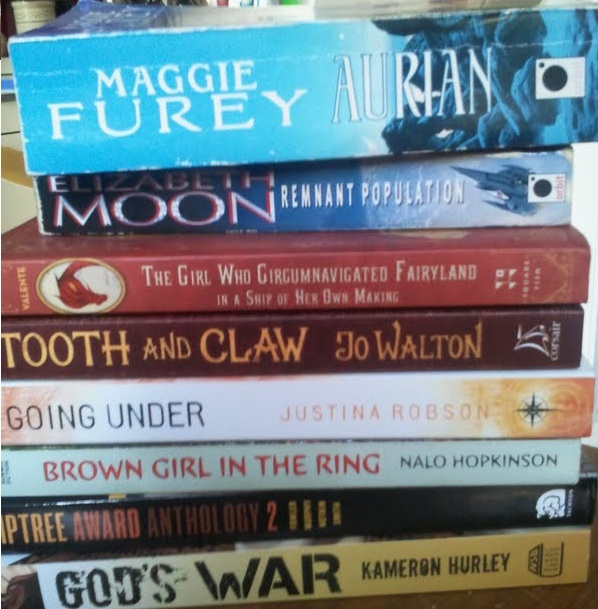
Some reasons why science fiction needs more diversity


Science fiction and fantasy can be incredibly whitebread at times, though it is slowly getting better. One of the things that having more writers of more diverse backgrounds brings to the genre is new and interesting perspectives, as the two examples below make clear.

First, in a review for the LA Review of Books Nalo Hopkinson made the point that the Caribbean makes a good hjumping off point for a colonional or post-colonial sf setting that would be more interesting than the usual American frontier nonsense:

To my delight, in Lord’s afterword, she claims the Caribbean as the post-colonialist convergence of cultures that it is, pointing out that it is thereby an apt jumping-off place for speculative extrapolation. Sing it, sister. It’s all too common for the rest of the world to assume that the Caribbean is a bucolic vacation playground of villages and beaches, incapable of initiating any real scientific or technological progress.

Then I also found an old post of Aaron Hawkins (RIP), who quoted Mark Dery on why science fiction is so relevant to African Americans:

African Americans, in a very real sense, are the descendants of alien abductees; they inhabit a sci-fi nightmare in which unseen but no less impassable force fields of intolerance frustrate their movements; official histories undo what has been done; and technology is too often brought to bear on black bodies (branding, forced sterilization, the Tuskegee experiment, and tasers come readily to mind).

No real conclusions here, just some things that made me think.
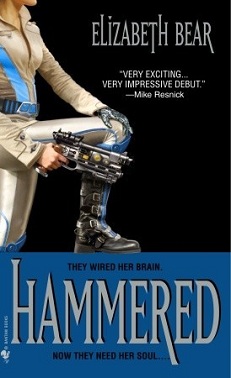
Hammered — Elizabeth Bear

Cover of Hammered


Hammered
Elizabeth Bear
324 pages
published in 2005

Elizabeth Bear is a newish science fiction writer who I’ve been aware off, but hadn’t read anything off until now. Hammered is her first novel, published in 2005 along with its two sequels, Scardown and Worldwired. It was well recieved, with Bear winning both the 2005 John W. Campbell Award for Best New Writer and the 2006 Locus Award for Best First Novel. Both are well deserved, as this is one of the better first novels I’ve ever read. Elizabeth Bear is in complete control throughout and it reads like the work of a much more experienced writer.

Hammered starts out in the most cyberpunk posssible way, with local gangster boss Razorface bringing a kid overdosing on an army combat drug called Hammer to Maker, Jenny Casey, a UN combat veteran of what wasn’t WWII, now left with a cyborg left arm and prosthetic left eye, to see if she can save him. Razorface has mouth full with “a triple row of stainless steel choppers”, hence his nickname, while Jenny has hers because she fixes things. Neither is fond of Hammer, a dangerous drug even when pure and the batch the kid o.d. on is anything but. Some corporation is leaking tainted drugs in their city (Hartford, Connecticut) and together they have to stop them. Meanwhile, an online multiplayer game in which the best players get a chance at piloting a virtual star ship is infiltrated by an AI, who suspects the game is more than just entertainment. It’s 2062, climate change and the wars resulting from it have wrecked the world, China and Canada are locked in a Cold War and somebody’s after Jenny Casey. It might even be her sister.

Read more

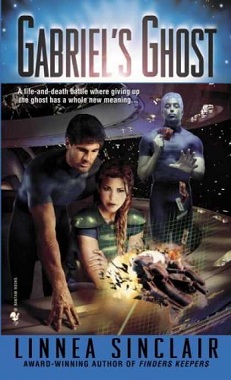
Gabriel’s Ghost — Linnea Sinclair

Cover of Gabriel's Ghost


Gabriel’s Ghost
Linnea Sinclair
447 pages
published in 2005

I’d never heard of Linnea Sinclair before I picked Gabriel’s Ghost up in a secondhand bookstore, but the cover and plot looked interesting. Also, I’m still trying to read more female authors. Googling Sinclair made clear she’s a science fiction romance writer and indeed Gabriel’s Ghost won the 2006 Romance Writers of America’s RITA award for Best Paranormal Romance. Neither this nor the title however means there’s anything paranormal about this novel. Rather, it’s a science fiction adventure story with a somewhat greater emphasis on the romance between the two main characters than usual, which does have some consequences for the rest of the plot.

Gabriel’s Ghost starts imperial fleet captain Chasidah Bergren banished to the prison planet Moabar for crime she didn’t commit. Barely arrived, she had to kill a guard who tried to rape her and only then the real danger began, as the next person she met turned out to be somebody from her past, somebody she thought long dead. Gabriel Sullivan is a rogue and a smuggler she had clashed with repeatedly when she was still a frigate captain, until he died a few years ago. Now he’s back and offering her escape, if she helps him with one little job…

Read more…

It’s only sexism when it happens to you

Science fiction writer Patty Jansen ran into a spot of sexism the other day when she tried to sell a hard sf novel to an unnamed publisher, only to be told that women writers don’t sell. She blogged about and something about she introduced it struck me as wrong:

I also get weary of people blaming their lack of success too easily on external factors. Having success is a matter of luck and talent–but mostly luck, and persistence–before being a function of anything else. I believe that quietly chipping away and engaging with the community is more valuable than agitating out loud, because I don’t believe there is anything to be gained by being accusatory to people you should try to engage in discussion instead.

In short, I really dislike playing the gender card, but when someone chucks a whole packet of cards in my face, it becomes harder to ignore.

It’s annoying that she felt the need to distance herself from those other women who use sexism as an excuse for their own failings. It shouldn’t be necessary and it comes across as if sexism is only real now it happened to her. You hope now that she has had this experience, Jansen will be a bit more charitable when hearing other women’s experiences.