Dragonsong — Anne McCaffrey

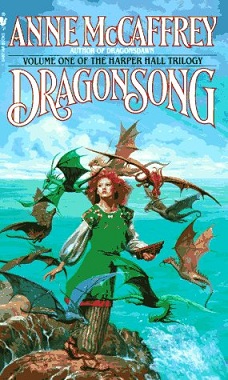
Cover of Dragonsong


Dragonsong
Anne McCaffrey
192 pages
published in 1976

Dragonsong is the first novel in the Harper Hall trilogy of novels that Ann McCaffrey wrote in 1976-1978 as a continuation of the original Pern novels, Dragonflight and Dragonquest, weaving in and out of the main series. The heroine of the series, Menolly, would also show up in the later Dragonriders books, e.g in The White Dragon as a supporting character, occassionally hinting at her adventures in her own series. I hadn’t actually read this particular subseries before, as I never came across them until recently. All I knew was that the Harper Hall books had been consciously written for a young adult audience, unlike the original Pern books.

And reading Dragonsong that impression turned out to be right. This is as close to the platonic ideal of a certain kind of adolescent power fantasy as I’ve ever read. It’s even better than Harry Potter in this regard. You have the young heroine, on the verge of becoming an adult, with a special talent that’s not only unappreciated by her family, but actively suppressed and forbidden from practising it. She of course runs away from home, only to find people who do appreciate her and to find out she’s capable of more than not just her family, but she herself thought she was capable of. That’s the daydream of almost every misunderstood teenager at one point or another.

Read more…

I see what you did there

From an otherwise slightly rambling Adam Roberts Guardian article about the two souls of science fiction:

o say that SF has more imaginative and discursive wiggle-room than “realist” art is, while true, also to say that SF has the potential to be a more heterogeneous and inclusive conceptual space. This is something that’s understood by the genre’s greatest writers: Ursula K Le Guin, Octavia Butler, James Tiptree Jr, Margaret Atwood, Karen Joy Fowler, Pat Cadigan, Justina Robson.

Not actually that bad a list of writers to get your teeth in, to be honest…

She said I’d need a blaster and I’d need a freezer gun


Nicked from James. A folk song written in 1952 by Ewan MacColl and Peggy Seeger, parodying Golden Age science fiction, kept alive in filk, then reworked as a straight forward folk song by what’s basically a folk supergroup.

I hadn’t heard it before, even though James had linked to it two years ago, but it’s a great song, sung by Eliza Carthy with just the right kind of wistful melancholy undertone to it.

If you want to know where all the clips are from, the creator put a list on their Livejournal.

Iain M. Banks

Fuck. Fuck. Fuck. Fuck. Iain (M.) Banks has cancer and is not expected to live out the year:

“I have cancer. It started in my gall bladder, has infected both lobes of my liver and probably also my pancreas and some lymph nodes, plus one tumour is massed around a group of major blood vessels in the same volume, effectively ruling out any chance of surgery to remove the tumours either in the short or long term.”

He continued: “The bottom line, now, I’m afraid, is that as a late stage gall bladder cancer patient, I’m expected to live for ‘several months’ and it’s extremely unlikely I’ll live beyond a year. So it looks like my latest novel, The Quarry, will be my last.

“As a result, I’ve withdrawn from all planned public engagements and I’ve asked my partner Adele if she will do me the honour of becoming my widow (sorry – but we find ghoulish humour helps). By the time this goes out we’ll be married and on a short honeymoon. We intend to spend however much quality time I have left seeing friends and relations and visiting places that have meant a lot to us. Meanwhile my heroic publishers are doing all they can to bring the publication date of my new novel forward by as much as four months, to give me a better chance of being around when it hits the shelves.”

Damn, this is not good news to hear from one of your favourite novelists. I never met him, but his books had a huge impact on me, discovering them at a time when there were only three Culture books and before anybody I knew had ever heard of him. He has had a huge impact on the shape of UK science fiction in the nineties and noughties and without him, it’s hard to see how writers like Ken MacLeod, Richard Morgan, Neal Asher, Charlie Stross, Liz Williams or Justina Robson would’ve developed.

And of course he also wrote more general fiction, under his Iain Banks pseudonym. That too, is as good as anything I’ve ever read, The Bridge, Complicity and The Crow Road especially.

Good luck to him and his family.

Anne McCaffrey again

Tom Spurgeon links to my review of Dragonquest and expands on it:

I think he’s right, but I actually think he undersells those core trilogies, which I think are pretty great for smart kids and teens. There are a bunch of reasons, including but not limited to: McCaffrey’s prose is ideally suited for younger readers, straight-forward and no-fuss; the plots are reasonably complex without being over-challenging in terms of adult themes, the Harper Hall trilogy is where I first discovered the boarding-school fantasy that the Harry Potter books utilize to even greater effect, and the good-guy/bad-guy elements are interesting in that the biggest threat is environmental rather than all-encompassing, directed evil. I was also fascinated by the fact that the two trilogies kind of wove in and out of each other, and by the concept of a civilization that declined rather than progressed. I’m very grateful to have read those books in my tweens.

All points I’d agree with, save perhaps for the declining civilisation; that’s the case in the first book, but by the second it’s clear there’s a renaissance of sorts going on.

Now I have to confess I’d actually never read the Harper Hall books, but by sheer coincidence I picked them up yesterday, meeting my father at Amsterdam’s Waterlooplein flea market. I just finished the first book, Dragonsong today; at less than 200 pages it’s not a long read. But my goodness, this was even more of a wish fulfilment story than the first Harry Potter book is. A girl on the edge of becoming an adult is denied her talent in making music, put down by her family and Hold, runs away and discovers that not only she’s able to impress more fire lizards than everybody else who ever tried, but has her musical gift recognised by the masterharper itself.