Silence or rape threats

Catherynne M. Valente explains why what Christopher Priest did could not have been done by a woman:

I couldn’t, of course, even if I wanted to. But neither could almost any other woman writer or blogger I can think of. Go after popular SF writers and a respected award? She’d have gotten death threats, rape threats, comments telling her everything from shut up and make [unnamed internet male] a sandwich to wishing she’d be raped to death because that would shut her right up.

[…]

That’s the line I walk, and most female authors and commentators walk. On one side of it is a silence which we can’t afford and on the other are the blowback and threats, which come quietly and secretly through email or boldly and baldly in comments.

This is a reality you don’t have to face as a bloke; one of the greatest advantages/privileges of being a straight, white male is that if people dislike me or disagree with me, it’s purely because of what I say or do, not what I present as. Which means that voices like mine or Priest’s are both overrepresented and overvalued, both because we are listened to more and because other voices are dismissed; even worse is that some voices aren’t just ignored but actively chased away. With rape threats even!

Apart from anything else, this impovers the dialogue we’re all having with each other about science fiction, if you can only be taken serious if you’re a straight white bloke and if you’re not, you get sexist or racist slurs (or both) aimed at you. It’s not good for fandom and it’s obviously incredibly bad for those who are subjected to it.

For those of us who don’t run this risk, there’s the obligation to do something about it, to speak out against such attacks whenever we see them, obviously not participate in them ourselves and most importantly, not blame the victims for something they supposedly done to “provoke” these attacks.
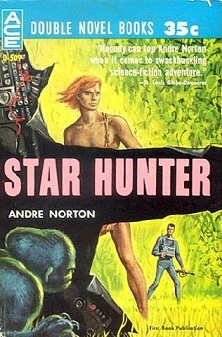
Star Hunter — Andre Norton

Cover of Star Hunter


Star Hunter
Andre Norton
96 pages
published in 1961

For a lot of American science fiction fans my age or older, Andre Norton was the first “real” sf writer they ever read, largely because she was hugely prolific and specialised in what we’d now call young adult novels. For some reason however she was never all that popular in the Netherlands so I’ve read little of her work so far. But that’s changing, thanks to Project Gutenberg, who have a fair few of her books available, those on which the original US copyrights had not been renewed. Star Hunter is one of them, originally published as an Ace Double. I read it during a couple of lunch breaks at work.

Ras Hume is a pilot for the Out-Hunters Guild who on a trip to the newly discovered planet of Jumala has made a discovery that could make him incredibly rich, but to exploit it he needs to make a deal with Wass, the biggest crime boss on Nahuatl. What he found was the lifeboat from the Largo Drift, a space ship which disappeared six years ago, taking with it the heir to the Kogan estate. He also has a plausible candidate to play the part of Rynch Brodie, the teenage heir. What he needs Wazz for is to condition this boy to actually believe he is this heir, then he will be let lose on Jumala for Hume to discover him when he brings over the safari party he’s scheduled to pilot there. It’s an almost foolproof plan, surely nothing can go wrong.

Or can it?

Balancing gender in reviews

For the second year in a row Niall Harrison has looked at the gender balance in science fiction/fantasy reviewing, looking at both which books were reviewed and who reviewed them, for a range of sf and fantasy outlets. A month ago, Renay at Ladybusiness did the same for individual bloggers, which in turn inspired Martin Lewis to take a look at his own output, which prompted me to do the same.

As you know, last year I made an effort to read more female sf writers, both by picking a reading list at the start of the year as by in general paying more attention to female writers. As you may also know, I try and review everything I read, though I don’t always succeed; I’ve read some hundred books last year and wrote only fiftytwo reviews, not all of books finished that year. But of those fiftytwo reviews, it turns out twentyseven, or roughly fifty percent were by female authors. Slightly more than a third of those (twelve) were the books I’d put on my reading list; the rest are not just fantasy and science fiction, but also include a fair few history books.

Why is this important? Because obviously, if you agree that a rough gender balance in science fiction and fantasy is a good thing, just reading more female writers is not enough, you also need to talk more about them too. One of the perennial problems with female writers after all has been that their contributions to the genre have often been overlooked, ignored or minimised. Getting more people to review them is a first step to put this right.

Below is the complete list of reviews:

As for 2012, so far I’ve continued striking the right balance: of the twentyone reviews to date, eleven were of female writers.

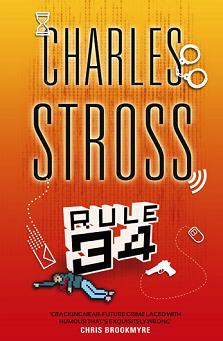
Rule 34 — Charlie Stross

Cover of Rule 34


Rule 34
Charlie Stross
358 pages
published in 2011

It’s only thanks to Christopher Priest’s tirade about this year’s Clarke Award shortlist that you remember that you haven’t reviewed Charlie Stross latest novel, Rule 34 yet. You know that, like Halting State, which it is a sequel to, it’s written in the second person and you briefly toy with the idea to write your review the same way. But then you come to your senses and decide to write the rest of the review in a less irritating way.

Not that I minded the second person point of view in Rule 34, as Charlie Stross made it work and it fit the central metaphor of these books, reality as a massive multiplayer immersive game. At the same time I can see where Christopher Priest is coming from when he writes:

Stross writes like an internet puppy: energetically, egotistically, sometimes amusingly, sometimes affectingly, but always irritatingly, and goes on being energetic and egotistical and amusing for far too long. You wait nervously for the unattractive exhaustion which will lead to a piss-soaked carpet.

Read more…

Let’s leave out the cod psychology shall we?

Let’s talk about Damien G. Walter’s poorly thought out attempt to understand Christopher Priest for a moment. I mentioned it in passing in my last post, but it’s wrong enough for me to want to point this out at greater length. Walter’s core argument is as follows:

Christopher Priest has spent his entire career being close enough to the top table to smell the gravy, but has never quite been invited to sit down. His writing is extremely clever, but even in the ‘literature of ideas’ that is SF, “extremely clever” is really a way of saying rather unemotional, dry, and hard to love. It has all the qualities of someone who has spent decades studying, learning, dedicating every fraction of a considerable intellect to learning the rules and structures of fiction, but never quite managed to get his own soul on the page. Which, in the end, is the only thing we really demand of a novelist.

Walter also characterises Christopher Priest as having spent “most of his professional career not being J G Ballard”, as in driven by jealousy of his contemporaries and envy at their supposedly greater success, sublimated into this magnificent rant against the current generation of sf writers.

In other words, “he’s just jealous”, the most single predictable thing you can say about any critic ever. It’s something you learn on the playground and should stay there. We’re grownups now and we should be able to argue against criticism without subjecting our critics to amateur psychoanalysis.

The other idea, that Christopher Priest never quite made it as a science fiction writer is ridiculous as well. Walter’s portrayal of Priest as somebody who “has spent decades studying, learning, dedicating every fraction of a considerable intellect to learning the rules and structures of fiction, but never quite managed to get his own soul on the page” is a great invention, but not true of the real Priest. Let’s leave out the strange notion that what we all want from a writer is them “getting their own soul on the page” which is a) a meaningless cliche and b) no, not what we want at all; that’s the sort of thing somebody forced to study literature in middle school would think writing was all about, not at all what real writers universally do. Some writers may feast on their own neurosises and personality, others don’t.

If you look at Christopher Priest’s career, he has always existed at the literary end of the sf spectrum and has largely followed his own path. His early 1970ties works were inspired by the New Wave but not of it, he slowly meandered from science fiction into magic realism in the eighties and nineties, returning to more mainstream sfnal themes in the last decade. He’s never really been driven by commercial considerations or any burning desire to be the top dog in science fiction, as far as I can see.

So I don’t see where Walter gets the idea from that this is what drove Priest to write his rant, when he has form for sticking his oar in. Remember the Last Deadloss Visions? Why not just take him at his word rather than invent needless psychobabble theories as to why he was driven to write this?