Priest!

Whether you’re annoyed or amused by Christopher Priest’s broadside against the Clarke Award shortlist depends on how you rate the writers he attacked. For me, it was a mixed bag. On the one hand I loved his description of Sheri “genocide is too a proper tool for solving ecological problem” Tepper’s The Waters Rising:

how can one describe it? For fuck’s sake, it is a quest saga and it has a talking horse. There are puns on the word ‘neigh’.

Which is nicely hateful to a deserving target. But how to take his judgement of Charlie Stross:

Stross writes like an internet puppy: energetically, egotistically, sometimes amusingly, sometimes affectingly, but always irritatingly, and goes on being energetic and egotistical and amusing for far too long. You wait nervously for the unattractive exhaustion which will lead to a piss-soaked carpet.

Charlie decided to take it as a joke and brought out a line of t-shirts to celebrate. Which is probably the best attitude to take as writer. Now you may know that I’m a bit of a Stross fan myself, but I can still see where Priest is coming from. Charlie can be quite enthusiastic about some very geeky things and if you don’t share those interests this might just be a bit wearing at novel length. But this is a question of taste more than of worth. Nobody can like every science fiction novel ever written and unless you want to argue that nobody should write novels like Rule 34, this isn’t a legitimate complaint.

His complaints about “PC Plod characters” and “och-aye dialogue” are more factual, but I find both of them unjustified. If you write a police procedural you’re bound to have coppers while Charlie has lived north of the border long enough to have a good ear for proper Scottish accents; he’s certainly no worse than a true Scotsman like Ian Rankin.

Meanwhile what Charlie Stross has tried to do with Rule 34 and in which for me at least he succeeded for the most part is to write a believable, proper near future science fiction thriller, in a future that we could actually be living in a few years from now. So for example there’s the subplot of exactly what a small time crook is creating with his illegal three-d printer/matter fab: creating highly realistic sex doll facsimiles of five year old girls for pedophiles. That is something you wouldn’t really imagine as an element of your standard near future setting, but you wouldn’t be surprised to be reading about in the newspaper in a decade or so.

So whether or not Rule 34 was the best sf novel published in Britain last year, it is a credible candidate and Priest’s irritation with Charlie’s writing style blinds him to this. Remains to argue why Priest wrote this attack in the first place, which is probably not, as Damien G. Walter wants to argue a belated jealousy of J. G. Ballard. More likely it’s just general irritation with a shortlist that ignores several worthy candidates for far weaker ones, expressed more strongly than other people might’ve done.
The 2012 Clarke Award short list is out

Remember a couple of weeks ago I tried to predict the Clarke Award shortlist? Yeah, It’s not looking good:

The six shortlisted books are:

Greg Bear, Hull Zero Three (Gollancz)
Drew Magary, The End Specialist (Harper Voyager)
China Miéville, Embassytown (Macmillan)
Jane Rogers, The Testament of Jessie Lamb (Sandstone Press)
Charles Stross, Rule 34 (Orbit)
Sheri S.Tepper, The Waters Rising (Gollancz)

That’s two out of six, with only one book out of the shortlist read (Rule 34) and one more on the to be read list (Embassytown). Not a very inspiring list, what with Bear and Tepper on there, both being Big Name American science fiction authors whose best work is decades in the past at this point. Coming after the nomination of a Tim Powers book last year that was a decade old, it seems “respectable but aging American novelists” is the Clarke’s version of Connie Wilis…

Sensawunda

China Miéville on what weird fiction means to him:

I’ve been thinking about this a lot recently. I’m teaching a course in Weird Fiction at the University of Warwick, so this has come up a lot. Obviously it’s kind of impossible to come to anything like a final answer, so I approach this in a Beckettian way – try to define/understand it, fail, try again, fail again, fail better…I think the whole “sense of cosmic awe” thing that we hear a lot about in the Weird tradition is to do with the sense of the numinous, whether in a horrific iteration (or, more occasionally, a kind of joyous one), as being completely embedded in the everyday, rather than an intrusion. To that extent the Weird to me is about the sense that reality is always Weird.

Sounds a lot like that old, much derided sfnal concept of sense of wonder, that moment of conceptual breakthrough you get when you’re shown what the universe is really like. In its most mundane form it’s achieved by plopping a Big Dumb Object in front of the reader (Ringworld frex), at its best it’s a literary thrill that no other genre can offer. Weird fiction is one of those genres that’s even less definable than science fiction, but it does have the same sensawunda, if in a more horrorific sense. The best example is H. P. Lovecraft with his dread and revulsion about the scale of the universe and the insignificance of mankind, the anti-science fiction writer.


Incidently, for a personal sort of horror, the opening sentence fragment, “China Miéville (1972 – )”, has it. Two years older than me and look how much more he has accomplished. Moments like that I appreciate where Michel Vuijlsteke is coming from when he talks about how much he had wanted to leave some sort of legacy behind. Work is alright but just work, at best an interesting and challenging way to make money, but not something people will remember you for or all that important in the scheme of things, while unlike Michel I also don’t see myself ever having kids and leaving my mark on the world in that way. There must be more to life than work and entertainment.

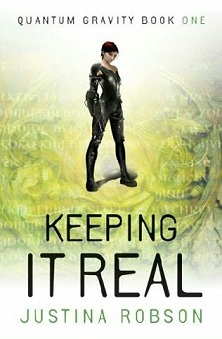
Keeping it Real — Justina Robson

Cover of Keeping it Real


Keeping it Real
Justina Robson
279 pages
published in 2006

Justina Robson is one of those writers I’ve known about for years, but have never read anything by so far. One of the new breed of British science fiction writers who popped up around the turn of the millennium, her first couple of novels found critical acclaim, each being nominated for the Clarke or BSFA Award. Unfortunately popular success seemed to elude her however, until she started the Quantum Gravity series, of which Keeping it Real is the first novel.

It is also the first novel of hers I’ve read. A high concept description of it would be urban fantasy meets cyberpunk, a bit like the old Shadowrun role playing game but much less naff. Personally I’ve always thought cyberpunk was urban fantasy’s science fiction’s mirror counterpart anyway, so the combination seems logical. As Robson explains it in the prologue, an unknown “quantum catastrophe” in the Superconducting Superconductor in Texas in 2015 had torn reality into six realms: Earth, now called Otopia, Zoomenon, the realm of Elementals, Alfheim (elves country), Demonia, home of demons, Faery, home of fairies and finally Thanatopia, supposedly the realm of the dead though no human being has ever visited. The catastrophe was quickly dubbed the “Quantum Bomb” on Otopia, with the big question that keeps human philsophers and scientists awake at night being whether the Bomb really recreated reality or just made it visible to Otopia.

Read more…

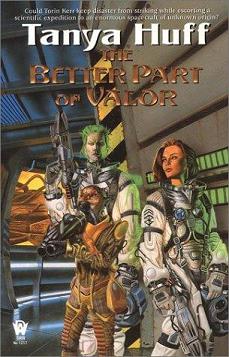
The Better Part of Valor — Tanya Huff

Cover of The Better Part of Valor


The Better Part of Valor
Tanya Huff
411 pages
published in 2002

Once I had finished Valor’s Choice, I knew I was going to have to go back to the bookstore I’d found it in and get the other two Tanya Huff books I’d saw there too. To be honest, I hadn’t even taken me as long as finishing the first two chapters to decide this. I’m always on the lookout for good, intelligent military science fiction and Valor’s Choice was just that, which meant I had to get the sequels too. What I especially liked was the absence of the sort of nasty rightwing politics souring me on so many other mil-sf writers.

The Better Part of Valor starts with staff sergeant Torin Kerr just back from her mission in Valor’s Choice. Having had words with general Morris, who was responsible for said mission, she is immediately sent out on another one by him, without her own platoon even. Whether this is punishment or reward she isn’t sure, but it turns out she will join a new marine platoon put together from scratch to protect a scientific expedition to an “unidentified alien vessel drifting dead in space”. She hopes it will be an uneventful recon mission, but after the last one she was sent on by general Morris, she isn’t hopeful.

Read more…