Anthology bashing is sometimes necessary

The debate about science fiction and fantasy’s inherent gender imbalance (particularly acute in the UK) is rumbling on and one of the latest flashpoints has been the editing of the Solaris Book of New Science Fiction, yet another anthology series heavily skewed towards male contributors. Rose Fox has probably the best summing up of the whole conflagration, the ebb and flow of which is intensely familiar to everybody familiar with Racefail two years ago. The editor of the series is called out, defends himself, more people chose sides, rhetoric gets overblown on both sides and it all gets a bit heated with the original point obscured. Which in turn prompts Cheryl Morgan to go meta and explain why these sorts of contratempts are counterproductive:

Before going into the specific issue at hand, let me say that I think anthology bashing is not terribly helpful. Looking at a single anthology, you have no idea where the real problem lies. It could be the editor, it could be the publisher, it could be the submissions, you can’t tell. Also, just as an individual’s reading and voting habits are more likely to be a product of cultural conditioning than of conscious sexism, so an individual editor is more likely to choose stories based on cultural conditioning than a deliberate intention to exclude a particular group of writers. The objective of pointing out gender imbalances (or any other sort of imbalance) should be to encourage people to examine their cultural conditioning, not to decide who we are going to burn at the stake.

I disagree.

Yes, these confrontations are unpleasant for everybody involved, but if you are worried about the gender imbalance in science fiction and would like to see more women being published, than you do need to rake editors over the coals when they produce female free anthologies. That the whole sf&f publishing field is guilty doesn’t excuse individual failure; blame is a renewable resource. It doesn’t matter why a given anthology has few or no female contributors, only the end result matters. Just like readers like me need to address their biases in chosing who they read, so editors need to work towards getting more female writers published if they care about the gender imbalance of fantasy and science fiction. It’s hard is not an excuse to not do this.

And especially because the majority of editors and publishers isn’t consciously deciding to be sexist and to ignore women, it’s important to call them out on their subconscious but systemic biases. Each controversy like this carries the message that it’s wrong to publish anthologies skewed towards male writers, that you will need to pay attention to which writers you approach and accept submissions from, or you might find yourself in the centre of a shitstorm. Confrontation and “anthology bashing” are necessary tools, if not always the right tools…

All of which also means that, if you’re a reader concerned about the huge gender imbalance in science fiction, you should not buy any anthologies that makes this worse. I therefore won’t buy any anthology that isn’t at least forty-sixty percent women-men. No matter how good it is.
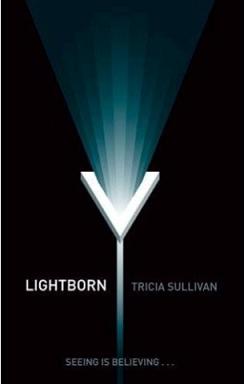
Lightborn — Tricia Sullivan

Lightborn


Lightborn
Tricia Sullivan
438 pages
published in 2010

Late last year Tricia Sullivan decried the fact that of the ten Clarke Award winners in the last decade, only one had been a woman, which in turned triggered a long discussion about women in sf in general much of it indexed at Torque Control. For me personally this discussion triggered a resolve to read more sf and fantasy written by women, as they had been woefully underrepresented until then. It was through the same discussions I learned about Tricia Sullivan herself, who as a writer had been completely unknown to me until then. Not only did she trigger the debate, her novel Maul ended second in the top ten Future Classics poll that Torque Control ran. So I kept an eye out for it at the local library, but they didn’t have it.

What they had instead was Lightborn, her latest novel. It’s a classic coming of age story, set in the city of Los Sombres in a somewhat alternate America, where instead of computers they have Feynmans and people use a special sort of light, Shine to program their own brains, as well as communicate with their version of the ‘net, the field, which is also inhabitated by the lightborn of the title, artificial intelligences, both benign and rogue. There are safeguards build/created in the field to keep the lightborn tame and Shine under control, but of course these fail at the start of the novel –otherwise there’d be no story after all. It leaves almost all the adults in Los Sombres permanently Shined and useless and kids like Roksana and Xavier, our heroes, scrabbling to survive in the aftermath.

Read more…

Jennifer Pournelle’s The Mote in God’s Eye sequel actually looks interesting

Sequels written to well loved science fiction classics by the children of the original writer never turn out right therefore you can safely ignore them. It’s a rule that saved me a lot of frustration, but I think I might break it for Jennifer Pournelle’s Outies, a sequel to her father’s and Larry Niven’s The Mote in God’s Eye. If the novel is as interesting and intelligent as this article makes it out to be, this could be a very good book:

What do you want the reader to get out of your novel?

JP: That monolithic viewpoints tend to drown out available options. That “first contact” is not a singular event. That urban sustainability depends upon ecological sustainability. That local people are not necessarily incompetent. That religion is as much about organizing principles as about belief systems. That the “hard science” in science fiction isn’t (or should not be) limited to physics and rocketry – to genuinely do “hard science,” you need to get your biology, geology, archaeology, anthropology, etc. right too.

Pournelle herself is an archaeologist and here she’s hitting a lot of my buttons — science fiction with a genuine grasp of the complexity of human history is rare and even in modern sf a lot of planets still feel no bigger than a small island…

A novel to look out for. Thanks James.

Her facts are all wrong, but does she get the spirit of the thing!

While Sarah Newton gets everything, but everything wrong about hard science fiction to rage against a problem with it that does not exist, she inadvertedly gets the spirit of it spot on in her introduction:

ow, a hundred or so years ago, it was widely regarded that all the known laws of physics had been discovered, and that theoretical physics was a “completed” science, with nothing more to do other than cross a few t’s and dot a few i’s. It was also believed that if you travelled more than 15 miles per hour in an automobile you’d probably suffocate…

Can you see what’s wrong with that? That’s right, “a hundred or so years ago” gets you to 1911, after the Wright Brothers, when the automobile was well on its way to become more than just a rich man’s toy and when steam locomotives had been travelling at speeds greater than fifteen miles an hour with no reports of suffocation for donkeys ages. Worse, 1911 was smack dab in the middle of the Einsteinian revolution, six years after Einstein’s Annus Mirabilis in which he introduced the special theory of relativity, his observations about the photoelectric effect that helped get quantum mechanics started, not to mention that whole E=MC squared thingie.

In this small paragraph Sarah gets her facts wrong, doesn’t think through when “a hundred years ago” was and ignores actual history and science for comforting myths about Progress — sounds remarkable like most hard science fiction to me.

(It doesn’t get much better in the rest of the post. Thanks James.)

They came from the seventies

From James Nicoll: which of these female sf/f authors who debuted in the 1970ties do you know? Italicize the authors you’ve heard of before reading this list of authors, bold the ones you’ve read at least one work by, underline the ones of whose work you own at least one example of.

  • Lynn Abbey
  • Eleanor Arnason
  • Octavia Butler
  • Moyra Caldecott
  • Jaygee Carr
  • Joy Chant
  • Suzy McKee Charnas
  • C. J. Cherryh
  • Jo Clayton
  • Candas Jane Dorsey
  • Diane Duane
  • Phyllis Eisenstein
  • Cynthia Felice
  • Sheila Finch
  • Sally Gearhart
  • Mary Gentle
  • Dian Girard
  • Eileen Gunn
  • Monica Hughes
  • Diana Wynne Jones
  • Gwyneth Jones
  • Leigh Kennedy
  • Lee Killough
  • Nancy Kress
  • Katherine Kurtz
  • Tanith Lee
  • Megan Lindholm (AKA Robin Hobb)
  • Elizabeth A. Lynn
  • Phillipa Maddern
  • Ardath Mayhar
  • Vonda McIntyre
  • Patricia A. McKillip
  • Janet Morris
  • Pat Murphy
  • Sam Nicholson (AKA Shirley Nikolaisen)
  • Rachel Pollack
  • Marta Randall
  • Anne Rice
  • Jessica Amanda Salmonson
  • Pamela Sargent
  • Sydney J. Van Scyoc
  • Susan Shwartz
  • Nancy Springer
  • Lisa Tuttle
  • Joan Vinge
  • Élisabeth Vonarburg
  • Cherry Wilder
  • Connie Willis

Lots of names I recognise but either never read or only read a few stories off in various anthologies.