Short SF Marathon Week 2

The second week of my short sf marathon has just concluded:

  • Day 8: Jeffrey Ford, Karen Joy Fowler, Max Gladstone
  • Day 9: Kathleen Ann Goonan, Theodora Goss, Nicola Griffith
  • Day 10: Shane Halbach, Maria Dahvana Headley, Kat Howard
  • Day 11: Pasi Ilmari Jääskeläinen, N. K. Jemisin, Xia Jia
  • Day 12: Xia Jia, Rachael K. Jones, Stephen Graham Jones
  • Day 13: Vylar Kaftan, Caitlín R. Kiernan, Ellen Klages
  • Day 14: Jay Lake, Rich Larson, Yoon Ha Lee

All her Children Fought


Proof you can tell a science fiction story with only three actors and one, not entirely convincing special effect. Based on the story by Tobias Buckell, who has the story of how it came to be up on his blog. It’s an excellent example of how much you can convey with just a bit of subtle incluing, by working within genre expectations. I can’t be the only one to watch this and be reminded of Ender’s Game, can I?

Some comments: I wonder if the choice of accents for the three actors was deliberate or just a coincidence, but it works in contrasting the boy and his minder with the main character. I’m not sure the premisse of the movie is valid, the reason why it’s young boys/children being sent up there rather than adults, but it makes emotional sense.

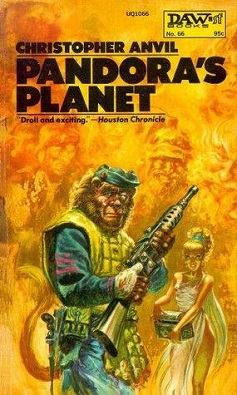
Pandora’s Planet — Christopher Anvil

Cover of Pandora's Planet


Pandora’s Planet
Christopher Anvil
192 pages
published in 1972 (original in 1956)

Libertarianism has a well deserved bad reputation in science fiction, largely because so many writers who profess to be adherents also are godawful people who write jack off fantasies about how freedom requires there jackbooted thugs putting their boot in somebody else’s face, whether it’s Heinlein’s repeated wish to kill off all the lawyers or Kratman resurrecting the Waffen SS to deal with an alien invasion. But once upon a time there was a gentler, more humane sort of libertarianism, one that still catered to the prejudices of Analog notorious editor John Campbell Jr, but that hadn’t quite lost its humanity. H. Beam Piper was its best known representative, but there were others, like Christopher Anvil.

Anvil is one of those writers I only ever had heard about, but had never read simply because I’d never seen any of his work for sale, new or secondhand. He was never translated in Dutch as far as I know, one of those minor Analog writers who’d been reasonably popular in the sixties and seventies but was passed by when the genre moved on. From what I gather he specialised in stories in which clever humans put one over militaristic aliens and Pandora’s Planet is in that mold, gently cocking a snoot at authority in general in the process. It’s gentle and not very humourous satire, but much better than the modern libertarian habit of genociding every alien race that looks at Earth funny.

Read more…
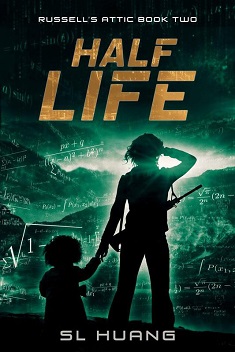
Half Life — SL Huang

Cover of THalf Life


Half Life
SL Huang
150 pages
published in 2014

SL Huang’s first novel, Zero Sum Game was a tightly plotted, fast paced technothriller, which I only got to know about because I’d been following her blog. The sequel to it I got to read because SL Huang offered a review copy, which is always appreciated. It’s actually the first time that any author has done this, so it’s a bit of new terrain for me as a reviewer. What about ethics in science fiction reviewing? No matter; I would’ve bought this anyway and getting a free book is nice, but had I not liked Half Life I would’ve said so too.

Now when we met Zero Sum Game Cas Russell was an amoral math savant making her living doing …retrieval… work for anybody who could pay. Thanks to the events of that novel she went from being bad at ordinary relationships and not worrying about it to being still bad at them but working on them. In Half Life she goes further; it can be best summed up as “Cas learns the value of friendship through the medium of extreme violence”. It all starts when she gets a somewhat particular retrieval mission, to rescue the daughter of Noah Warren, an ex-engineer laid off from Arkacite Technologies, who claims that they hold her for experiments. Cas is weirdly possessive about kids and even though she immediately notices during the rescue mission that Liliana isn’t a real girl, but an extremely advanced robot, that doesn’t stop Cas from wanting to protect her.

Read more…

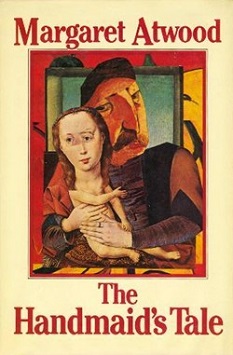
The Handmaid’s Tale — Margaret Atwood

Cover of The Handmaid's Tale


The Handmaid’s Tale
Margaret Atwood
308 pages
published in 1985

About a decade ago, when promoting her book Oryx and Crake, Margaret Atwood said some dumb things while distancing it and herself from science fiction, insising it was “speculative fiction” (ironically a term invented by that most hardcore of sf writers, Robert Heinlein when he tried to make sf respectable half a century before Atwood) and being dismissive about “talking squid in space”. Science fiction fandom has a long history for (imagined) sleights and while Atwood has long since walked back her remarks, sf fans tend to still be a bit grumpy about it. Yet Atwood does have a point that she isn’t writing for science fiction readers and therefore her books shouldn’t be judged by science fiction standards.

Which is fair enough. If you read the Handmaid’s Tale it soon becomes clear that though it is science fiction, it’s science fiction in the dystopian tradition of Orwell and Huxley rather than in the tradition of e.g. Heinlein’s If This Goes On…, another story of religious oppression in a future America. That has flying cars and blaster guns and other sfnal paraphernalia though no space squid, while Atwood’s story is set in what are still recognisable eighties suburbs.

Read more…