Monument — Lloyd Biggle

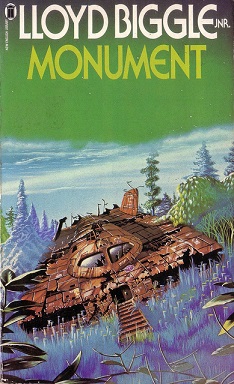
Cover of Monument


Monument
Lloyd Biggle
173 pages
published in 1974

It’s been a while since I’d read any of Lloyd Biggle’s novels; the last one had been The World Menders back in 2007. I’ve always liked his writing, quietly liberal and anti-colonialist in a way that few other science fiction authors of his generation were. His belief in the idea that “democracy imposed from without is the severest form of tyranny” seemed especially apt during the darkest days of War Against Terror triumphalism. He is however, not a writer much read these days, having done the bulk of his writing in the sixties and seventies. He died relatively recently, in 2002, after a long illnes, having written only some six novels since the seventies.

Science fiction is often an imperialist, colonialist genre, in which it’s taken as natural or even desirable for there to be a galactic imperium to which newly discovered worlds should be gently or firmly — depending on the author’s preference — be persuaded to join. Sometimes this is dressed up as the need to avoid interstellar wars and even in stories with a Galactic Federation rather than an empire the need for newly discovered worlds to be assimilated is rarely questioned. Not so with Lloyd Biggle; several of his books question this mentality and Monument is one of them. Taken its lead from what was happening in e.g. Polynesia at the time, it’s an sfnal attack on ill considered economic development imposed from the outside.

Read more…

WALL-E: thriumph of the nice guy


So seeing WALL·E over Christmas again got me thinking. That love story between WALL·E and EVE, that’s pretty much the nice guy fallacy in a nutshell, isn’t it? WALL·E falls in love with EVE and pesters her while she’s doing her job, not taking no for an answer. He keeps hanging around and bringing her gifts she doesn’t need, isn’t honest about his feelings for her but seems to think that if only he brings the perfect gift she’ll like him. That by accident he does bring her just the thing she needs doesn’t alter anything. After this he stalks her to her home, interferes with her work again, makes her an accomplish in his jail break from the mental hospital for robots, keeps her in trouble with lawful authority and finally guilts her in loving him when she sees how he took care of her when she was incapitated. All that’s missing is the negging.

Yes, this may be tongue in cheek

Playing Civ V the Culture way

One of the things that stayed with me the most from Iain M. Bank’s The Player of Games more than twenty years ago was the following:

Another revelation struck Gurgeh with a force almost as great; one reading—perhaps the best—of the way he’d always played was that he played as the Culture. He’d habitually set up something like the society itself when he constructed his positions and deployed his pieces; a net, a grid of forces and relationships, without any obvious hierarchy or entrenched leadership, and initially quite profoundly peaceful.

In all the games he’d played, the fight had always come to Gurgeh, initially. He’d thought of the period before as preparing for battle, but now he saw that if he’d been alone on the board he’d have done roughly the same, spreading slowly across the territories, consolidating gradually, calmly, economically… of course it had never happened; he always was attacked, and once the battle was joined he developed that conflict as assiduously and totally as before he’d tried to develop the patterns and potential of unthreatened pieces and undisputed territory.

The Player of Games is of course all about playing a particularly complicated game, insanely complicated even, which functions as the central controlling metaphor for a rather nasty interstellar empire the Culture wants to Do Something About. It made sense for the resolution to be about playing the game the Culture way, but ever since I’ve been looking at Grand Strategy and 4X games and how to play those the Culture way, starting with Master of Orion way back when.

Now last week I started getting into Sid Meier’s Civilisation V. Yes, I know, I’m so ahead of the times. After playing a first few games, I started thinking how I would play this game as the Culture. Obviously, it means going for the science victory rather than just attacking and conquering every other player, but how else should I play?

As we know from the Culture novels, the Culture isn’t military aggressive, but can respond quickly and with overwhelming force when provoked. This means building up an empire in Civ V that’s scientifically advanced, with enough resources (gold, otherwise) to quickly build an army when necessary. The other aspect of the Culture is that it is an exploring and flexible civilisation, continueously establishing new outposts and welcoming new peoples, as well as letting others leave. In Civ V terms this means therefore lots of scouting out the world, quickly establishing new colonies and forging ties with other civilisations and city states, including the occasional annexation of a city state.

As for simulating contact, there are the scouts and the diplomatic functions, trading directly with other civs, giving gifts and pledging protection to city states, with the spies acting in the background as Civ’s version of Special Circumstances. On the whole a Culture civilisation should focus on discovering new territories and settling them, improving the empire’s economy and keeping an eye on the more aggressive fellow civs. When need be a bit of dirty trickery should provide the excuse to start a war against an aggressor civ, after which the military forces should be hidden or dismantled again.

It may not be as much fun to play the Culture as it would be to go full Gandhi on the world and let rain the atom bombs, but it is an interesting challenge…
John Carter – Borelord of Mars


Had the movie been more like the the trailer it would’ve been more successful. But having just watched it on the BBC tonight I understand why it was such a box office failure. Boy did this drag, mainly out of the misguided desire to put a framing story around it. It also doesn’t help that John Carter himself is a huge dick during most of the film and an incompentent dick at that. Or that the story itself, that of the reluctant hero unwillingly learns to fight for a greater cause than his own greed, is so predictable.

All of that is fixable though. Cut out everything in the first fifteen-twentyfive minutes until Carter is chased by Apaches into the cave with the portal to Mars/Barsoom, tighten up some of the running to and fro once he’s on Barsoom and with the Tharg, cut at least some of the “Carter gets angry, gets in a fight and gets his arse kicked” scenes, then end the movie with him calling himself John Carter of Mars. That should cut out at least half an hour of tedium and puts the focus back on the fighting and the great setting. Edgar Rice Burroughs’ Barsoom is a great place for a spectacle film, but not if you load it up with tedious extras.

I’m not sure why Disney felt it necessary to make the film the way it did, why it didn’t just film A Princess of Mars, but it’s such a shame because it could’ve been a great sci-fi romp. When it does gets going it’s a great movie to watch. The CGIed Tharg look great, the Martian technology looks cool and the low gravity jumping looks fun. A missed opportunity.

The Dark Colony — Richard Penn

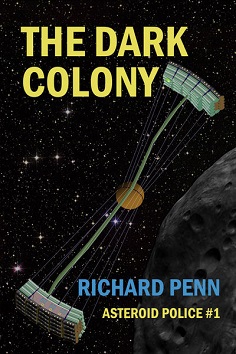
Cover of The Dark Colony


The Dark Colony
Richard Penn
327 pages
published in 2014

James Nicoll is a longtime science fan active on Usenet and Livejournal, who has been working as an internal reviewer for various publishers. As that work started to dry up earlier this year, he started doing sponsored reviews, where people (but not authors) can buy reviews of books they’re interested in, suspect James would like, or at least would have an enjoyable reaction to. I’ve known James for a long time and he’s one of the people I absolutely trust their taste in books of, so I pay attention when he says something he’s worth reading. Which is exactly what he did with Richard Penn’s The Dark Colony and since it was cheap on *m*z*n, I bought it.

Now there was a risk with this. At times James’ fondness for exactly the kind of setting The Dark Colony provides — near future, the real Solar System, no magical rocket propulsion to let people pootle around it in hours or even days, no cheating — can blind him to some of the other qualities (or lack thereof) of a book. Fortunately however, in this case, the book’s appeal exists beyond its setting. Basically, this is a police procedural: it starts with the discovery of a body floating around in the the giant free fall hangar of Terpsichore Station. What’s remarkable is that it’s the body of a stranger to the Terpsichore colony, which only has a few hundred people living in the station and the asteroid itself. It’s up to constable Lisa Johansen to find out where the stranger comes from and in the process she finds herself unravelling a huge conspiracy in the heart of her community and beyond. Yes, this is not just a police procedural, it’s a gloomy Scandinavian one…

Read more…