“Chief Engineer Grandma?” Meade said sweetly, ducking her head into the room. “Would you please tell Buster to stay out of my garden? He may think he’s clever, but he’s killing my broccoli. I’d tell him myself, but he obviously doesn’t listen to me.”
Hazel looked across the chessboard at Lowell. “Best do as she says, Junior,” she commented.
“But she’s wrong about the salinity gradients-” he protested.
“Grandmother dearest,” Meade said, her hands on her hips. “Why does everyone aboard this ship assume I am incapable of doing math?”
“Beats me,” Hazel said. “I tutored you myself; you can handle a differential with the best of ‘em.”
Really. The voices, the way the characters speak, that mixture of banter and infodumping, it’s all prime Heinlein and Kalirush has done a great job capturing it. I wish they’d do more Heinlein stories.
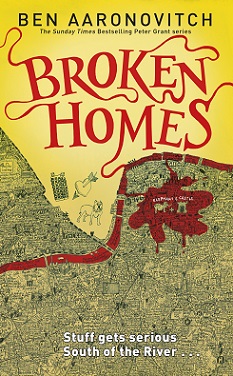
Broken Homes
Ben Aaronovitch
357 pages
published in 2013
Peter Grant was a normal copper until he noticed he could talk to dead people in Rivers of London/Midnight Riot. Now he’s part of the Folly, the Metropolitian Police’s special unit for magic, which apart from him consists of one elderly but backwards aging survivor of the glory days of British wizardry before the war, as well as his colleague Lesley May, Toby the dog and Molly, the folly’s housekeeper of indefinitive species, currently experimenting with cooking from one of Jamie Oliver’s recipe books, to mixed results.
Broken Homes is the fourth novel in the Rivers of London series. There has been a mini boom in London based fantasy these past few years and Aaronovitch isn’t the only one either who has his protagonist working for the Met. There’s a sort of inevitability about the idea. London with its long history and dominant presence in the psyche of not just Britain, but arguably the world, just fits as a nexus of magic in a way that say Amsterdam wouldn’t. Of course the Met would have its own magical police force, some hangover from Victorian times, staffed with aging public schoolboys, into which the thoroughly modern London figure of police constable Peter Grant fits awkwardly. That tension between the gentlemanly tradition of magic and modern policing is part of the charm of the series.
Unlike Elsie, Jackie, or Peewee, poor Podkayne is cut off at the knees before her adventure begins. Podkayne can dream of commanding a space ship but she can never see that dream realized because her narrative purpose is to serve as a doleful lesson to readers. This is where misplaced female ambition can lead! Well, if not Podkayne’s misplaced ambition, then her mother’s. Where the classic Heinlein juveniles are about boys reaching for the stars, Podkayne of Mars is a hectoring lecture, telling women to stay in their place.
To be fair, it’s not just Podkayne of Mars James has problems with, as shown by the list of the other reviews, below. It’s abundantly clear that many of the problematic opinions Heinlein had in his later books towards the proper role of women, sex, incest and consent were not a product of his medical troubles nor a new development, but present already in his juveniles. For somebody lauded for being so forward looking, he sure is wedded to gender models already becoming obsolete at time of writing. With rare exceptions, women are there to be mothers or wives and while his heroes may often be overshadowed by their female companions, they still need to be satisfied with these roles once the story is over.
Rocket Ship Galileo (1947):
“Depraved indifference” and “the uncle who used his relatives as living meat shields” are going to be book-ends for this series of reviews.
Space Cadet (1948):
It’s entirely possible that Matt is part of a terrible machine and too naïve to realize but at least, unlike my memory of Starship Troopers, the Patrol has ambitions of being lawful good.
Red Planet (1949):
By this point in his career, Heinlein was still sticking with the “girls are ick and moms are a drag” model; there’s a genially patronizing treatment of the female inability to handle math in a discussion of the air plants that made me idly wonder what that character’s throat would sound like if his wife stuck a knife in it in mid-sneer.
Farmer in the Sky (1950):
It’s pretty clear to me that George’s Plan A was to ditch Bill on Earth so George could secretly marry Molly and emigrate to Ganymede; given the difficulty of communicating with Earth, it’s possible Bill might not have found out about George’s new family for years, if ever.
Between Planets (1951):
I’ve never particularly noticed it before but there are parallels between the plot of this and the plot of Lord of Rings; Don is stuck with a ring of great importance and what he needs to do to save the day is get rid of it under the right circumstances.
The Rolling Stones (1952):
Heinlein paid lip service to the idea that women could be professionals but all that had to stop as soon as he married one of them, even if it meant poverty for the Heinlein family.
Starman Jones (1953):
This book stands out as possibly the first young adult novel I ever encountered that featured pretty transparent references to johns being rolled by prostitutes.
The Star Beast: (1954)
Of all the Heinlein Girls in Charge, The Star Beast’s Betty Sorenson is the girl most in charge and in Mr. Kiku we find an extremely uncommon figure for SF, a sympathetic career bureaucrat.
Tunnel in the Sky (1955):
Since the majority of Americans didn’t come to see mixed race marriages as acceptable until the mid-1990s, forty years after this book was written, that minor bit of business was pretty daring on Heinlein’s part.
Time for the Stars (1956):
Given that telepathy completely breaks relativity, I don’t know that it makes any sense to discuss whether the way he telepathic communication is affected by relativistic star-flight is realistic.
Citizen of the Galaxy (1957):
Purchased on an apparent whim by the beggar Baslim the Cripple, Thorby is rescued from a life of exploitation and abuse for one as the acolyte and adopted son of a man who is far more than he appears.
Have Spacesuit, Will Travel (1958):
For me, the highlight of the book is young Peewee Reisfeld, twelve years old — almost — and willing to take on an alien invasion single-handed if she has to. Peewee might be the finest example of Heinlein’s girls in charge. Peewee is smarter than Kip, she is just as brave, she manages to escape (temporarily) from the wormfaces before she ever meets Kip, something she keeps up through the book, and she saves Kip on a number of occasions.
Starship Troopers (1959):
The book opens as Juan Rico nerves himself to murder alien civilians, “Skinnies”, as he calls them. Heavily armed and armoured, Rico and his human confederates rampage through the Skinny city, destroying infrastructure and leaving a trail of bodies behind him (including what may be a substantial fraction of the congregation of a church).
Does this mean these books aren’t worth reading? Not entirely; certainly the best of the bunch like Citizen of the Galaxy have charms that make their flaws easier to overlook, but the overwhelming sexism does sour a lot of the fun in these.
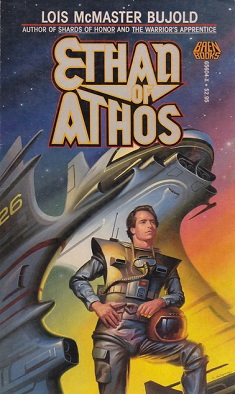
Ethan of Athos
Lois McMaster Bujold
237 pages
published in 1986
Ethan of Athos is the third published book in Bujold’s Vorkosigan series and the third published in 1986. Whereas Shards of Honor told the story of how Miles Vorkosigan’s parents met and The Warrior’s Apprentice showed his first adventure, this is a spinoff not featuring any of the main characters in the series. In fact, at first it barely seems to take place in the same universe.
It all starts on the all male planet of Athos (named after the all-male Greek monastry on mount Athos, natch) where Ethan’s greatest worry is how to take his relationship a stage further and get his boyfriend to be more responsible. His dayjob is as a obstetrician. On a planet full of men natural child birth is of course impossible so uterine replicators using female gene cultures taken along by the original colonists are used instead. Recently these cultures have started to deteriorate however, showing their age and new cultures have been ordered from Jackson’s Whole. Unfortunately, once they show up, these turn out to be unusable thrash. Despite their desire to remain cut off from the rest of the Galaxy, the people of Athos have no choice but to send somebody out into the darkness, somebody pure who can handle the temptations of women, somebody like, well, Ethan.
So I’ve not been too impressed with the latest Doctor Who series. None of the episodes have been great and a great many have been actively bad with shoddy characterisation and nonsensical plots. Throughout the series there have been the usual hints at thr big mystery waiting in the season final, with the irritating Missy popping up at the end of various episodes to vex recently killed extras. I wasn’t that confident that it would all add in the end and the trailer, which already gave away that the Cybermen would be involved, didn’t help. Giving away the big reveal like that took away much of the tension in the episode.
Now my pet theory had been that Missy somehow was the spirit of the TARDIS, revealed to a) exist and b) be female a few series ago, but this fortunately turned out to be wrong. Instead she’s a gender changed master, not even another Time Lord like the Rani, for a revival of that camp flirting between the Doctor and the Master that we saw in his previous appearance as well. There really are no new ideas in NuWho.
And then there was the plot catalyst that set the whole story in motion, as Clara’s boyfriend Danny Pink gets killed off screen in a car accident, she turns eevil and threatens the Doctor with losing the TARDIS if he doesn’t find a way to bring him back. Danny meanwhile finds himself in the Afterlife being interviewed by Chris Addison in which a Mysterious and Awful Secret from his Soldiering Past is revealed. So that’s a fridging, a Danger Room scenario and a troubled past in one sequence, which is impressive with its cliche denseness.
Things did get better as details of this afterlife and its implications became known, reminding me somewhat of Iain M. Bank’s Surface Detail, but this seems to get lost once Missy starts chewing the scenery, the Cybermen are revealed and all this afterlife business turns out to be a way to get recruits for their army: the dead outnumber the living.
It does feel as if two different stories have been smashed together, to the detriment of both. Why go through this whole charade if the whole intention is just to reprogram dead people as Cybermen? Why go for a tedious Cybermen invasion (again) if you have the whole idea of an artificial afterlife to play with?
As for the revelation that Missy is the Master, this both seems about the least interesting thing to be done with her and a deliberate snub of those who had been wanting a female Doctor for this series. I can’t even find it halfway progressive, as some seem to find it.
So yeah, of course I’ll be watching the second part to see if there’s any improvement, but I’m not hopeful.