It’s Charlie’s world, we just live in it

Back when he was writing Halting State Charlie Stross already complained that reality was overtaking his imagined futures and with the sequel, Rule 34 this process only accelerated.

Today The Pirate Bay announced it was going into fab distribution, setting the first steps to making another of Charlie’s predictions come true:

We believe that the next step in copying will be made from digital form into physical form. It will be physical objects. Or as we decided to call them: Physibles. Data objects that are able (and feasible) to become physical. We believe that things like three dimensional printers, scanners and such are just the first step. We believe that in the nearby future you will print your spare sparts for your vehicles. You will download your sneakers within 20 years.

The benefit to society is huge. No more shipping huge amount of products around the world. No more shipping the broken products back. No more child labour. We’ll be able to print food for hungry people. We’ll be able to share not only a recipe, but the full meal. We’ll be able to actually copy that floppy, if we needed one.

Incidently, one of the things Charlie predicted widespread use of 3-d printers/matter fabbers would be used for is the distribution of particularly nasty, highly illegal sex dolls. Hope this doesn’t come true too…

Looking back on a Year of Reading Women

Last year I set myself the task to read at least twelve science fiction or fantasy books by women, making a list of what I was going to read, based on what I had already on my bookshelves. Having written my review of The King’s Peace yesterday, I’ve reached my goal. I’m not going to do the same this year, but I will keep a check on how many science fiction or fantasy books by women I’m reading. At the start I was a bit apprehensive about how difficult this would be, but in the end it turned out to be relatively easy to keep to my goal, with only an occasional hiccup.

The list:

January: The Left Hand of Darkness — Ursula LeGuin

This is not a feminist science fiction novel. It’s a novel about gender and gender expectations and the role our assumptions of having two separate sexes each with their own character, strength and weakness play in our societies, but it’s not feminist, unless every book about gender is by definition feminist.

February: Bold as Love — Gwyneth Jones

At first glance Bold as Love looked like a late and out of date example of New Wave nihilism, but thinking about it when reading it I realised that instead it mirrors the anxieties of late nineties Britain, when the optimism of early New Labour had long since vanished, the country resigned to being rundown and slightly shit, but still with a bit of the glamour of Cool Britannia left, that idea that rock bands could influence politics by rubbing shoulders with the politicians.

March: The Female Man — Joanna Russ

The Female Man is a tough book, but not a hard book to read. Joanna Russ is a brilliant writer and everything in here sparkles; at times you can only sit there open mouthed with awe. It’s a tough book because of the raw anger Russ has put in it.

April: China Mountain Zhang — Maureen McHugh

China Mountain Zhang is not just a good first novel, it’s a good novel period. What strikes me most looking back on it is the sheer ambition of Maureen McHugh to write such a kitchen sink, slice of life story in a genre not know for its patience with that sort of thing.

May: Foreigner — C. J. Cherryh

Yet, once you’ve read a few of her novels, you discover that there is one narrative trick all her stories have in common, no matter what the setting or the plot is. What she likes to do is to take her protagonists out of their comfort zone, get them at their most vulnerable and then put the pressure on.

June: The Halfling and Other Stories — Leigh Brackett

As a genre planetary romance has always been a bit dodgy, an evolutionary offshoot of the Africa adventure story, with a lot of the same racist and colonial assumptions build in. So you have cringing Gandymedian natives, mysterious jungles and alien drums, crazed halfbreeds and all those other tropes recycled from Tarzan.

July: A Point of Honor — Dorothy J. Heydt

A Point of Honor is an enjoyable, light adventure science fiction story that sadly did not get the readership it deserved,

August: Golden Witchbreed — Mary Gentle

It was the beautiful Rowena cover that got my attention, a long long time ago when I was browsing the English shelves at my hometown’s library. Showing a blonde woman in jeans and fur cape, armed with a stave and linking fingers with an obviously alien six fingered man, two swords at his side. That intriqued me, it promised both adventure and romance and it got me to pick up the book and that was how I got to know Mary Gentle.

September: 10,000 Light Years from Home — James Tiptree, Jr

10,000 Light Years from Home starts on a high note, with a classic Tiptree story that embodies everything that you should associate with Tiptree. It takes something that lies at the heart of science fiction as a genre, a worldview and turns it on its head, not to mention reveals the sexual undercurrent running through it.

October: Trouble and Her Friends — Melissa Scott

What Trouble and Her Friends does that few other cyberpunk novels do is to look at the internal politics of that hacking underground itself. And by doing so Melissa Scott is the only cyberpunk author that actually understood and anticipated the dynamics of online groups, of how even in groups that define themselves as outsiders there can be people who are outside the group as well, because for one reason or another they are different from the dominating members of a given group. Not a new dynamic of course, as any veteran of a socialist or anarchist splinter group can confirm. Even in progressive groups race, gender and sexuality play a role, but most cyberpunk authors assumed that in the bodiless worlds of cyberspace these things would no longer matter. Melissa Scott was clever enough to know that this is naive at best.

November: No Present Like Time — Steph Swainston

What also helps to set the Fourlands apart is that while like in other series the technology and society is vaguely European and Medievaloid, it also has cigarettes, newspapers, t-shirts and professional football matches: it’s clearly not our Middle Ages. Swainston never tries to explain these incongruities; it’s just the way the Fourlands are and it works. In some ways her world building reminds me of China Miéville’s, only less gorey and incessantly baroque, though she comes close in the scenes set in the Shift, another element never fully explained or even understood by Jant, part hallucination but very real in its own terms.

December: The King’s Peace — Jo Walton

As anybody who has actually been reading my booklog over the past few years knows, I’ve been reading a lot about the fall of the Roman Empire and the transformation of Late antiquity into the Early Middle Ages and about whether the Roman world really fell or was just transformed and how that would’ve looked like to the people living through it. The King’s Peace may be set in a disguised, fantasy version of this part of history, but I think it got it as well as anybody could’ve gotten it. The world changes, but change does not have to be bad and although what was lost could not be recaptured, what was built in its stead is good in its own right. A very complex, bittersweet and mature attitude for a fantasy novel to take.
Suspension of disbelief

John Scalzi is being a bit silly about suspension of disbelief:

“When my daughter was much younger, my wife was reading to her from a picture book about a snowman who came to life and befriended a young boy, and on each page they would do a particular activity: build a snow fort, slide down a hill, enjoy a bowl of soup and so on. The last three pages had the snowman walking, then running, and then flying. At which point my wife got an unhappy look on her face and said ‘A flying snowman? That’s just ridiculous!’

[…]

“So, yeah: In a film with impossibly large spiders, talking trees, rings freighted with corrupting evil, Uruks birthed from mud (not to mention legions of ghost warriors and battle elephants larger than tanks), are we really going to complain about insufficiently dense lava? Because if you’re going to demand that be accurate in a physical sense, I want to know why you’re giving the rest of that stuff a pass. If you’re going to complain that the snowman flies, you should also be able to explain why it’s okay to have it eat hot soup.”

No, no, you don’t.

Suspension of disbelief is a private thing and like all matters of taste cannot be discussed. If you don’t believe in flying snowmen nothing will get you to take them seriously. And while that’s a deliberately silly example, we do this all the time, whether or not it’s drawing the line at vampires that sparkle in the sunshine or at having the Force explained as being caused by socalled midichlorians. Especially when these sort of developments go against the earlier established “rules” of an universe or don’t fit the traditional tone of a (sub)genre, they can be hard to swallow. This also explains why some adaptations of e.g. Sherlock Holmes work and some don’t. The recent modern BBC updating of Holmes worked because it kept the cores of Holmes and Watson intact, but for some people it just won’t work without the Victorian fogs.

But that’s not really what Scalzi was talking about, because his original ire was awoken by a discussion about the realism of the lava at the end of the last Lord of the Rings movie. This is entirely different from not believing in flying snowmen, as this is about something that actually exists in the real world and you therefore can get wrong. Just like there was no reason for sound in space in Star Wars, there was no real reason for the lava to behave wrongly in the LotR movie, save for dramatic reasons. It’s therefore sort of acceptable in this example, but usually this sort of thing is either an error or just pure sloppiness on the part of the writer.

It’s the writer’s job to make their worlds as believable as possible — unless it’s not of course — and these sort of mistakes drop people right out. Even in a fantasy world you need to keep everyday reality straight. One commenter at James Nicolls’ place, quoting C. K. Chesterton, put it best:

“It really is more natural to believe a preternatural story, that deals with things we don’t understand, than a natural story that contradicts things we do understand. Tell me that the great Mr. Gladstone, in his last hours, was haunted by the ghost of Parnell, and I will be agnostic about it. But tell me that Mr. Gladstone, when first presented to Queen Victoria, wore his hat in her drawingroom and slapped her on the back and offered her a cigar, and I am not agnostic at all. That is not impossible, it’s only incredible. But I’m much more certain it didn’t happen than that Parnell’s ghost didn’t appear; because it violates the laws of the world I do understand.”

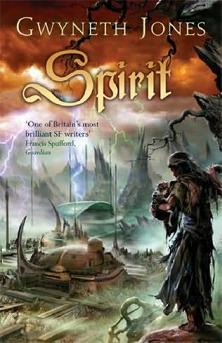
Spirit — Gwyneth Jones

Cover of Spirit


Spirit or The Princess of Bois Dormant
Gwyneth Jones
472 pages
published in 2008

So about halfway through Spirit, or The Princess of Bois Dormant, when the heroine is rotting away in prison on an alien world, forgotten by everybody, it looked like the novel was going to be a science fiction adaption of The Count of Monte Cristo. It wouldn’t have been the first; The Stars My Destination just being the most famous example of such an adaptation. But while the imprisonment of Bibi, Spirit‘s protagonist does consciously echo Dumas’ famous novel, including having an older mentor imprisoned with her who leaves her a fortune, it changes its mind almost instantly and doesn’t become a revenge story after all.

Which is for the best, as Bibi is no Edmond Dantès. Whereas the latter was unknowingly framed for a political crime for those he thought his friends, only discovering the truth years into his imprisonment, Bibi was just collatoral damage, not for the first time either. She had started live as Gwibiwr, the probable daughter of a (Welsh?) chieftan of the White Rock clans who’d long lived in rebellion against the one world government, a rebellion now crushed. Bibi herself is taken into the entourage of Lady Nef and becomes a minor servant, young enough to have lost most of her memories of before. She was therefore a victim of politics long before she was left ot rot in an alien prison for being part of a conspiracy against an emperor who hadn’t yet taken the throne when she had last been on Earth. And unlike Dantès, the people on which she could’ve had her revenge were mostly innocent bystanders as well.

Read more…

Cyberpunk: erasing the seventies

A couple of days ago James Nicoll linked to Jeanne Gomoll’s open letter to Joanna Russ which I hadn’t seen before. Written around the time William Gibson’s seminal cyberpunk collection Burning Chrome was published, it talked about how Bruce Sterling’s editorial in it rewrote seventies science fiction history, turning the seventies from a decade that explored the boundaries of science fiction and opened up the genre to writers with a greater range of backgroundsrs into something that was just a bit dull. Something which Gommoll argued was systemic for how science fiction fandom was remembering the seventies a decade later, erasing the very real accomplishments women science fiction writers had made:

It was not one or two or a mere scattering of women, after all, who participated in women’s renaissance in science fiction. It was a great BUNCH of women: too many to discourage or ignore individually, too good to pretend to be flukes. In fact, their work was so pervasive, so obvious, so influential, and they won so many of the major awards, that their work demands to be considered centrally as one looks back on the late ’70s and early ’80s. They broadened the scope of Sf exploration from mere technology to include personal and social themes as well. Their work and their (our) concerns are of central importance to any remembered history or critique. Ah ha, I thought, how could they suppress THAT?!

This is how:

In the preface to Burning Chrome, Bruce Sterling rhapsodizes about the quality and promise of the new wave of SF writers, the so-called “cyberpunks” of the late 1980s, and then compares their work to that of the preceding decade:

“The sad truth of the matter is that SF has not been much fun of late. All forms of pop culture go through the doldrums: they catch cold when society sneezes. If SF in the late Seventies was confused, self-involved, and stale, it was scarcely a cause for wonder.”

With a touch of the keys on his word processor, Sterling dumps a decade of SF writing out of cultural memory: the whole decade was boring, symptomatic of a sick culture, not worth writing about. Now, at last, he says, we’re on to the right stuff again.

So help me, I bought into this back then. When I started reading science fiction sometime in the early/mid eighties, I was almost completely dependent on the local library, which had a fairly good collection of classic forties and fifties science fiction, a lot of seventies sf, but not much published after that. Once I’d read my way through the children’s section and could finally get into the adult section, the science fiction that I had to my disposal was all seventies New Wave doom and gloom, or so it seemed to a twelve to fourteen year reading somewhat above his comprehension level. Especially since I could get into the English books earlier than the Dutch adult section, as the latter had an age check and the former …didn’t. It seemed to me that a lot of “adult” science fiction was just dull and depressing, not to mention a bit old fashioned and dated.

So when the cyberpunk revolution finally hit my provincial library, it hit me pretty hard. Here suddenly was evidence that science fiction, adult science fiction could be modern, could be relevant and didn’t have to be dull or depressing. I lapped up Bruce Sterling’s editorial in Mirrorshades telling me how smart and clever I was for liking cyberpunk, how all other science fiction was just awful and uncool.

I was just a dumb teenager then and I sort of learned better later, but I do think Jeanne Gomoll had a point. There was a backlash against what had been achieved in the seventies, even though most science fiction written since has build on these achievements. We’re still noticing the consequences today, as the whole kerfuffle over reading female sf writers last year and this year shows.