Via James I heard this morning that Anne McCaffrey had died on Monday; it’s not been a good month. I haven’t read a book of her in at least a decade or longer, but once upon a time she was very important to me, as she was to a lot of (proto) geeks. She managed to get blokes interested into horsey stories long before bronies were invented, which is a huge achievement in itself, but what also impressed me was how many queer folk said they got their first hints about their own sexual preferences from her matter of fact references to homosexuality in her Pern stories. Just having that out there as something natural, no big deal at a time when positive examples of homosexuality in science fiction were far and few between makes up for all of her own weird ideas about it.
science fiction
Ask a simple question
James Nicoll wants to know when cyberpunk died, a question that isn’t that easy to answer. Cyberpunk was an eighties movement, but there are still cyberpunk novels being written and cyberpunk inspired movies being made. In one sense then it hasn’t died yet, but in another it’s clear that somewhere when the eighties turned into the nineties cyberpunk was mugged by reality.
As I said in my review of Trouble and Her Friends, that book came out just when the real internet broke into the mass consciousness, which is as good a place as any to mark cyberpunk’s passing, when its visions of what online life would be like were definatively proven wrong. Cyberspace moved from fiction to non-fiction, there was a small boom of silicon snake oil and that was it for the genre.
But that might be too late. Cyberpunk actually might have died early, at the end of the eighties, between 1989 and 1991 as the Soviet Union collapsed, the Gulf War made spectacle out of consensus reality and the political systems cyberpunk thrived on and took for granted collapsed. Let’s not forget that one of the casualties of the end of the Cold War was the Reaganite return to a manned space programme. Remember, the Shuttle and the ISS would’ve only been the beginning as America would go to Mars, while the Soviets were methologically working on extending their space programme as well, with Mir and all that. Cyberpunk always had in its background this idea that manned space exploration was not only important, but the inevitable future.
And then it turned out not to be…
Leaving books like Neuromancer (climax set on a space station big enough to have tourism), Frontera (set partially on Mars) and The Schismatrix (set in a Solar System ruled by O’Neil colonies) instantly outdated.
Trouble and Her Friends — Melissa Scott
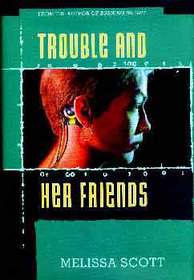
Trouble and Her Friends
Melissa Scott
379 pages
published in 1994
Trouble and Her Friends is the tenth book I’ve read in my Year of Reading Women project and the first and only cyberpunk novel in the bunch. It’s a book I’ve long wanted to read, having heard nothing but praise for it over the years and seeing it compared to e.g. Pat Cadigan’s cyberpunk novels. As I started reading it, there were two minor things that disappointed me: the first was the publication date, 1994, much later than I though, the second was the tendency of the covers to flake, something it has in common with other Tor books of that period. I’d always assumed Trouble and Her Friends had been published in the mid-eighties; certainly the setting is very eighties.
This matters because it means that not only is its future dated now, but it was already obsolete when it was first published. Trouble and Her Friends‘s vision of cyberspace is essentially an eighties one, where it’s important but largely unused by regular people, divided into discrete blocks owned by huge multinationals and hidden behind ICE (Intrusion Countermeasures (Electronic)) to ward off hackers, who seem to be the only people behind corporate drones to use cyberspace. It’s obviously inspired by the BBS scenes of the eighties and indeed the main hacker hangout is called the BBS. Yet 1994 was the year the internet fully broke into the public consciousness, when it should’ve become clear that it’s the openness of the internet and interaction with other people on it that are its greatest strengths, far removed from the lonely adventures of isolated hackers battling in virtual reality with faceless corporate ICE software that most cyberpunk, including Trouble and Her Friends, offers — it’s probably no coincidence that it largely died as a subgenre in the mid nineties. What saves Trouble and Her Friends from complete obsolescence can be summed up in one word: politics.
Omnitopia Dawn — Diane Duane
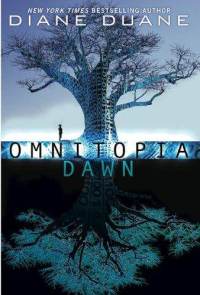
Omnitopia Dawn
Diane Duane
360 pages
published in 2010
Omnitopia Dawn revolves around the upcoming launch of a new extension to the world’s most popular online RPG, Omnitopia, the deadline of which is just days away. Omnitopia is so popular because it’s not just one game, but it’s like something you’d get if you’d roll World and Warcraft, City of Heroes, Second Life and every other current online game into one gigantic universum, held together by the Ring, the one place where you can move from world to world directly. It’s the brainchild of Dev Logan, the CEO and principle inventor of Omnitopia and all around nice guy, who is more interested in creating wonderful new gaming experiences than the bottom line. Which is why he split up with his old buddy Phil Sorensen, who was more interested in making money than in endlessly fiddling with the game and who is now Logan’s most bitter rival and is doing his best to ruin him.
What this reminded me of were Arthur Hailey’s business novels, like Hotel, Airport and Wheels, all of which revolved around an iconic American business in crisis and its heroic executives trying to turn it around, as well as a cast of dozens of other characters going around their daily doings. Omnitopia Dawn has the exact same plot, only this being the twentyfirst century the business in crisis is the world largest and most popular online roleplaying game. It is barely science fiction, only set a couple of years in the future (2018 if I remember correctly), with the world still recognisably our own. A bit of technological improvement, but the most futuristic gadget on display is a bog standard virtual reality system. What instead gives it a sfnal flavour are the parts of the novel set in Omnitopia itself.
Evaluating Gollancz’s science fiction gateway
So Gollancz finally launched their SF Gateway site after having teased us for months. When they first announced it, I was cautiously optimistic about it. As long as it got the pricing and ease of purchase right and avoided relics from the pre-digital age like territorial restrictions, I could see myself spending a lot of money there. I’m a fairly recent convert to the e-book, liking the ease with which I can carry a small library on my phone, but I still rate physical books higher than their digital counterparts. There are only a few authors I buy in hardcover (Banks, MacLeod, Martin, Miéville, Pratchett, Stross and Walton), more I buy in paperback, but most I buy secondhand. E-books have to compete mainly with the last. They’re certainly not worth buying at hardcover prices and even standard mass market paperback prices is pushing it. Especially for backlisted books.
In short, the books available through the SF Gateway have to be as cheap as buying them secondhand would be. Most of which cost me in the region of two to four euros, being lucky enough to live in a city with loads of cheap, well stocked secondhand bookstores. I’m more than willing to pay roughly the same price or a little bit more for those books I can’t find there, but not much more.
Gollancz got one thing right, from the start offering a wide range of authors and books, but they got it wrong on the other aspects. The first is that you can’t buy the books directly from their site, but are directed to a selection of online booksellers like Amazon. Worse, there’s no pricing information there either. So if I want to buy Pat Cadigan’s Fools, I’m redirected to Amazon, where it costs $8.25. I’m also invited to buy it at Kobo (never heard of it), but that site doesn’t know this book at all!
I could just as well do a search on Amazon UK directly and find the books there, which brings me to the second flaw: the pricing. Here they got it almost right: many of these books are available for three pounds, but there are also quite a few more expensive than that, five pounds and up. Three quid is reasonable; five quid not so much. Annoyingly, most of the books I would like to get are on the expensive side.
Finally, as James Nicoll noted, there are territorial restrictions on these books, while the gender ratio of the authors is a bit skewed…
In conclusion: Gollancz’s experiment is a mixed success. It hasn’t really made it easier or cheaper for me to get these books, but I think I will get at least some of these books at some point. Unless I find them secondhand first of course.