A simple question turned into a great video: what would the sky look like if the Moon was swapped for the various planets in our Solar System:
Scale from Brad Goodspeed on Vimeo.
A simple question turned into a great video: what would the sky look like if the Moon was swapped for the various planets in our Solar System:
Scale from Brad Goodspeed on Vimeo.
Strange Horizons has put out their science fiction year in review and the interesting thing is: no mention of Iain M. Banks. Funny, for me Surface Detail was one of the best books I read this year, but no peep of it in SH’s list. Reviews elsewhere have been lacklustre as well, something that I’ve noticed before with the previous “new” Culture novels. It’s as if the original three novels have set expectations so high that everything that Banks has done afterwards is consciously or not compared to the impact the original trilogy had. Hardly fair, but perhaps inescapable.
Now for something completely different. We knew crows were clever, but they are even more clever than we thought. New Caledonian crows have long been known to use twigs to pry insects out of trees, but now experiments have proven that these crows know how to adapt their tools for multifunctional use by poking at a rubber spider with a twig. It sounds like nothing, but these are probably the first non-mammal species shown to have the mental capacity and creativity to not only use tools, but adapt them for other uses and, as the Wired article also notes, use them in sequence: using a twig to get a twig to get food. I’ve had co-workers who showed less promise…
Finally, would you like some cheese with that white whine?
You’d think that in such a densely populated, crowded and completely manicured country like the Netherlands the only new species to be found to be single celled, but you’d be wrong. Because late last month an entirely new mushroom species (Dutch) was found in Schouwen-duiveland, an island in my home province of Zeeland.
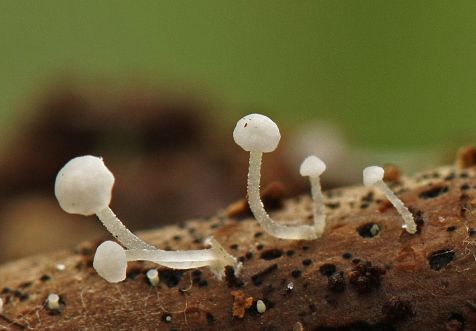
The new species was discovered during a research week organised by the Nederlandse Mycologische Vereniging (Dutch Mycological Society), who regularly organises this sort of trips to less well researched parts of the country. the new species wasn’t the only surprise, as they also found several species new to the Netherlands.
It seems that despite the fact that it’s almost impossible to think of any part of the Netherlands as being nature, rather than nature park, we can still be surprised by new or rare species.
…so I can do a Branko and actually take some pictures when traveling around the city. I bike to work at about seven AM every day (well, only ten minutes or so to the ferry to take me to Central Station) and there’s all sort of wildlife coming out that early, in the various unclaimed pieces wasteland by the water side. One spot in particular, when I have to cross a canal and which used to be used by the building crews for the North-South metro tunnel, is rife with birds as well as rabbits, profiting from a benign neglect. Lots of undergrowth, fairly quiet and nobody as of yet interested in redeveloping this little area. So each morning I’m greeted by sparrows, magpies (whom I always greet: “hello mr magpie, how are you today” as apparantly it brings bad luck otherwise; when they do say something back it’s usually just a “mustn’t grumble”), pidgeons, rabbits as well as parakeets or parrots, the latter descended from escaped/released cage birds.
It would be nice to be able to take pictures of this, especially since S. is still in hospital, having had to go back in in early July, with the prospect hanging in front of her of quite a few more months of having to stay there, with another operation to look forward to. Having some pictures of what she’s missing this year might help a bit in taking her mind off when the internet, radio or television are no longer working…
