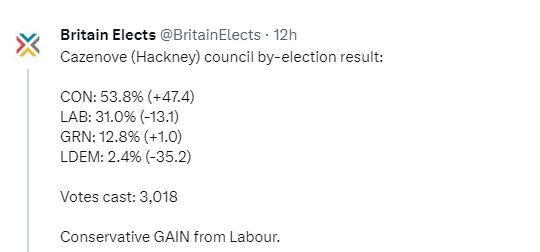
This is an interesting anecdote to open your big article with about how Labour should be a broad church but the left can never be in control again:
Let me be more specific. In the summer of 2019 I was writing a regular monthly article for the online New Statesman. Within hours of publishing my latest piece, where I suggested Corbyn would do less harm as Prime Minister than Boris Johnson, they withdrew it. I was told I could continue writing for them only if I stuck to economics and did not mention to anyone what they had just done. I didn’t accept the latter condition, and have never been invited to write for them again. It meant I briefly felt I was doing the right thing and in reality the potential audience for my writing shrank.
I wasn’t following Simon Wren-Lewis back then, but did he ever mention it at the time that he was censored by a supposedly leftwing magazine for preferring Corbyn over Johnson? Not that I imagine it would’ve mattered much either way, but it seems sort of important that this happened. It certainly seems to have left an impression on him, but I fear Simon learned the wrong lesson from this experience.
As that last quoted sentence indicates where he regrets taking the right moral stance but losing his audience as a consequence, Simon seems to think it’s better to acquiesce than to fight and applies it to the party as a whole. The idea presumably that some compromised flavour of Labour in power is better than one out of power, no matter how ideologically pure. It’s the morality of the beaten dog:
However, while it is essential for the left to be part of the Labour party, it is also crucial that it never controls that party. To many who are not on the political left this may seem obvious. You just need to mention Jeremy Corbyn’s time as leader, after all. But this is partly because the mainstream media treats ideas and many individuals on the left as ‘beyond the political pale’ while simultaneously treating ideas from the far right as worthy of discussion or even mainstream.
My own reasons for believing this part of the proposition are two-fold. First the Labour right will not tolerate the left controlling the party, and would rather sabotage the party than allow the left to control it. As they have demonstrated in more than one recent historical period they can be very effective at that. Second, Labour led from the left will never win power in today’s UK except by accident, because the forces against it are too strong (see also below). In both cases those facts may be regrettable, but they are nevertheless real. Many on the left believe it is better for the Labour party to be pure than to be in power, but I don’t.
In other words, a truly leftist Labour can never win because neither that internal clique of Blairite bangers nor the rightwing forces arranged against it outside the party will allow it and that’s why that very same clique should be in control. Simon doesn’t quite come out and say this, but that’s clearly what his analysis here is driving at. It’s all a bit vague because Simon insists in portraying everything in terms of “left” and “right” without ever defining these groups. It makes engaging him on this incredibly frustrating, as various critics have found out. He keeps retreating to this theoretical construct of the Labour party he created with minimal acknowledgment of the party as it exists right now.
But if the only groups mentioned are “the left” and “the right” and the former should never be in control of the party as his main proposition has it:
The Labour Party only works if it is a broad church that spans left to right, but only if the left does not have control.
The only conclusion you can draw is that Simon wants the right in control of the party because in his view it’s the only way it is allowed to take power.
He’s not wrong in this, as 2017, 2019 and 2024 have shown. The 2017 election was one Labour was widely expected to lose and lose badly, but instead it came in a hair of winning outright and slashed the Tory majority to the point it had to depend on the DUP for control of Parliament. That put the fear of god into the UK establishment and the next five years saw the mobilisation of all forces to prevent a repeat and destroy the left as a force in Labour. 2024 was the culmination of that project, a hardline Blairite party elected with an overwhelming majority. It neatly vindicates Simon’s thesis that the party can only win without the left in control, a shame the outcome is so shit.
And this is why Simon needs the left to remain in Labour, to provide the vision and morality the Blairite headbangers lack.
The first is that Labour’s right needs the left to at the very least critique its own ideas, and more generally to provide ideas and some vision. As Steve Richards writes, the current government is desperately lacking a political vision, and is even failing to point out the failures of the visions of other political parties (e.g. privatisation). The second is that the left can provide a much needed moral compass, as the Labour’s governments complicity in what many believe is genocide in Gaza clearly shows, and what a Labour government treating as terrorists civil disobedience groups who had become annoying (in part because of the habit of juries not to convict them) also shows. The third is that the left represents the views of a sizable proportion of the population, and it is better having that in the tent than outside it.
The Labour right also needs the left to remain in the party because otherwise Farage will be allowed in power:
The Labour right is delusional because the left also has the power to help put Farage/Jenrick in power. They can sabotage Labour, not in the same way as the right did when Corbyn was leader but to the same effect. They can help us get a Trump type government in the UK [3].
You think this is a problem for the Labour right and their responsibility to set right, but no because:
One of the delusions of many on the left is not to recognise the shift in UK politics that has occurred over the last few decades. It is a shift which means that, under a FPTP voting system, the left has no chance of gaining power.
[…]
But what many on the left find difficult to accept is that the struggle now requires them ultimately to make common cause with more centrist social liberals. While every attempt should be made to get a Labour government to pursue more socially liberal and less authoritarian policies, it has also to be recognised that Labour are never going to abandon trying to attract socially conservative voters, because only by attracting those voters can it stop the election of a right wing populist government.
It’s hard not to get the impression that Simon wants the left in Labour to completely and unconditionally submit itself to eternal rightwing rule here. What’s missing is any acknowledgement of the fact that this was already tried, from 2019 and Corbyn’s resignation onwards. There has been little to no resistance to the Blairite takeover of the party, indeed there was an eagerness to cooperate and start over, but Starmer and his clique have responded by intensifying their purges.
The right doesn’t want the ideas and morality Simon correctly sees as necessary, they’re happy with the state of the party and country as it is. Farage is not the threat to them Simon thinks he is either, as they’re perfectly happy enacting the same policies and engaging in the same rhetoric. Nor can you scare the left with him if Starmer himself is doing Enoch Powell cosplay already.
The overwhelming feeling I have about this article is that it might have been relevant in 2018, 2019 at most, when it was still possible to entertain the idea of a Labour Party that could do Corbynism without Corbyn, before it was clear that nope, the Blairites would wreck any party they weren’t in control of. The best time for a broad church Labour was when Corbyn was in charge and attempted to create just that, but the right overwhelmingly rejected it. To think we can go back to trying it in 2025, without the wreckers having been run out the party first is delusional or even downright criminal.