Wandance is good actually

People have been slagging off Wandance for its supposedly bad CG animated dance sequences, but I don’t see it myself. Maybe I’m used to seeing slightly dodgy CG animation being used in idol or magical girls shows, but doesn’t this, part of the dance battle in episode 8, look perfectly fine?

What you need to understand is what Wandance is trying to do here. If you go in expecting idol show like performances, you will be disappointed. This is not a style of dancing we see a lot of in anime, street dancing, hip-hop style, raw, improvised rather than carefully choreographed as in a Love Live or IdolM@ster. The dance scenes are not animated to make them look cool or dramatic, they’re animated to showcase the moves the dancers make, to allow you to understand what they’re doing and how it relates to the music they dance to.

This why it doesn’t matter that the faces look plasticky or the background spectators a bit wonky: you’re not supposed to look at them, you should look at the dance moves, at the way the dancers use their arms or legs instead. Throughout the series each dance scene goes for clarity over impact, to make sure you understand what’s happening. Which is why you can easily understand how both Iori in the clip above and On-chan in the clip below take the same part of the song to dance to yet dance so very differently from each other

The way the animation is created is by motion capturing actual professional dancers, with each of the main cast having their own real life counterpart. It’s honestly impressive how dedicated Wandance is to keeping the dancing as real as possible. For how well it does, check out this reddit thread from a professional dancer. For me, this sort of fidelity easily trumps the occassional goofy CG face. And for a taste of what the real dancers can do when not limiting themselves to high school amateur level, check out them dancing to the opening.

Wandance is one of those series where each episode feels like it’s only five minutes long: no sooner are you invested in this week episode then the ending theme plays already. It fits in well with the trend of somewhat more realistic high school sports and romance series.The protagonist Kabo is a big long dude who has always gone along with whatever his friends did, partially because he stutters. (This must be the only anime that has a Scatman Jones clip in its first episode). Wanda, the girl that inspires him to dance is slightly less well defined than him, but not a manic pixie girl either and the supporting cast, so far mainly Iori and On-chan as featured above is great too.

Franka: Comics Got

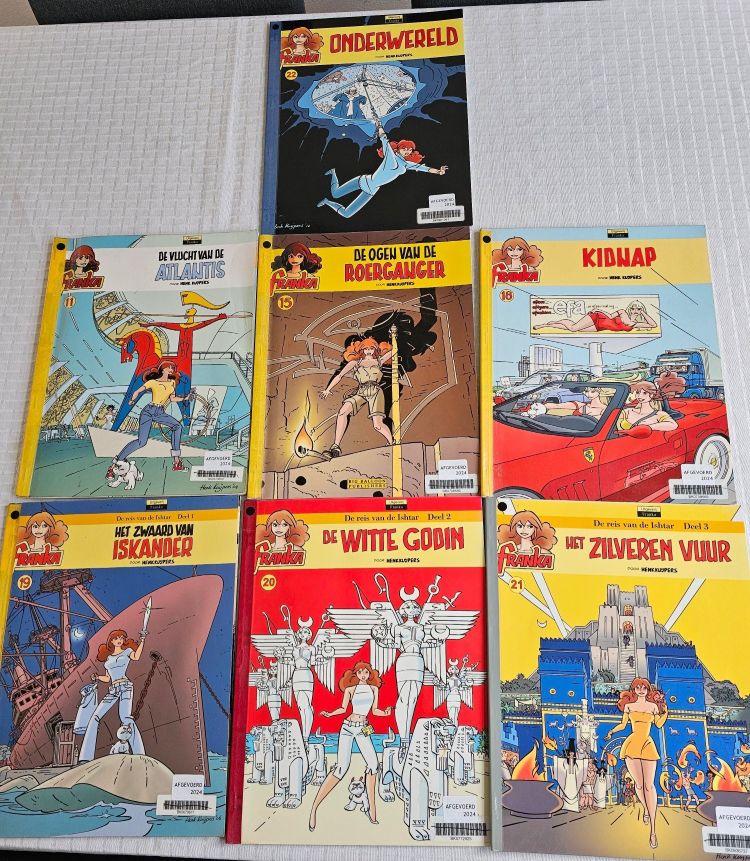
Don’t you love a good library sale? My sister in law got me half a dozen Franka albums by Henk Kuijpers her local library had discarded. There were soem doubles but still I got seven new ones:

Seven Franka albums

Franka is basically what you get if you take Tintin, make her a girl and have her take her top of at least once every story. I used to read these in Eppo, a weekly Dutch comics magazine, back in the eighties. Because unlike American children, Dutch kids can handle the occasional tit or (implied) sex scene in their adventure stories. (Eppo still exists and Kuijpers’ still writes Franka stories for it, but its audience now is mostly fiftysomething year old men wallowing in youth sentiment, but we can still appreciate her undiminished perkiness).

Kuijpers’ art style is very much influenced by Herge and the Clear Line in general, but slightly looser. Like Herge, an absolute manaiac for authenticity and getting it right. Trams, cars, planes, buildings, all these are drawn with every detail correct. The first three pages from De Vlucht van de Atlantis e.g. have Franka move from her far too hot Amsterdam apartment to Centraal Station, to take the train to the beaches of Zandvoort and it’s immediately obvious she lives near Museumplein.

Henk Kuijpers is a bit of a local boy made good: not just popular in Holland for over forty years now, but his comics have also been published in Germany, Denmark and France. He’s turning 79 this December and still writing new Franka stories. Franka herself was born in 1974, just like me, but has aged a lot more gracefully…

How to Introduce a Trans Character — Zach No Koi — Friday Funnies

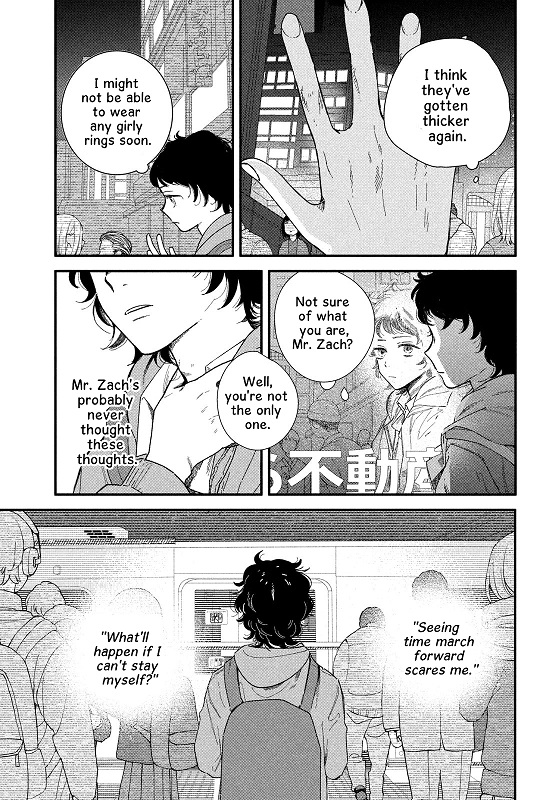
These are all perfectly normal things to think of as a perfectly normal girl, right, no hidden gender stuff here!

A manga page. The first panel shows a close-up of a hand, with a thought bubble reading 'I think they've gotten thicker again'. Second panel shows a short haired girl in profile thinking 'I might not be able to wear any girly rings soon'. Third panel, same girl looking at her reflection in a window, thinking  'Not sure of what you are, Mr. Zach'? Panel overlapping balloon: 'Well, you're not the only one'. Teh girl clutches her throat looking anxious. Text in background: 'Mr. Zach's probably never thought these thoughts. Final page wide panel shows the girl in a grey hoody and backpack from the back, as a train comes into a crowded platform. Free floating text either side of her reads 'Seeing time march forward scares me. What'll happen if I can't stay myself'?

Zach no Koi is a manga by Arashiyama Nori about a vampire who fell in love with a girl one night and who has returned to her — only to find out that was sixty years ago and she’s now a grandmother living with her two granddaughters. The girl in the page above is one of these granddaughters, Yumeko, who actually helped Zach the vampire be reunited with her grandmother Tsumugi. Most of the manga of course is about the rekindling of the relationship between Zach and Tsumugi, but chapter three focuses on Yumeko, who asks Zach to make her a vampire too, because “now us the cutest I’ll ever be”. The chapter actually opens with a flashback to when Yumeko and her sister Himari first came to live with their grandmother, the latter telling them that “while you’re at granny’s place, I want you to be the version of yourself you like the most”.

All of which made sense when I read this page, as Yumeko is slightly depressing leaving her friends behind and wondering if she can stay positive about herself as she will grow out of being able to wear the right clothes and ‘girly rings’. Clearly the author here is heavily hinting that she’s trans, right?

I like how well it’s done. You’re prepped by the flashback, but on its own it’s just about a granny making her grandchildren feel welcome. Yumeko asking to be turned too is a clue, but she also could be just a girl wanting to stay cute forever. Then, in just three pages, it becomes undeniable that Yumeko is trans without the author ever having to spell it out. These are not the thoughts of a cis girl. And to drive it home, the pretend vampire woman Youtuber that inspired Yumeko to become one too, is revealed to actually be a young boy using computer trickery to make himself a woman on screen. If you ever want to introduce a character as trans while keeping it subtle, these three pages are a great example of how to do so.

OVAs We Love: Genmu Senki Leda

Back in August, to celebrate the tenth anniversary of the site, Zimmerit.moe asked a bunch of people about their favourite OVAs:

Direct-to-video anime was a format that really helped set anime apart. The original video animation format allowed unusual ideas to flourish, creators to experiment, and offered up the perfect mix of length and shock value to help jump start the anime licensing industry in the English-speaking world. OVAs (or OAVs, if you’re of a particular age) offered a new way to commercialize anime and make money off an older subset of anime fandom following the implosion of the early ’80s gunpla boom.
[…]
To celebrate the site’s anniversary and to encourage folks to go looking in the video bins of history, I reached out to a range of folks to hear about their favorite OVAs. I asked them to write about an OVA they loved. Not necessarily their favorite or even one that was easy to recommend, but a single OVA that they loved. The following article consists of what was shared with me.

The result is a love letter to the format, full of both obscure and well known examples. with the emphasis on the former rather than the obvious big names. Thinking about what example I would’ve chosen, if I did the same and not go for nostalgia titles (Bubblegum Crisis, Dominion Tank Police, Guyver, there waas only one choice: Genmu Senki Leda:

A 1985 original seventy minutes long story about a school girl upset about how her first love ended, that least with an elegiac mood piece of her mourning her lost love, before she promptly gets abducted into another world. Where it turns out she’s the legendary warrior princess destined to save the world, all while wearing a chainmail bikini and having to fight off barbarian warriors and mecha both.

It’s great fun and cramps a lot into its runtime but mostly I love the animation and mood setting in this. If you like things like Greed or Legend of Lemnear this is worth seeking out.

Your Happening World (Comix Edition)

Brains he got nix. Percy debuted in 1911, comics first robot; a robot so early even the word wouldn’t be invented until a decade later:

Percy is as formulaic as a Punch and Judy show; it has one joke, endlessly repeated, as expected as the squirt of seltzer in the baggy-pants comic’s vaudeville routine.
[…]
Percy begins in fine form and never veers from his programming, no matter that he wreaks his havoc starting in panel six and reduces the world around him to flinders by panel nine. The end. Place Percy in a different situation and repeat, 67 times. Don’t scoff. The formula worked then and it works now.

Thank god for obsessive monomaniacs with blogs. I got curious about Percy because he was mentioned in Jerry Robinson’s 1974’s The Comics and Steve Carper’s Flying Cars and Food Pills blog was there to satisfy that curiosity. All 67 Percy strips can be found at the link above.

Why didn’t they try using Agile Scrum instead? Instruments of Destructions is Alexander Wales’ behind the scenes story of how the second Death Star got ‘built’:

The Executor , first of the Executor- class Super Star Destroyers, had been built in four months. Every ship after that had taken ten months. How did you shrink ten months down into four? You could start by doing all the things that Jerjerrod had done, eliminating words like “testing” and “safety” and “sleep” from your vocabulary. Yet that wouldn’t make up for such a shortfall. The real answer to how the Executor had been constructed in four months was that it hadn’t been. Instead, the men and women who built the Executor had simply changed their definition of done. The ship had left the shipyard on time, under its own power, yet that was virtually all that it was capable of. The rest of the construction had been done as “final touches” to the ship long after its maiden voyage, at a far greater expense than if the ship had simply been completed in the shipyard.

If you know about Noel Sickles, you know that his artwork on Scorchy Smith would inspire a long line of comic strip and comic book artists like Milton Caniff, Alex Toth and Howard Chaykin. For Panels and Prose Steve Smith looks at how quietly transformed the strip when he took it over:

When Terry fell ill, in ’33, Sickles was assigned to stand in and directed to mimic the artist’s anodyne style. But as in all things, Sickles had studied cartooning extensively and had ideas of his own about how to innovate the medium. And so, in one of the most clandestine but radical transformations of a strip style in comics history, Sickles slipped into Scorchy Smith a six month trickle of subtle stylistic changes that were designed to get his way without jarring editors or readers.

Found this because Sickles was of course mentioned in Robinson’s The Comics and I got curious. It’s amazing that such an important artist neither has an in print biography nor has his best work available other than in two 55 euro French hardcovers, but that’s all I found. There was a mnodern biography written in 2008 or so but that’s long out of print and expensive.

An excellent interview with Mike Ploog, courtesy of Comic Book Artist, which reveals Ploog didn’t realise how good he actually was at the time:

I was always amazed when I met someone who had actually read one of my books. I’d spent ten years in the Marine Corps, and I was just making a living. I can remember many times I’d be walking through Marvel, delivering pages, and people’d come up and say, “I saw that last issue; that’s great!?” And my opinion of that person would drop enormously. [laughter] I felt like I really wasn’t an artist; I was just faking my way through this thing. It wasn’t until later years that I realized how good I really did have it, and how wonderfully supportive those people really were.

Another excellent interview, this time with Jerry Robinson, from The Comics Journal:

Somebody tapped me on the shoulder and said, “Who did those drawings?” I thought I was going to be arrested or something. I might have had some nude girl on it. I turned and said, “I did.” He introduced himself as Bob Kane. That’s how I met Bob. He said, “Oh, those are very good drawings. I’m a cartoonist. I just started Batman.” I had never heard of it. “Come down to the village. I’ll get a copy to show you.” The first issue had just come out. We walked down to the village and found a copy. Frankly, I wasn’t very impressed. I was used to Caniff and Foster and that level of drawing. I didn’t know anything about comic books. But, he was published. He said, “What are you going to do?” Well, I was 17 and he was six or seven years older. Still in his early 20s, probably 22 or 24. Well, close enough that we were able to hang out.

Finally, going for that other meaning of ‘comics’, here’s another obsessive with a blog, John Hoare, writing 3000 words on edits to the Yes Minister pilot:

So it was slightly bizarre to watch that BBC Four broadcast, and be greeted not with the version of the pilot I’ve watched on DVD all my life, but a version with the standard title sequence used instead. And it was clearly created while the show was still in production, because it has a proper episode title at the end in the correct style, not a bodged-together version made years down the line