Both the GitHub database and the Medium post outlining the project are no longer available. Lavigne said in an email that “Medium suspended the post because they felt it was doxing.” The Medium page now simply reads “unavailable,” while the GitHub page says “this repository has been disabled.” Twitter accounts that were posting the information were also suspended.
It’s not doxxing if it’s from Linkedin, put up by these people themselves, presumably proud to work for an organisation that rips children from their parents’ arms and puts them in concentration camps. But it makes a good excuse for tech companies that either profiting of nazis or loath to stand up to the Trump regime. It’s a good example of why it’s important to own your own web spaces and not depend on the benevolence of nazi friendly companies. Twitter, Facebook, Google and nerd friendly spaces like Github or Medium in the end will always side with power, you cannot depend on them ever doing the right thing. So it’s good to see people deciding to host this information themselves, keeping the raw information available.
If you work for ICE, you’re complicit in what are clearly crimes against humanity, on a par with what was done in nazi Germany. You don’t deserve to do so and not pay a price for it, as DHS secretary Kirstjen Nielsen found out when she went for dinner at a Mexican (!) restaurant the other day. Resign, quit your job, go do something useful with your life.
When a children’s anime series is more kind and insightful than the whole of socalled “gender critical” Twitter put together:
It all started with episode eight of Hugtto Precure, with the introduction of Wakamiya Henri, an ice skating friend of Kagayaki Homare who likes to wear dresses and who described himself as “both a refined Japanese lady and a Parisian”. Little fuzz was made about this, the real conflict that episode was about Henri wanting to take Homare back to figure skating full time. At the end of the episode he decided he would hang around alittle bit longer and transferred into the Precures’ school, but so far little more had been done with him. Until episode 19.
Episode 19 also sees the return of this asshole, the brother of Aisaki Emiru, the Precure fan who likes to hang around with Lulu. Last time we saw him, in episode 15, he was telling Emiru she couldn’t play the guitar. This time he’s telling her that girls cannot be heroes, as well as getting shook by seeing Henri wear a dress. Basically, he is the voice of conventionality in these two episodes and in both he’s quickly proven to be wrong. Girls can be heroes, boys can be princesses. Now of course Precure doesn’t use words like genderqueer or trans to talk about Henri, but just seeing a cool, handsome boy like Henri comfortable in his dress, unbothered by the censure of people like Emiru’s brother, in fact convincing them they’re wrong, is a great example for the young girls (and boys!) that are Precure’s primary audience. Such a contrast to the carrying ons of Graham Linehan, once best known as the writer behind Father Ted, currently best known as a transphobic asshole:
That’s him talking about trans men getting top surgery, as if there’s a cabal of trans people out there that takes innocent little butch girls and forces them to become men. Reality is of course that getting any help with physically transitioning is difficult enough for an adult and almost non-existent for those under eighteen. Note btw that his original example was of somebody in their mid twenties, hardly a child. How different this hysteria is from the calm acceptance of Precure. And no, people like Linehan may wring their hands about “unnecessary” surgery, but they don’t condone more “innocent” forms of genderplay either. Men or trans women dressing in female coded clothing: must be predators. Women or trans men dressing butch: must be brainwashed. Anything that doesn’t strictly adhere to a binary worldview where there are only men and women is suspect.
Case in point: this innocent tweet by UK Cancer Research, calling on everybody with a cervix to get themselves tested. Oh, that got the transphobes out in force. Starting with Labour (!) MP Anna “dumb dumb” Turley asking why have you used the term ‘everyone with a cervix’ in this tweet please? Because god forbid we pay attention to trans men or genderqueer people who may have a cervix but aren’t women. Better to use women and ignore that not all women, not even all cis women even have a cervix and need this test. Maybe you’ve already had cervical cancer and had to have it removed. But either these people don’t realise this or they don’t care, because keeping UK Cancer Research tweets ideologically pure is much more important.
So yeah, if you’re looking for understanding and acceptance, don’t look to media personalities like Linehan, look to an anime series aimed at young girls.
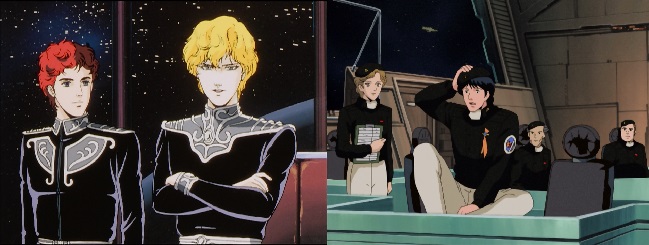
Forget the politics, the wars, all that crap. The most important question you have to ask yourself about Legend of the Galactic Heroes is: am I team Ketchup-Mustard or team for gods sake Yang, sit in a chair like a regular human being?
In a series with only half a dozen or so female roles but with lots and lots of delectable young men in uniform making bedroom eyes at each other, there’s a lot of gay potential. Not that any of it is actualised of course, this being a Serious Space Opera, but that has never stopped shippers. And honestly, it’s so obvious that Kircheis and Reinhard are attracted to each other, that the only real question is whether Kircheis is only in love with Reinhard, or would like to be the jam filling in a Lohengramm sandwich of Reinhard and his sister…
Yang Wenli does get a heterosexual romance later in the series, but it doesn’t have half the sexual tension that any given pair of strapping admirals has with each other.
In modern anime, there are plenty of series aimed at socalled fujoshi, female fans of boys love stories, but I wonder if some of the success and longevity of Legend of the Galactic Heroes can also be due to them…
Even if its opening every time reminds me of certain theme song to a magical mannequin movie, I have to be grateful to Legend Of The Galactic Heroes: Die Neue These, if only because it got me off my butt and watching the original series, which I’m currently twothirds through.
Legend Of The Galactic Heroes has a reputation for being difficult, unforgiven even: its first episode drops you almoat straight into a huge space battle while only understanding the barest outline of who is fighting who. And instead of exciting ship to ship combat, it’s mostly serious senior officers staring at electronic maps with the thousands of ships involved reduced to small blips. Seemingly dozens of characters — all men, all in uniform– are introduced and you need to keep your wits about you to follow what’s happening. It sets the pattern for the rest of the series.
Let’s stop a moment to admire just how big an accomplishment Legend Of The Galactic Heroes is. A story that took ten novels to tell was adapted in 110 episodes, one continuous story taking almost a decade, from late 1988 to 1997 to be completed, released not as a television series, but as original video animations for the home video market, on VHS. When it started the Japanese bubble economy was in full swing, when it was finished, it had survived the crash that followed it. And that for a series that relied on none of the traditional selling points of other anime OVA series. No sex, no fanservice, no glamourised violence, just blips on radar screens being extinguished with the occassional reminder of the brutal deaths that accompany it.
Legend Of The Galactic Heroes is a masterpiece of tell, not show. Much of the action consists of various men holding meetings in which they explain the geopolitical and military situation to each other, followed by more meetings determining strategy and tactics for the latest battle. When there are no meetings, the narrator returns, to explain what’s happening. Several times the entire story is interrupted in favour of our heroes watching video documentaries about the rise of the empire or the fall of Earth. There’s a lot of information to ingest, at times it can get a bit dry. Nevertheless, it’s fascinating. There’s a density there, a complexity that you can only get by not being afraid to tell, rather than show.
In many ways, it’s the anti-Weber. David Weber’s Honor Harrington series of space opera has a similar grandiose sweep of history as LOGH, but its politics are barely sketched out while its battles have the flight path of every missile described in loving detail. Legend Of The Galactic Heroes on the other hand goes in depth on the geopolitics, but couldn’t be bothered much with battle scenes. It’s enough to know that the 20,000 of the Galactic Empire are surprisingly defeated by the 13,000 of the Alliance of Free Planets, thanks to an brilliant tactic insight from Yang Wenli.
Watching Legend Of The Galactic Heroes therefore demands concentration. This isn’t a series you can just watch in the background while checking Twitter. Especially if you have to read the subtitles to follow the conversations. I notice that while I can easily marathon a regular anime series 10-20 episodes a day if I got the time, my concentration lapses after only a few episodes. LOGH is hard work, but it’s worth it.
Of course, Cutie Honey Universe is by no means a perfect show; it is a good series, it is definitely an interesting series, but it has some major offputting flaws. For all the good interactions between Honey and Genet that play with relationships between women, it also uses old women being sexually active as a punchline, puts schoolgirls in their skimpies in bondage and is making jokes about the male gaze even in its opening credits as Junpei and his father orbit Honey, ogling her particulars.
But one comes into a Go Nagai production expecting crude sex jokes and breasts. It is an unavoidable, innately divisive part and parcel of the fiction. You are going to get a show about two powerful, badass women in complicated relationships, but you are also going to get jokes about how good they look and how unattainable they are.
Problem is, Devilman Crybaby showed you could take a Go Nagai series, extract all the interesting things from it, update it for a 21st century audience and leave all the awkward sexual harassment and “comedic” stereotypes back in the seventies. Cutie Honey Universe on the other hand seems to think that what the story needs is for Honey to be sexually harassed out of her depression after she saw her entire school die the previous episode. Their groping routine is not only obnoxious, it actively hinders the story, shutting it down for minutes on end for more “comedy”. It rankles, especially coming on the heels of such a heavy episode.
Cutie Honey Universe tries to put a bit more depth in its story than the original anime had, with the Panther Claw villains a bit more humanises, a bit more sexual attraction between Honey and the main villain, Sister Jill, a bit more introspection in general. But all of that doesn’t work if every five minutes we get these two crashing the scene. Perhaps some people enjoy the contrast between the high drama and the low comedy, but I’m not one of them. There’s so much more the series could’ve done rather than redoing comedy bits already dated when the original anime series came out.