How is Precure so good?

No really? How is Precure this good?
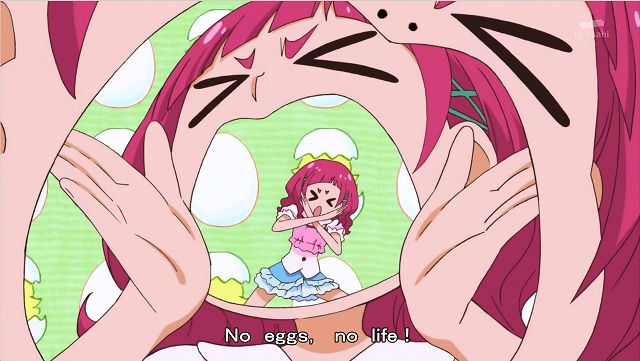
Hugtto Precure: no eggs no life!

To recap: Precure is a long running series of magical girl shows that has put out a new series each year since 2004 following roughly the same formula each time, though each series bar two stands on its own. There’s a team of two or more young teenage girls who’ve gotten Precure powers from a magical talking animal mascot to defend the Earth against some sort of primordal evil, which mainly manifests in fighting the monster of the week while also having to deal with more mundane problems. For more detail, see my review of Fresh Precure, which aired in 2009. Hugtto Precure is the latest installment, started last February and so far has been rather good, episode four being a particular highlight, but I think this week’s episode topped even that one.

Sakugablog has the nitty gritty of just who is responsible for making episode fifteen so great and mentions that this is actually supposed to be a budget saving episode. Which just goes to show talented creators can do a lot even under strict limitations. But what sets this episode apart from regular episodes is not just the good use of limited animation, but the focus on two supporting characters. There’s Lulu, the enemy infiltrant now living with main Precure Nono Hana, who is sent out to buy eggs and runs into Aisaki Emiru, first seen in episode nine, who introduces herself as Cure Emi-ru protecting the world through careful prevention. Emi-ru is great, trying to do all the usual stuff Precures do, in which the show obliges her by using the same musical and animation cues it uses for the real Precures. Intrigued, Lulu follows her (or rather, Emi-ru keeps clinging to her warning her of increasingly unlikely dangers she could encounter as she makes her way to the supermarket to buy eggs) and watches as Emi-ru attempts to help people and fails. Lulu then points out that even if she failed, at least she made the people she helped happy.

Lulu and Emi-ru hit it off immensily and it’s great seeing the fired up Emiru trying to explain things to the stoic Lulu. As the former keeps going into these flights of fancy, the latter keeps shooting her down, but not in a mean way. Rather, she seems genuinely concerned for her when her brother comes in to lecture Emiru on how it’s improper for girls to play the guitar. Lulu defends Emiru by continuing to ask him who died and made him boss as well as why playing the guitar is unseemingly, doing that in the same cold, logical way she has done everything this episode. Only when the brother flees, does Lulu reveal some genuine emotion and upset. Which also leads to the most adorable pout in Precure history.
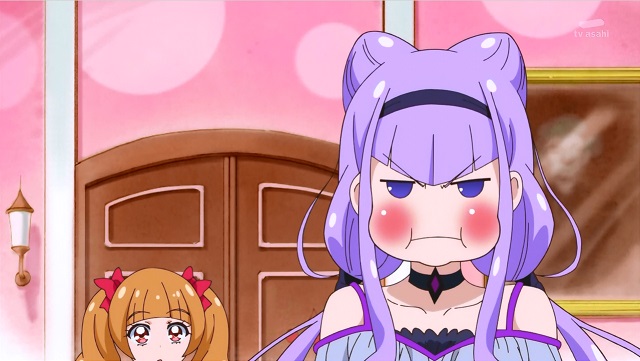
Hugtto Precure: Lulu pouting

The stoic, logical, emotionless girl is a staple in anime ever since Neon Genesis Evangelion. But what struck me here is how much characterisation and character growth the series could put in one episode. There had of course been hints before that Lulu wasn’t as emotionless as she first seemed and she’s a prime candidate for mid-series conversion to the good side, but in this episode we learned she had a sense of humour, was able to make friends and get angry on their behalf and it all happened naturally. That’s what makes this such a good episode even without the brilliant animation to go along with it. Both Lulu and Emiru gained a lot of depth in what was nominally a gag episode and while this episode was incredibly funny, it also adhered to the standard formula of a Precure episode, showing how much the staff could fit in its limitations.

Otoboke Beaver & finding new music

Otoboke Beaver is a punk band from Kyoto named after a love hotel in Osaka that was located near the high school of one of its members. They’re brilliant:


Metafilter recently had a post about the death of the music review’s power to end careers and people wondered how you find new music without looking at sides like Pitchfork et all. For me, finding this particular band started by looking up Shonen Knife on Spotify, then browsing through the related artists, finding another great punk band 54 Nude Honeys, browsing through their related artists list and ending up with Otoboke Beaver. Shonen Knife of course had a brief burst of popularity outside Japan in the early nineties, so I knew them from when Dutch radio used to play them, when it was still possible for cult bands like this to actually be on the radio. Spotify now fills the same function for me.

Reviews, especially those of the Pitchfork variety, have never been that important to me, though there were times when I’d follow the recommendations of a site like warr.org — run by two enthusiasts rather than professional reviewers– religiously. And sometimes it was the random musings of a blogger I followed that got me interested in a particular band — and ultimately in this case, an entire prog rock subgenre. You can only find new music if you’re open to experiment and break out from your regular listening, by either getting recommendations from people you trust, or by just following the trail leading out from a band or artist you already like. What with so much music available effectively for free, there’s no need for the safety net of a review anymore before you sample a new band.

Faces of Deathbook

Dutch newspaper De Volkskrant interviewed an ex-Facebook moderator about how the moderation process worked and it was shocking:

De haat, dat is wat hem meteen raakt. ‘Ik schrok daarvan.’ De intense haat, tegen asielzoekers, Marokkaanse Nederlanders, zwarte mensen. Erik: ‘En alles in Nederland is kanker. Kankerjongen, kankerneger, kankerhoer.’ In Vlaanderen krijgen de ‘makakken’ de schuld, in Nederland de ‘Marokkanen’. Elk gebied heeft zo zijn eigen ‘overlast’: gewelddadige foto’s en video’s van bendes in Latijns-Amerika, porno en geweld tegen vrouwen in het Midden-Oosten. De Portugese en Griekse moderatoren hebben het relatief rustig. Zij kunnen nog weleens Netflix aanzetten. Nederlanders niet: Nederland is het land van de haat, zegt Erik.

First, it turns out the Netherlands is about the most racist, hateful European country on Facebook, with the most complaints per day, lots of it racially motivated. Most of this occurs below the radar, but we saw the tip of the iceberg last year, when Dutch politician and media personality Sylvana Simons who had become the target of racial hatred on Facebook, reported this to the public prosecutor and examples of this hatred were given in the resulting lawsuits. To hear that this is indeed a common occurrence for Dutch people of colour on Facebook is disappointing, but not unsurprising. There is a huge amount of resentment hiding behind the white Dutch liberal pretence.

But second, there’s also the way Facebook treats its moderators, who turn out to have no support whatsoever except from a dodgy “feelgoodmanager”. Barely trained people working for little more than minimum wage are supposed to review material that goes beyond “just” racist comments, but includes snuff videos, child porn and other traumatic material even experts are supposed to only see in moderation, not eight hours a day, five days a week. No wonder so many moderators either quit or self medicate with alcohol or drugs.

But of course moderation is only a cost to Facebook and their real interest is to get as many people as possible posting and who cares what they’re posting. As long as ad revenue keeps coming, Facebook don’t give a fuck.

Hisone to Maso-tan — First Impressions

A young woman joins the Japanse airforce wanting to become an F-15 pilot, but instead is lured to an old hangar to be swallowed and regurgitated by a dragon. Repeatedly.

Hisone to Maso-tan: eaten by a dragon

So far this season I’ve been mildly disappointed, as there hasn’t been any series coming out that’s as good as Yorimoi or Yuru Camp were last season. Hisone to Maso-tan comes very close though. For a start, the artwork is so different from what I’m used to seeing in anime, much more “western””? for lack of a better word. There’s a fluidity to the animation too which matches with it perfectly, just a cut above the norm. If it reminds me of anything, it’s last year’s Little Witch Academy, in that it looks like something designed to appeal to a worldwide audience, not just a Japanese or already anime fan one. And the dragon is adorable, very cat like in its behaviour.

Hisone to Maso-tan: Hisone

But perhaps the biggest draw in this first episode was the protagonist, Third Class Amakasu Hisone. She looks like your typical shy anime girl at first, passively going along with the weird situation she finds herself in, until this scene, when she unloads all of her frustration and anger at her superior. Hisone then flees the hangar and ends up in the bike shed, where she’s found by one of her co-workers and she further unloads her frustrations on him, as she’s brutally honest with how she feels. It turns out that this is actually a part of her character she usually tries to suppress, that tendency to say whatever she’s thinking. Now there have been shy characters before, even shy, sarcastic characters, but this combination of a general meekness with an unexpectedly sharp tongue when pressured is new.

Hisone to Maso-tan: Kaizaki Nao

And it’s clear that Hisone isn’t intentionally trying to put down Kaizaki Nao here by calling her “an elementary school punk wannabe’, which is what makes it all the more funny. Because Kaizaki Nao is the stereotypical anime yankee character, a short, short tempered foul mouthed brat with a chip on her shoulder who is far less intimidating than she wants to be. I love that sort of character and have a weakness for anime or manga series featuring yankees. Having one in this series is the icing on the cake for me. Nao and Hisone play off very well against each other too.


Now one of the advantages of getting your first impressions out so late that the second episode has already aired (at least in Japan, as everywhere else it’s held hostage by Netflix) is that you can include the absolute kickass ending song that debuted in that episode. There’s no reason whatsoever for this to be a cover of a classic France Gall song, but I’m not complaining. Best ending of the season.

Fans lashing out does not a story make

When certain socalled fans got angry with Darling in the FranXX episode 14, they thought harassing the show’s creators and other fans was justified. This is how Anime News Network reported on it: Latest DARLING in the FRANKXX Episode Inspires Angry Hashtag:

After Zero Two practically goes nuclear on the entire squad, her handlers separate her from Hiro and re-enlist her with the elite squad. Hiro feels tortured over the development because he rejects Zero Two’s actions but still loves her. He attempts to go after but Ichigo stops him and finally lays her feelings bare. Fans of the Hiro and Zero Two coupling, or those who disagree with Ichigo’s actions in the episode have started using a hashtag on Twitter to designate their anger towards Ichigo, dubbing her “#Bitchigo.” The hashtag is predominately being used by English-speaking viewers on Twitter and Instagram.

In my experience, whenever there are articles in the fan press about “fans being angry on Twitter”, even if it’s clearly disapproving of them like this one is, it encourages them. Especially when written in a “some fans say this, others disagree” template. Doing this without context other than a plot summary legitimises this behaviour. It’s a nothingburger of a story anyway, fans being outraged online, but if you have to write about it, at least provide the context, both in why certain Darling in the FranXX get so het up about their shipping as well as to why this sort of behaviour shouldn’t be condoned. Focus on the inevitable harassment this brings along with it.

Be more responsible.