Why Peter Parker is the better nerd

I. Coleman has a point, comparing the hero of Ernest Cline’s Ready Player One with Peter Parker:

If you want a geek hero, look at Peter Parker. He likes Star Wars and obsesses over superheroes. He’s a nerd. He gets bullied for being a nerd. But his fondness for LEGOs isn’t what makes him a hero – that would be his heroism. His goodness. The fact that he’ll go out of his way to help an old lady cross the street. He knows what it’s like to get picked on, and instead of picking on others in turn, he chooses to stand up for the little guy no matter how hard it is. Peter Parker is what geek culture needs to strive to be every day. When we write an article or a videogame or a book, we should think “Would Peter Parker write this? Would he agree with what we’re saying?”

And conversely, I propose we should also ask “would Wade Watts like this?” And if the answer is yes, you should delete your draft, burn your script, drown the thing in white-out and start over. And it’s this test, more than anything else, that Ready Player One so catastrophically fails. Yes, it’s boring, poorly-written, and literally contains a ten-page list of titles of things the author likes. But it also fails the basic test of humanity, creating a character and a world so repugnant that I feel more than justified in saying it represents the absolute worst of nerd culture.
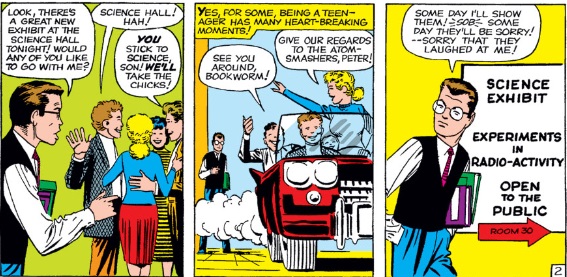
Peter Parker: science nerd

But there’s another way in which Peter Parker and Wade Watts differ, one that’s just as important as the one Coleman points out: what kind of nerd they are. It’s this difference that at least partially explains their moral differences as well. As we all know, Peter Parker got bitten by a radioactive spider that turned him into Spider-Man, but the reason he was bitten by that spider was because he went to a scientific exhibition, because Peter Parker was the kind of nerd who was really into science, who was studying to become a scientist. That’s why he was bullied, at a time when being a brainiac was not a good thing. There’s more than a hint of classism in the bullying, what with his principal tormentor being the popular, rich jock who could afford to tool around in a sports car, while Parker wore handme down clothes and thick nerd glasses. And that’s why he was bullied: he looked poor, he was a brainiac, he didn’t share the interests of the cool people nor felt the need to imitate them.

Wade Watts on the other hand is the worst possible sort of nerd, the one that thinks his (excessive) love of Star Wars and knowledge of eighties nerd trivia makes him special, gets him persecuted. He doesn’t create, he just consumes, never does anything original. He has a persecution complex but nobody’s persecuting him. His type is widespread among fandom, usually white men who’ve never had much hardship in their lives, but who’ve convinced themselves that a light spot of bullying during high school means the entire world is against them because of their brilliance. These are usually the same people who want to exclude anybody not like them — LGBT, women, PoC — from fandom, that only they are true fans though they never contribute anything. That’s the kind of fan who eat up flattering trash like Ready Player One.

Ramen Daisuki Koizumi-san — First Impressions

Because she’s cute, Ohsawa Yuu stalks her standoffish classmate Koizumi-san and discovers she’s really, really into ramen.

Ramen Daisuki Koizumi-san: Koizumi-san really, really loves ramen

I’ve been reading the manga of this and liking it, so I was looking forward of how it would be adapted. To be honest I expected this would’ve been a short, rather than a full length series, because the manga chapters are rather short as well and mostly standalone, so perfect for a five or eight minute short. What they’ve done instead is adapt 3-4 chapters per episode, if the first episode is an indication. I’m not sure how that would work long time. This time we got three stories about Koizumi going to eat ramen and Yuu stalking, then joining her. It could get a bit dull. Luckily I know the manga starts to mix things up quickly, introducing more characters for Koizumi to play off.

Ramen Daisuki Koizumi-san: ramen eating girls are cute

So far the characters are a bit one note. Koizumi-san is your archetypical cool beauty loner, with little to no interest in anything other than ramen, only coming alive if she’s eating it or explaining about what’s she’s eating. Yuu is a bit better, a cheerful, optimistic girl with a thing for cute girls that’s more than a little bit gay. Every story in this episode has Yuu attempting to talk to/chat up Koizumi-san, her rebuffing Yuu’s approach, then going to eat ramen, at which Yuu joins her and gets her to open up just a little bit by getting her to talk about ramen.

Compared to Sora yori mo Tooi Basho, Ramen Daisuki Koizumi-san is a much more conventional slice of moe anime, competently done but not yet with much to distinguish itself from any other slice of moe anime. The character designs are cute, the animation is all right without anything special and Koizumi-san’s blissgams are nowhere near as interesting as those in e.g. Food Wars. At the moment Ramen Daisuki Koizumi-san is more comfort food than haute cuisine: great if you like this sort of thing, skippable otherwise.

Heinlein talks


I came across this video thanks to File 770, following the bread crumbs back from a post about the latest rightwing sf writer making an arse off himself. Heinlein is arguably the ur-Puppy, in that most of their beliefs can be traced straight back to them. Heinlein would’ve known better than to insult sf readers on social media or pick public fights with other writers willy-nilly though. He could actually write, had to be able to write stories that everybody — rather than just those who ideologically agreed with him — could enjoy, or he would’ve had no income. Johnny come lately coat tail riders like Jon Del Arroz on the other hand seem to want to sell books as a way to stick it to the libs, rather than on their own merits. Buy this book and annoy Mike Glyer or something.

The problem with any of the Puppy authors is of course that everything they’ve done was done before and better by writers like Pournelle, Niven and especially Heinlein. If I wanted to read a rightwing tract masquarading as science fiction, I’d read them and still get a chance at a half decent story too. No wonder the Correias and Torgersens of this world are so salty: they can’t even buy the respect they feel is theirs even if they have the sales, because nothing they do is all that interesting or novel. They’re just copies of copies of copies of Heinlein. You’re better off reading the real thing.

School girls go to the South Pole — First Impressions

Sora yori mo Tooi Basho: high school girls go on a visit to the South Pole.

Sora yori mo Tooi Basho: school girls in Antarctica

Tamaki Mari is a very ordinary second year high school girl who one day suddenly realises that she’s a very ordinary second year high school girl. Which puts her in the mood to go on some big adventure, so she decides to skip school and travel to Tokyo. But then it rains so she doesn’t. She talks to her friend about her frustration of always failing to take that first step and always chickening out. Then, as she goes home, she notices the girl running past her to get her train drops an envelope. Tamaki picks it up and runs after her, but the girl’s gone. So she looks into the envelope to see what’s in it and finds:

Sora yori mo Tooi Basho: one million yen

One million yen!

That’s her first encounter with Kobuchizawa “Antarctica” Shirase, whose mother wrote a book about visiting the South Pole, but disappeared when Shirase was in middle school. Ever since she’s been working and saving up to make enough money to pay for a trip to Antarctica. For Tamaki Shirase’s dream is exactly what she wanted for herself, but never found or had the courage to go look for. But this time it’s different.

The ordinary school girl frustrated with her own ordinariness is not a new character type of course, often seen as the protagonist in school club series like K-on or Amanchu!, their frustrations driving them to try something, anything new to not be ordinary, overcoming their own fears in the process. They tend to be either enthusiastic go-getters (like Mikan from Love Live Sunshine) or shy fraidycats dragged into something almost against their will (Ami Kurata from Long Riders). Tamaki Mari is a mix of both, afraid to try new things and knowing this about herself, frustrated with it, but pushy and enthusiastic once she has made up her mind.

Sora yori mo Tooi Basho: Kobuchizawa Shirase is grateful

Kobuchizawa Shirase meanwhile looks like the typical well put together long black haired school princess, serious and driven. Having set herself a life goal, she’s dilligently working towards it while most of her peers are satisfied with just playing around. But she isn’t stoic or emotionally withdrawn; rather she wears her heart on her sleeve, most noticably when Tamaki hands her back the million yen she had lost. I like how aware she is how her dream of traveling to Antarctica to find her lost mother comes over to other people, that she isn’t deluded to how hard it would be to realise it, but accepts it and moves on.

Both Maki and Shirase than are archetypes I’ve seen in dozens of anime before, but with enough originality and character to come across as actual people you’d want to spend time with. There’s a good sense of humour, that doesn’t come at the expense of either of them and I like the pacing of this episode. All we saw was Maki coming to grips with her normalcry and wanting to do something about it, getting to know Shirase and the both of them deciding to go on a trip to Hiroshima where a polar exploration ship was holding an open house. There’s a sparkle to the animation, which is just that bit better than it needs to be, sharing some of its style and realism with last year’s Tsuki ga Kirei and Just Because.

Very much a recommendation. If this level of quality keeps up, this may be the sleeper hit of the season.

(01) the ultimate anime Christmas movie

This was supposed to be a post about what I wanted to see in anime in 2018 — in short, Crunchyroll to get its thumb out and actually sub openings and endings — but fuck it, this is about Tokyo Godfathers because damn this is a movie everybody really needs to see.

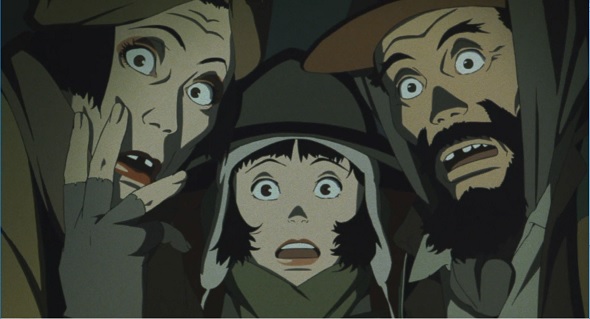
Tokyo Godfathers: the moment of discovery

Like most people, the first Satoshi Kon movie I watched was Paprika. Tokyo Godfathers had been on my wish list for several years to watch at Christmas, but I never got round to it. Until today, when I had a three hour train journey to fill and a laptop loaded with anime. What would be more fitting on Christmas Day than this movie?

Tokyo Godfathers starts on Christmas Eve as three homeless people: Gin, an alcoholic, Hana, a trans woman and Miyuki, a teenage runaway, find a baby in a garbage dump. Instead of doing the obvious thing and handing her over to the nearest police post, the three take her “home”, mainly on the insistence of Hana, who always wanted to be a mother. After a night getting Kiyoko — as Hana has named her — to eat and sleep, the next morning Hana persuades the other two to look for Kiyoko’s mother.


What follows is a series of misadventures that are connected together by a series of coincidences and accidents, as in the fragment above. The ultimate coincidence is of course the homeless trio finding the baby in the first place. Normally such a string of incidents and coincidences would’ve bothered me, but the movie sets them up early and cleverly enough that this wasn’t a problem. As Hana puts it, Kiyoko is a child gifted by god, while the explicitly Christian opening to the movie, when the homeless trio attend a Christmas service to get free food, already telegraphs that there will be miracles here. And of course, a good Christmas movie always depend on a little bit of magic to get things going.

Tokyo Godfathers is a horribly sentimental movie, but the sentimentality fits. Everything works out, everybody gets some sort of happy ending, a reconciliation with their past and where it not for me watching this in the train, it would’ve had me ugly crying most of the way through. This never felt cheap or theatrical, as it was earned, through the Gin, Hana & Miyuki themselves, their backstories as well as their actions. Each time they let their better side guide them, they get rewarded for it.

Tokyo Godfathers is also incredibly funny, like when that ambulance out of nowhere crashes into the chemist, but also in the character acting. Just look at the way Gin and Hana run in the clip above and how it fits their characters and is funny in its own right. The exaggerated reactions and movements of the characters keep things funny even in the most melodramatic scenes, yet are grounded in their character. So Hana at all times is overly correct in her feminine way of moving and her mannerisms, which are exaggerated in a dramatic chase scene like the above.

This is such a clever, intelligent movie that I feel I’ve only scratched the surface having seen it once. It has enormous heart as well, which is why it’s such a good Christmas movie.

This is the twelfth and final post in this year’s twelve days of anime challenge.