Biff! Pang! Zoom! comics aren’t just for white dudes anymore!

Howard Chaykin is the best example this side of Steve Brust of the nominally leftist guy who keeps showing his ass in public:

For the record, the cover depicts the horrific wish dream of some 45% of their fellow Americans. Perhaps if they spent a bit more time paying attention to the fact that the world they were born into is on the brink of serious disaster, they might have less time to get worked up about an image of genuine horror that depicts an aspect of that impeding disaster.

[…]

And of course, that left has evolved into a culture and community that feels that a white, cisgendered male has no right to tell stories of characters who are not white cisgendered males. Beyond its obvious and ridiculous limitations, this is just one more variety of fascism with a sympathetic and friendly face–from a left that still hasn’t figured out a cohesive way to save itself, the country and the world from the crushing monster that my country has become.

The mistake Chaykin makes here is thinking it’s still 1987 and you could pretend comics are read only by white male nerds. Chakyin wants to pretend he’s the voice of the voiceless enlightening an audience somehow ignorant of the plight of trans women or Muslims in Trump’s America, that just depicting atrocities is a courageous stand against injustice. And perhaps in 1987, what Chakyin is doing in The Divided States of Hysteria, when you compare it to e.g. Chris Claremont’s hamfisted lynching analogies in X-Men: God Loves, Man Kills, where “muties” stand in for Black people. But it’s 2017, not 1987 and you have to do better than that.

Because biff, pow, zap comics are not just for well meaning white dudes anymore.

Not that they ever were.

There’s a huge, diversive audience out there, some of which actually have first hand experience with the issues Chaykin writes about. So the bar is higher than if you are writing for a well intentioned, but largely clueless white nerd audience. Get things wrong and you will be criticised, even if you’re a Big Name Leftist cartoonist like Chaykin. And he fails at the first hurdle by falling right into the victim trap. Got a gay or lesbian character in your story? The victim trap has him dying of aids, her getting raped and all of it is oh so inspiring for their straight friends and the straight audience watching. Same of course goes for trans characters, whether or not they “power up” from their rape or abuse trauma and become angels of vengeance. Given that Chaykin has previous with regards to trans characters in Black Kiss — which wasn’t the most subtle of characterisations — it’s not suprising people won’t cut him slack with a new series that opens with the rape and assault of a trans protagonist.

It’s not that you don’t have the right to write characters other than white, cisgendered males — and didn’t John Byrne already complained about not being allowed to create anything other than white villains back in 1992 — it’s that you have to get it right. Don’t fall into the same victim narratives white male cis writers always fall in when writing about characters unlike themselves. And perhaps listen when people criticise your writing, rather than brag that you didn’t read it?

Tsuki ga Kirei — final impression

As the final episode proper ends, Akane is on the train to her new home, her father having been transferred to another office. It’s spring break, she and Kotarou have graduated from middle school, but she’ll be in another town in another high school two hours away by train. Kotarou is watching the train move out of sight as he reminisces about his first love, while Akane does the same. A bittersweet ending to a romance that week after week had me besides myself with anxiety, shouting at the television whenever one of them screwed things up again, or weeping in relief when things went right. I could have lived with that ending, not knowing how it would’ve turned out in the end, but with strong hints that it might not have lasted. As the credits roll, we get one last shot of the Moon, then fade to white and let the ending song roll.

Tsuki ga Kirei: the moon is beautiful

And yet… Would it be too much to ask to cheat? To have a proper, they lived happy ever after ending for the best, most real feeling romance in anime I’ve ever seen? Sure, first loves don’t last, it’s rare that you meet the love of your life in middle school and stay together all the way through high school, uni and getting a real job. It wouldn’t be realistic in a series that never went for anime clichés, but…

In my family at least, everybody’s first, serious relationship has resulted in marriage or kids. My brother met his girl friend in high school and they’re still together, with two children and a book published. As for long distance relationships, I met my wife online and we spent our first three years shuttling between Holland and england. It can happen. And surely now would be the time for one of those after credits codas the series had been using so well to check up with minor characters? Surely…
Tsuki ga Kirei: perfect ending

Yes. This, this is fine.

Tsuki ga Kirei is my anime of the season and this ending was perfect. It made romance anime relevant again by ditching all the usual cliches, setting the story in middle school rather than high school hence making Akane and Kotarou a little bit younger and more naive than otherwise and refusing to make any of its characters into clichés. Akane may be shy and somewhat anxious, but she is also the star of the track team. Kotarou might be an impressionable Dazai quoting book nerd, but he also likes boxing and he’s not into otaku stuff. Even the incidental characters, like Akane’s friend Aika, have some complexity to them, ie. she’s somewhat brash and loud, but genuinely cares when Akane loses her stress release stuffed toy. Tsuki ga Kirei never stopped moving the romance forward, starting the first episode with the two of them getting curious about each other, having them going out by episode three and out to the world by episode seven, ultimately ending, well, see above. I hope this will inspire other anime romances.

Tsuki ga Kirei: always the bridesmaid, never the bride

Remains only to say something about Chinatsu. Poor, poor Chinatsu. Akane’s best friend who made the unfortunate choice to fall in love with Kotarou just slightly too late to ever have a chance. That moment in episode seven where she sees Kotarou walk hand in hand with Akane, when she tried so hard to get his attention earlier, is heart breaking. She was the best kind of romantic rival, one who actually hurt as she lost, who wasn’t mean or stirred up shit for the sake of it, didn’t try to steal Kotarou, just a girl who struggled hard to reconcile her feelings with her friendship with Akane and ultimately succeeding. I wouldn’t mind an OVA in which she finds her own love as well. She deserves it.

Final impression — The King’s Avatar

Well, they’re not wrong.

Ye Xiu was the best know professional player of Glory, until he got unnecessarily nastily fired from his team, so the first thing he does is duck into a nearby internet cafe, apply for a job as night manager and start playing Glory again, on the newly opened tenth server where, as the tweet says, he spents his time grieving nobodies. And that’s basically Quan Zhi Gao Shou/The kings Avatar, a series of imagined battles played out within the game interspersed with scenes of young men and the occassional young woman looking really serious at their monitor, with close-ups of exciting keyboard and mousing actions. And yet…

As Youtube anime critic The Pedantic Romantic argues, this looks a bit like Sword Art Online, only without the actually being stuck in the game and dying in real life if you die in Canada the game bits. What’s more, Glory feels much more like a real MMO than SAO’s games ever did. It was this review that picqued my interest enough to watch the first couple of episodes, something made easy because the Chinese television producer behind it, Tencent, released the whole series on Youtube for wordlwide viewing. What I like about this is that it keeps the focus on gaming and gaming culture instead of having to add some supernatural or fantasy element to it.

It’s also the first actual Chinese cartoon to hold my interest enough to finish the series; it was always one of the first series I watched on a Friday night or Saturday morning this season. Even if the stakes were low and the story this season was little more than Ye Xiu getting a band of new players with potential together to perhaps form a new team when he goes back to the pro-leagues, on an episode by episode base it was always interesting. just as watching an underdog succeed despite the odds, there’s also pleasure in watching an expert quietly finishing off supposedly superior players. If you should want to watch it, I’d advise against binging it, as then its flaws quickly become apparant: each episode is basically the same story of Ye Xiu kicking ass, there’s an over reliance on some stock fighting animations, etc. Watched one episode at a time it’s perfect brain candy if you like seeing somebody play an MMO perfectly.

Your Happening World (26-06-2017)

  • the Mangaka who came in from the cold — Below is a small selection of four manga artists and one writer who are being overlooked by American publishers. They work, by and large, within the field of seinen, a loosely defined category of manga anthologies ostensibly geared towards young adult males in Japan. Admittedly the sample’s homogeneity is partly a result of my own preference as a reader towards this niche, but seinen takes on a special relevance these days as well.
  • On VidCon, Harassment & Garbage Humans — To kick off the Women Online panel at VidCon last Thursday, the moderator posed the question: Why do we still have to talk about the harassment of women? I replied, “Because I think one of my biggest harassers is sitting in the front row.”
  • Beowulf and the Comic Book: Contemporary Readings — This paper explores the appropriation of the Old English poem by modern popular culture in such a distinctive 20th-century art-form as the comic book, which proves that a heroic, legendary story already old for the Anglo-Saxons —it was set in geardagum, “the ancient days”— still elicits the interest of the audience in the modern world.
  • This week’s Bookscan chart is a wake-up call for the comics industry — Let me spell it out for you: girls and women, black and white, cis and trans alike, are the driving force behind comics readership expansion. This has been happening for a while, but it’s a full on avalanche now. It’s also something I saw coming 25 years ago. (No one else is gonna pat me on the back so I gotta do it myself.) Seeing the devoted fandoms that female content-consumers developed for anything that interested them, ESPECIALLY genre material like paranormal romance, horror and fantasy – I had a hunch that once they turned their spotlight on comics, the full force of female fandom would bowl over the fragile shreds of male safe spaces like a Mack truck through a pile of empty Axe cartons.

After the flood you strengthen the dykes

The New York Times has an excellent, if slightly triumphalist article up about how the Dutch handle flooding risks and water management in the face of climate change, most of which focuses on the technical nitty gritty, but which also has some insight in the mentality behind them:

“It’s in our genes,” he said. “Water managers were the first rulers of the land. Designing the city to deal with water was the first task of survival here and it remains our defining job. It’s a process, a movement.

“It is not just a bunch of dikes and dams, but a way of life.”

Of course it’s a way of life in a country that has been literally won from the sea which without dykes would be three quarters flooded. It’s no coincidence that the waterschappen — the local water management equivalents of city councils or muncipalities — are our oldest democratic institutions. The Netherlands is shaped by a thousand year struggle of keeping out the sea, winning new land from it and regaining what was lost through storms and flooding. With the most recent disastrous flood still firmly in living memory, it’s no wonder there’s a seriousness to water management and climate change that a country like the United States, perfectly willing to let a major city drown, lacks.

So while our politicians might be just as idiotic and in denial about climate change as anywhere else, there is no debate on how to counteract the consequences of it for our country, at least in this context. However, this hasn’t gone entirely without a hitch. The current water management approach and philosophy took time to evolve, in some ways is diametrically opposed to traditional Dutch values.

The instinctive response to the floodings of 1953 was to immediately start strengthening the dykes, but now systematically, according to the socalled Delta Plan. Instead of just strengthening the existing dykes, the decision was made to redue the existing coastline, by closing off all the river openings between the Westerschelde leading to Antwerpen and the Nieuwe Waterweg leading to Rotterdam. A real technocratic approach to things, which ran into trouble once the ecological impact of the closings became known. Hence why the Oosterschelde wasn’t dammed in the end, but got a storm surge barrier that’s normally opened, but closes during storm conditions, keeping the ecology of the estuary alive but still protecting against flooding.

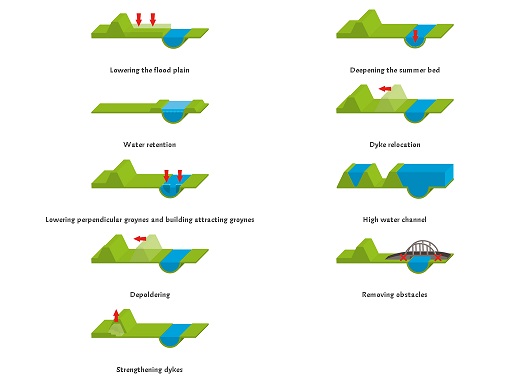
Around the turn of the millennium the Deltaplan was largely completed and it seemed we were save from the water, but then it turned out we forgot about the rivers. The reason the Netherlands is a delta is of course because the Rhine, Maas and Scheldt flow into the sea here and with the more unpredictable weather and more frequent winter downpours, any access river water will ultimately flood here as well. We got a rough wakeup with a series of flood threats in the late nineties, which proved that the previous approach of just damming in rivers with no room for them to roam was no longer working.

types of flood measures taken to give rivers more room for absorbing floods

instead we got a nationwide approach on the lines of what the article descripes for Rotterdam: Room for the River. Create room for a river to meander and it has more room to absorb flood water. Counterintutitive for a country that has always prided itself on taming water, not working with it. And certainly there has been local resistance against e.g. deliberately returning a polder back to the sea. But on the whole the idea that climate change means more unpredictable weather and therefore more flood danger that needs to be defended against, is not controversial. And as a country we are rich enough to defend ourselves against such relatively simple dangers. The problem is that the more unforseeable dangers of climate change are still largely ignored and that for the past decades we’ve on the whole had more climate change skeptic than aware governments…