After the flood you strengthen the dykes

The New York Times has an excellent, if slightly triumphalist article up about how the Dutch handle flooding risks and water management in the face of climate change, most of which focuses on the technical nitty gritty, but which also has some insight in the mentality behind them:

“It’s in our genes,” he said. “Water managers were the first rulers of the land. Designing the city to deal with water was the first task of survival here and it remains our defining job. It’s a process, a movement.

“It is not just a bunch of dikes and dams, but a way of life.”

Of course it’s a way of life in a country that has been literally won from the sea which without dykes would be three quarters flooded. It’s no coincidence that the waterschappen — the local water management equivalents of city councils or muncipalities — are our oldest democratic institutions. The Netherlands is shaped by a thousand year struggle of keeping out the sea, winning new land from it and regaining what was lost through storms and flooding. With the most recent disastrous flood still firmly in living memory, it’s no wonder there’s a seriousness to water management and climate change that a country like the United States, perfectly willing to let a major city drown, lacks.

So while our politicians might be just as idiotic and in denial about climate change as anywhere else, there is no debate on how to counteract the consequences of it for our country, at least in this context. However, this hasn’t gone entirely without a hitch. The current water management approach and philosophy took time to evolve, in some ways is diametrically opposed to traditional Dutch values.

The instinctive response to the floodings of 1953 was to immediately start strengthening the dykes, but now systematically, according to the socalled Delta Plan. Instead of just strengthening the existing dykes, the decision was made to redue the existing coastline, by closing off all the river openings between the Westerschelde leading to Antwerpen and the Nieuwe Waterweg leading to Rotterdam. A real technocratic approach to things, which ran into trouble once the ecological impact of the closings became known. Hence why the Oosterschelde wasn’t dammed in the end, but got a storm surge barrier that’s normally opened, but closes during storm conditions, keeping the ecology of the estuary alive but still protecting against flooding.

Around the turn of the millennium the Deltaplan was largely completed and it seemed we were save from the water, but then it turned out we forgot about the rivers. The reason the Netherlands is a delta is of course because the Rhine, Maas and Scheldt flow into the sea here and with the more unpredictable weather and more frequent winter downpours, any access river water will ultimately flood here as well. We got a rough wakeup with a series of flood threats in the late nineties, which proved that the previous approach of just damming in rivers with no room for them to roam was no longer working.
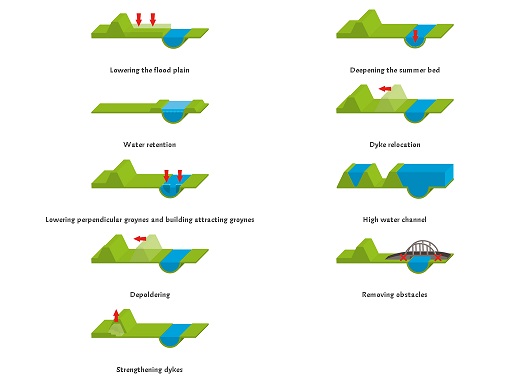
types of flood measures taken to give rivers more room for absorbing floods

instead we got a nationwide approach on the lines of what the article descripes for Rotterdam: Room for the River. Create room for a river to meander and it has more room to absorb flood water. Counterintutitive for a country that has always prided itself on taming water, not working with it. And certainly there has been local resistance against e.g. deliberately returning a polder back to the sea. But on the whole the idea that climate change means more unpredictable weather and therefore more flood danger that needs to be defended against, is not controversial. And as a country we are rich enough to defend ourselves against such relatively simple dangers. The problem is that the more unforseeable dangers of climate change are still largely ignored and that for the past decades we’ve on the whole had more climate change skeptic than aware governments…

Friday Funnies: grief is weird

This comic reduced me to a sobbing wreck.

always distressing to see a loved one in a dream knowing they are dead

I had those dreams in which it turned out that Sandra isn’t dead, but still in hospital, or she’s just there as we go about our daily business, only to wake up and realise that of course it’s all a lie. There’s nothing as nerve wrecking, as guilt inducing and soul crushing as waking up from that sort of dream and Sara Goetter captured it well. All three of her comics dealing with the grief over the death of her mother are excellent depictions of what it feels like to lose someone dear to you in fact, hard to read because of it. It’s been a while since I had to cry this hard over Sandra, it having been five year since she died after all, but this went through all of my defences like a punch to the gut.

(For something lighter by her, this comic about spotting and wanting to befriend a fellow geek in middle school is adorkable.)

Your Happening World (Kingsday is bogus edition)

  • 10 Things You Didn’t Know About Fujoshi: Fujoshi, which literally means “rotten girl,” refers to a type of anime fan who is especially interested in imagining male homoerotic subtext in her favorite media. But while the term “fujoshi” was only coined in 2001, rotten girls and their male counterparts, “fudanshi,” have been around since the Edo period. In “The Forgotten History of Fujoshi,” Keith and Mari Minton—two self-professed fujoshi—shared some of the fascinating origins of a subculture that is typically somewhat misunderstood.
  • The Ostrogothic Military: Whether the Ostrogoths themselves were an army, the nature of the army’s settlement and salary in Italy, and ethnic identity’s role in the formation of the army are all discussed. The army itself has rarely been studied as a separate institution, which may be because, throughout the Ostrogothic kingdom’s short life, the military was inextricably bound up with the nature and the fate of that polity.
  • Alternate Futurescape: The Bubblegum Crisis We Never Got: Where Bubblegum Crisis’ Knight Sabers were a mercenary team that’d take any job for the right price, FutureScape’s “Night Saviors” were advertised as “Four girls who will accept no money in their never ending battle against the Boomers!“ Fans familiar with Bubblegum Crisis and the Knight Saber mercenary group that were mostly motivated by revenge would probably have been a little more than shocked to see them instead portrayed as a super-heroine team fighting for “freedom and justice” under the new name of “The Night Saviors”.
  • X-Force by Cory J Walker: Great, 90s nostalgia drawings of various X-Force characters.
  • Your audience doesn’t think you suck: To make your audience happy, you don’t need to be the most talented person. You don’t need to invest tons of cash into a project to make it watchable. You need an idea that you believe in and the enthusiasm to power through and put it out into the world.
  • The Left’s Long History Of Transphobia: Trans people generally lean left because we feel that we have to, but we’re also aware that liberalism won’t protect us when the chips are down. It’s easy to oppose an enemy that is consistently hateful, and at the end of the day trans people know where Republicans stand on whether or not we should exist.

Is diversity killing Marvel sales?

Short answer: no. Long answer:


Good gods do I hate most of what Marvel has been doing in the 21st century, from the debased widescreen storytelling to the shitting on everything its characters stand for, but what it has done right is providing space for more diverse superhero comics, both character and creator-wise. I stopped being a regular comics buyer, let alone a superhero floppies buyer since, well, the start of this century and getting a view of what the industry is like a decade and a half later I’m glad I did. Everything this dude listed as being more of a problem than Marvel pushing diversity is shit I’ve already seen in the nineties, then secondhand in the naughties, just more chaotically and more intensive. Pushing more titles, an obsession with events, an overwhelmingly short term focus at the cost of a long term vision: we’ve seen that all before. It’s just the speed that’s different.

The end result is a constant churn that just zaps all of my will to invest time and effort into the Marvel Universe — and I’ve been a Marvel fan for thirty years now. Best I can do currently is reading the “fringe” books: the Hawkeyes and Ms. Marvels that do new things at the edges of the Marvel universe, but even these get weighted down by events and extraneous shite. What I wouldn’t give for having a gimmick of just having twelve issues of a series coming out in a year with the same creative team, without crossover events or other crap cluttering it up.

None of which has much to do with diversity and its supposed flaws. Diversity is actually, as any fule should know, Marvel’s greatest selling point. Every time a white, male hero is replaced by a hero of colour, a woman, or both, it’s an immediate attention grabber in the way “the death of…” stories were in the nineties. Each new diverse hero creates immense goodwill among non comics readers, if done right because there’s such a hunger for heroes that look like America in the 21st century, Trumpian backlashes nonewithstanding. And if only Marvel could have a coherent, respectful way of marketing this diversity and not let it be buried under an avalanche of shite only diehard floppy readers care about, things like the Miles/Gwen romance would set the world alight, rather than being a one-week wonder…

First impression: Grimoire of Zero

A young witch hires a Beastfallen tiger man to be her bodyguard and occassional (involuntary) bed during her quest for her stolen grimoire.

Grimoire of Zero: tiger men make the best beds

Zero kara Hajimeru Mahou no Sho/Grimoire of Zero is a classic quest fantasy, which is unusual in anime. The first episode is mainly setup, with a meet cute when our nameless tiger man protagonist — on the run from a murderous witch — lands in the soup of Zero. She saves him, he runs away when it turns out she’s a witch as well, then she shows up again to steal back her soup. Long story short, she recruits him for her quest to get her grimoire back and the end of the episode has them setting out together. What makes all this fairly standard setup sparkle is the interaction between the Mercenary and Zero, who hit it off immediately. It’s hard to do this sort of banter well, to have two people snipe at each other without it coming over too spiteful or too artificial, but this episode managed to keep a light, funny tone to its banter.

Grimoire of Zero: grim and gritty background

The light tone of the interactions between Zero and the Mercenary does clash somewhat with the grim and gritty background it is set against. We’re in a world were witches are real and persecuted by an almighty Church, burning them to death. So far, so Catholic, but while I’m feeling sympathetic to the witches, at least some of them do seem objectively evil. Meanwhile there are also the Beastfallen, human/animal hybrids created by witches and which occassionally pop up among normal humans, as in the case of our tiger man Mercenary. Who seem to be hunted by humans and witches both from what we’ve seen from the Mercenary’s background. It feels inconsistent with the lighter, cuter mood between Zero and Mercenary. How the show will reconcile this will be interesting to watch.