Is it just me, or does this trailer sound too Hollywood?
To be fair, Luc Besson has already created a perfect save for the absence of the heroes themselves Valerian et Laureline movie in the form of The Fifth Element, but I’m still worried about how well the actual Valerian et Laureline movie will do. There are so many danger signs here. Most worrying is that the actors playing Valerian and Laureline look and sound dreadful here, but equally worrying is the plot as shown in the trailer, which looks dreadfully generic.
Which might be a fakeout, as the movie seems to be loosely based on Ambassador of the Shadows, from which it borrows its setting. The original had an ambassador kidnapped there and Valerian but especially Laureline coming to the rescue, chasing the kidnappers across all sorts of exotic, alien settings. In fact, Laureline did most of the heavy lifting there, with Valerian absent for long stretches. I have a feeling that won’t be the case in the movie.
In all, I’m somewhat skeptical that one of my abso;ute favourite nerd things will be translated correctly into film, but hopefully it will at least be a decent summer blockbuster to go see with the cow-orkers.
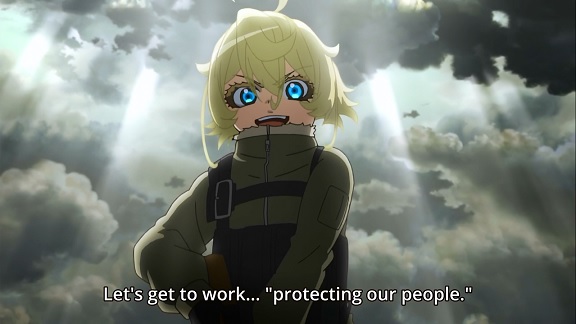
Youjo Senki proved that war crimes are fine as long as they’re performed by a cute blonde ten year old girl.
Well, not really. The show never quite spelled it out for you, but it was always clear that Tanya was fighting on the wrong side, was in fact the baddie, even if there was always the danger of the audience sympathising with her too much because she was cute and badass. There’s a fine line between making Tanya sympathetic and the hero and Youjo Senki managed to keep this distinction. That’s why the ending was great. The empire has finally defeated its enemies, only to see them refusing to acknowledge defeat and new, more powerful enemies rising up to continue the fight. For all its power Tanya knows the empire is probably doomed yet she has no choice but to keep fighting. A perfect stopping point while leaving room for a possible sequel.
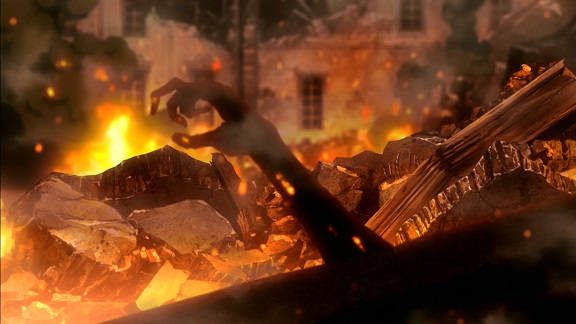
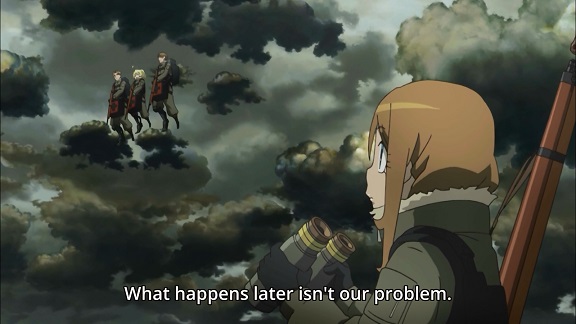
The core of the series for me lies in episode eight, in which a city that’s an important transport centre for the frontlines, revolts against the Empire and Tanya’s batellion is ordered to help put it down. What happens next is reminiscent of what happened during the German invasion of Belgium in World War I. Fury at the continued resistance of the Belgian Amry, which was supposed to stand aside to let the Germans through, as well as unfounded fears of civilian snipers led to a number of atrocities, most noticable the destruction of the university city of Leuven and the burning of its library by artillery fire. The same sort of destruction is brought to the city in Youjo Senki. After Tanya and her batallion suppress the enemy mages, an artillery bombardment is let loose on the already partially destroyed city, with predictable consequences.
And throughout the episode, Tanya is only occupied with keeping her own hands clean, not with stopping the atrocity or finding other ways to capture the city. It’s here that Tanya crossed the moral event horizon. No longer edgy antihero, she’s a straight up villain and while Youjo Senki remains sympathetic to her, keeps showing us her point of view, it is clear we are meant to see her that way. Of course, there are still asshats cheering Tanya on, but that’s not the series fault. Unlike a series like GATE or (ugh) The Irregular at Magic High School, Tanya is never shown as the hero, just the protagonist. In a sense, you could see Tanya as anime’s Flashman, a thoroughly nasty but sympathetic enough character that you want them to win, even though you know they don’t deserve to.
I just don’t understand why The Rolling Girls has the reputation it has, as as alluded to in this well timed post defending it. It’s not just that it’s seen as a flawed show, but as an example of a show that collapsed completely, with the promise of the first episodes not delivered by the rest of the series, even dragged out as an example of how Wit Studio always does that when e.g Kabaneri of the Iron Fortress went through its own *ahem* derailment. But I don’t see it. Having binged the entire series over the weekend I found a rather charming, fun seriocomic adventure series that actually holds together better than many more esteemed series.
But you have to understand what it’s about first. And to know that, you need to understand that subtitle: Rolling, Falling, Scrambling Girls. For others. For themselves. Even if they’re destined to be a ‘mob’. That’s the core of the series. The Rolling Girls start out as supporting characters in other people’s stories and through a series of misadventures, they don’t grow into heroes and remain supporting characters. And that’s fine. But if you don’t take it seriously and think that this is just another zero to hero type of story, you’ll be in for a disappointment. And I think that’s where a lot of the criticism of this series comes from.
To be honest, it is not difficult to get the wrong idea about The Rolling Girls from its first episode, with all its cool footage of superpowered vigilantes fighting each other. Because that’s apparantly how in a fractured, future Japan, the various warring states solve their disputes. Each “Best” is supported by their vigilante squad of “Rests” who mostly stand on the sidelines and get blown away by the intensity of the fights. Moritomo Nozomi is one of those Rests, her sister being the squad captain of the local vigilantes and not so secretly the resident Best. When she gets hurt during one fight Nozomi decides to take over, going on a tour of Japan to fulfil the requests asked of her sister, together with three other girls with their own reasons to travel.
The perfect setup for a group of four misfits to learn how to become Bests through their shared adventures discovering new countries and solving their problems, becoming close knit friends in the process. And that sort of happens. After the first two episodes set up, the next six have the four visiting Tokyo — one big year long Comiket –, Mie and Aichi — racing and deep fried shrimp — and Kyoto — rock and geishas. Each country has its own cultural tics and problems, which Nozomi and co try to solve, but they’re mostly serving as a catalyst rather than actively contributing. In fact, in a fair few episodes they’re rather useless. The final four episodes find the girls in Hiroshima, where everything comes to a head as all the various subplots brewing since the first episode come to a head. Again, most of these subplots are resolved without them or even in spite of them and in the end they’re still more or less the same people as that set out to travel.
I like that, personally, that they didn’t get to be the big heroes but in the end were arguably still supporting characters in their own series. No angst here about wanting to be the best, or boring platitudes about working hard to achieve your dream, but no learning to live within your limitations either. They may have been rests, they still ended up helping change the world.
The series isn’t perfect: the main plot is barely established before it comes crashing into the last four episodes, there are several times when characters behaved like complete idiots because the plot demands it, our protagonists are sometimes more bystander than catalyst and there are some tonal shifts in the first two episodes that were hard to swallow. But in the end, this is a series about finding a place in the world that’s too big for you to be the Best, without resigning yourself to be just a mob character, a series that revels in the fun worlds it creates, that was messy and too ambitious for its own good, but still ended up achieving much of what it set out to do. I hadn’t started watching weekly anime yet when The Rolling Girls was streamed, so I don’t know how I would’ve received it had I watched this week by week, but ultimately I think it’s much better than its reputation would lead you to believe.
What’s the Deal with Kemono Friends?– I wasn’t even paying enough attention to the announcements or the upcoming anime charts to know that what would become the Japanese anime fandom’s biggest anime of Winter 2017—a moe animal girls show based off of a defunct mobile game rendered in exceedingly poor CG—even existed. But here we are
The Anti-Library of Kemono Friends: Fans, Theories, and Everything in Between – With a plot like that, it’s easy to think of the show as a Dora the Explorer thing — except it aired as a late night anime. The more you watch the show too, the more you realize the Japanese fanbase might be onto something. There seems to be a cynical, dark past to Japari Park amidst all this cute girls doing cute things crap.
Being an itemised list of disagreements – The main reason RH/BS was able to bully people with impunity for such a long time was because it looked, from the outside, as though the SFF community condoned her behaviour. You’d see a Known Cool Person chatting with her on Twitter as though it was OK for RH to chase people around on the Internet having a go at them,
Forgotten Realms: The Isekai Boom of the 90’s – The main difference between isekai then and isekai now is the intended audience – 25 years ago, it was a staple of the shoujo demographic, rather than today’s escapist playgrounds for young men. Ordinary young women were pulled into alternate worlds where attractive young men told them they had a special destiny to fulfill. They went on grand adventures and usually – though not always – fell in love along the way.
The 2017 Hugo Awards: Why Hugo? – So no, nominating for the Hugos this year is not an act of resistance. But I think that it can be an act of affirmation. A reminder that just because the world is going crazy around us, doesn’t mean we’re not going to hold on to what’s ours. That just because we seem to be surrounded (and governed) by people who care about nothing and no one, doesn’t mean we’re not going to keep caring about things ourselves–even when they are completely trivial–and keep working to preserve them.
Peter Chung on Japanese animation theory – It’s very easy for even a casual viewer to notice that Japanese animation has a different “feel” than American animation. Usually the difference is attributed to a divergent cultural viewpoint. What most viewers don’t realize is how much it actually comes down to the physical differences in the technical processes.
Breaking Gender Norms, Healing Trauma and Finding Acceptance in PriPara – It’s never stated that Love is trans, but it’s very easy to make the connection between her self-image to that of many trans women. I personally couldn’t help but view her as trans as I watched the episode the first time and the same goes for later episodes and rewatches. Intentional or not, PriPara made what might be the most positive and accepting portrayal of trans women in anime with Love’s character. Nobody ever bashes Love for her build, not during her reveal or later episodes. She’s always looked up to by the people around her as a beautiful woman whose height and etc. only enhances her lovely appearance.