Fifteen years later & still not famous

Fifteen years ago I wrote the first post on this blog as a way of getting me to shout at my television less often. It worked. These days I shout at Twitter.

A lot happened in those fifteen years. I moved jobs three-four times (once involuntarily), got three cats and lost one, started living together with Sandra, bought our first house together, donated a kidney to her, spent two years struggling to ger her healthy again, failed, learned to live alone again. The blog meanwhile continued steadily, madly swerving in content as well as blogging system every few years, from pure reacting to the news using blosxom (as recommended by Charlie Stross) to finally settling down to WordPress with mostly anime, taking my cue in this if nothing else from Steve Den Beste. Its archives are now a vast warehouse of half assed ideas and temporary obsessions and every so often I look at them and despair.

The world has changed a lot since 2002 too as well. We got a mad Republican regime hell bent in driving its own country to destruction while sowing the seeds for war, pandering to a following of out and out racists and assholes who don’t care how bad it gets, as long as those people get what’s coming. The UK meanwhile is not much better, with a sycophantic prime minister happy to lick US arse and pretending there’s such a thing as a Special Relationship while flogging of the country to whoever wants it. And in the Netherlands some xenophobic wanker is poised to win big in the upcoming national elections while establishment parties can only countered with a watered down version of same.

Sometimes you wonder why you get out of bed.
Naoki Urasawa’s Manga Exertions

Urasawa Naoki no Manben is a NHK documentary series in which mangaka Urasawa Naoki (20th Century Boys, Yawara, Master Keaton) goes around talking to and filming other cartoonists at work. There has been one special and two seasons of each four episodes so far:

  • Pilot: featuring Urasawa himself as well as Kawaguchi Kaiji (Zipang) and Yamashita Kazumi (The Life of Genius Professor Yanagizawa)
  • S01E01: Higashimura Akiko (Princess Jellyfish)
  • S01E02: Fujita Kazuhiro (Ushio and Tora)
  • S01E03: Asano Inio (Dead Dead Demon’s De De De De Destruction)
  • S01E04: Saitō Takao (Golgo 13)
  • S02E01: Hagio Moto (They Were Eleven)
  • S02E02: Hanazawa Kengo (Boys on the Run)
  • S02E03: Igarashi Daisuke (Children of the Sea)
  • S02E04: Furuya Usamaru (Lychee Light Club) NO English subtitles

Urasawa was inspired by an 1985 documentary the NHK broadcasted about Tezuka Osamu, the God of Manga. A third season of Manben was scheduled to run in September 2016.

Originally published at Metafilter.

Why you should watch Youjo Senki in one scene


Japanese salaryman turned ten year old warrior mage in an alternate, 1920ties Germany uses his/her little girl voice to obey the letter, if not the spirit of international war crime law, then bombards the undefended capital of the enemy. So edgy you can cut yourself, but the series so far manage to balance Tanya’s coolness and bad-ass attitude with how sick (s)he is not to mention how fucked over by the god that landed him/her in this predicament. This could’ve been fodder for the anime reichwing, but the occassional Trump meme video notwithstanding, it seems to have managed to escape that fate, even though blonde, murderous under age girls are like catnip to that crowd normally.

I’ve worked with Kobayashi-san

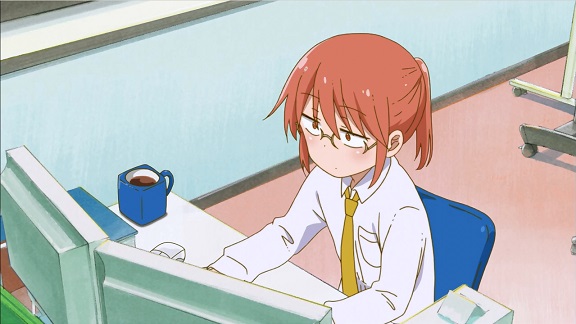
Kobayashi-san Chi no Maid Dragon: Kobayashi-san at work

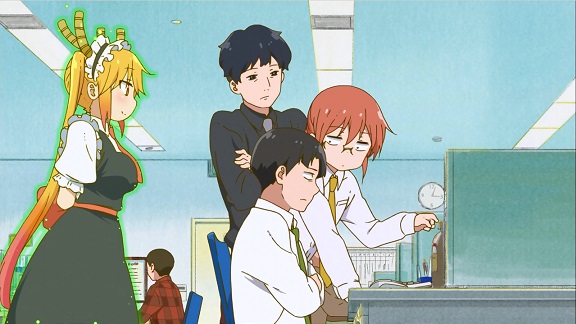
I’ve worked with Kobayashi-san. Not literally of course, but with women like her, testers and developers in an overwhelmingly male workplace, often the only woman in a department or team, sometimes pioneers. In the almost twenty years I’ve been working in IT I’ve seen a fair few of them and while the numbers of women in IT has crept up, my current team of fourteen still only has two female developers. Sometimes it seems IT has actually regressed in this regards, software development becoming more male dominated rather than less.

Kobayashi-san Chi no Maid Dragon: our typical IT workplace

As we’ve seen throughout the series so far is that Kobayashi-san doesn’t dress very girly, shall we say. At home she wears comfortable, somewhat slobby clothes, jeans and sweaters. At work she dresses like her male colleagues, shirt and tie, not overly formal, but good enough for IT work. She gives the impression of not overtly caring about how she looks, other than being neat enough for the office. It stands in sharp contrast to the usual office lady we see in anime, dressed in a work uniform or at the very least in skirt and blouse; Kobayashi-san must be deliberately dressing as one of the boys, to not stand out or perhaps to not be mistaken for a secretary. You wonder what her co-workers make of her behind her back.

Kobayashi-san Chi no Maid Dragon: being asked for advice

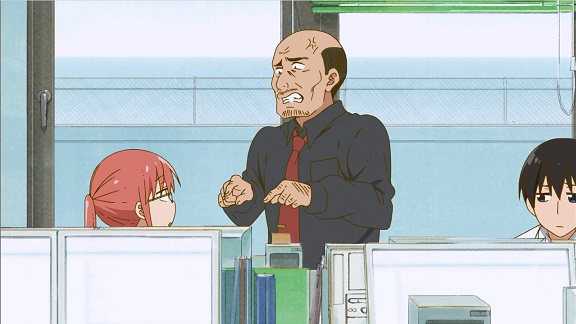
In episode five Tohru goes to visit Kobayashi-san in her workplace, giving us the first extended look at her work life. What struck me immediately was that she seemed slightly older and more experienced than her co-workers. She’s acknowledged as such too by the people she works with. Takiya ask her for help with his own projects and a little bit later we see her advicing two other co-workers, not to mention that she has to take over the project of a co-worker off sick in order to solve a problem that cropped up in production. Her expertise is at least unquestioned, but at the same time her nominal boss sees her as an easy target, expecting her to do his work, demeaning and belittling her and blind to the more important work she’s already doing. Not that Kobayashi is defenceless: we later find out that somebody dobbed her boss in with his superiors about his work ethics, getting him fired…

Kobayashi-san Chi no Maid Dragon: bullied by the boss

The mangaka behind the original manga apparantly drew inspiration from his own work experience in IT, which tells me some experiences are universal, because everything I mentioned above I’ve seen with female co-workers of mine. AsI said, I’ve worked with a fair few of slightly older, much more experienced and knowledgable, tough as nails women like Kobayashi-san. Not always appreciated them, but still.

Another reason to prefer subs

Sometimes a small, seemingly insignificant change can make you lose all trust in an adaptation. Kobayashi-san Chi no Maid Dragon recently got an English dub courtesy of Funimation, but when the first episode aired it turned out a small, but important line was altered.

In the original Japanese dub (and English subtitles) Kobayashi-san says, in answer to Tohru’s declaration of love: “But I’m a woman though”. Which, as MayaScientist demonstrates on Twitter, is an old, old Yuri cliche, when a woman is first confronted with another woman’s love for her. in context, what with Tohru’s unfamiliarity with modern life and Kobayashi’s overall appearance, it also makes sense for her to say something like that, to drive the point home to both herself and Tohru.

The dub changes this line to “I’m not into women or dragons”. Which is an outright rejection of Tohru, rather than a gentle confirmation that Tohru knows what she’s doing. Worse, it turns Tohru’s displays of affection from amusingly over the top to downright creepy.

In the original manga and the anime series so far, though Kobayashi never states it outright, it’s clear she accepts Tohru and her love at some level, that it is more than just friendship. The entire series is as much about Kobayashi coming out of her shell as it is about funny dragon antics, as Andrea Reventon argues in the series of Tweets linked to above. Yet you cannot get there if you start with her outright rejecting the possibility of being lesbian, of falling in love with another woman. That’s why this is such a bad change and such an important one, as it means that Funimation will probably change more things in the anime, erasing the queer (sub)text of it.