First impression: Youjo Senki

Blonde ten year old flying loli-wizard kills for the Reich.
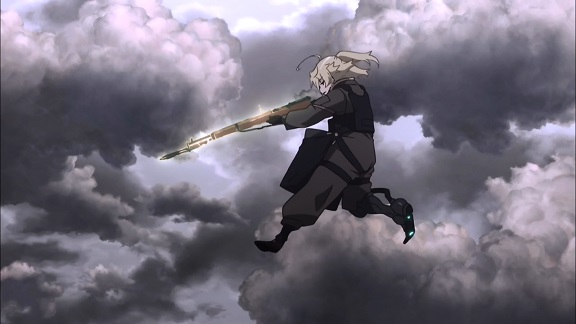
Youjo Senki: niping for the Reich

Last season we had Izetta the Last Witch her home country from invasion by not-nazi Germany, this season we have ten year old second lieutenant Tanya Degurechaff defending not-quite Wilhelmine fantasy Germany from invasion from not-really France. Not quite World War I — there’s a Scandinavian front frex — but not quite World War II either. There are wizards flying around, but no planes so far, nor tanks either. Most of the fighting depicted fits the trenc warfare of the Great War better and the episode isn’t shy in showing the bloody consequences.
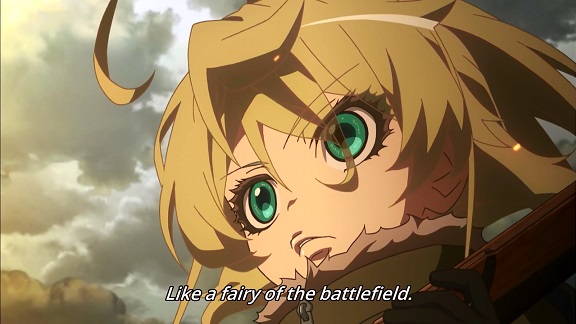
Youjo Senki: angel

We see Tanya mainly through the eyes of her subordinate, corporal Serebryakov who hero worships her. She sees Tanya as a symbol of strength, gruff and no nonsense, but who comes through for her soldiers when the chips are down. Early in the episode two of them disobey her orders and she punishes them by relieving them from duty and sending them somewhere safe. Or so she thinks.
Youjo Senki: devil

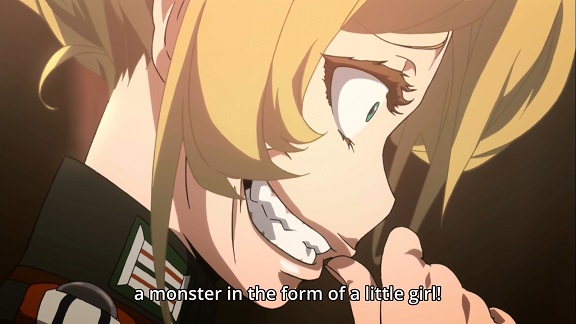
In reality Tanya sent them to their deaths, as on of the first targets of the not-French bombardment was the very bunker she had sent them to… There’s more to Tanya Degurechaff than meets the eye, but we only see her through other people’s eyes. Some, like corporal Serebryakov at first, see her as an Angel, the perfect hero to defend the fatherland, but it’s not just the Reich’s enemies that fear and loathe her.
Youjo Senki: height difference

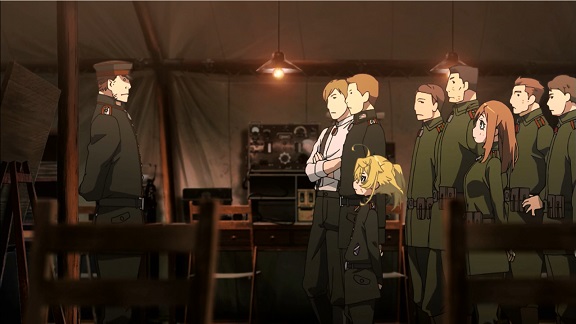
it’s not surprising. Tanya doesn’t behave like a ten year old girl, is composed and serious way beyond her years, speaks with little emotional affection and only when it’s needed or to affirm her faith in God und Vaterland. Not to mention she’s more than a head shorter even than her corporal, who herself is at leat a head shorter than the other soldiers. It makes Tanya stand out and alien even if she wears the same uniform. (And how rare and great is it, to have the women in the same uniform as the men?)

First impressions: Masamune-kun no Revenge

A boy sets out to prove that old margaret Atwood quote:

Masume-kun no Revenge: cruel rejection

Men are afraid that women will laugh at them.

Masume-kun no Revenge: physical attack

Women are afraid that men will kill them.

Masume-kun no Revenge: revenge is a dish served hottie

Also, men are such fragile creatures that one rejection as a child drives them to a decade long quest to become the perfect man in order for the girl who rejected them to fall in love with them, so they can reject her in turn and have their revenge.

First impressions: Minami Kamakura Koukou Joshi Jitensha-bu

Girl gets introduced to the wonders of biking, starts doing it for fun. Like Long Riders, only with high school girls rather than college students. Sounds promising, a nicely relaxed show about cute girls riding bikes together.

who rides a bicycle for the first time to school

Okay, everything about this first scene annoyed me. First, if you haven’t biked since you were little, why would you make your first bike ride to school, on the first school day even? Why not practise first? Especially if you’re going to a new school? Second, how tiny are you that you can still use the same bike as when you were little? And how the hell did it stay this nice if you’ve never used it since? Especially since you just moved halfway through the country and still brought it with you.

Learning to brake

Nevermind having to learn how to brake; this girl doesn’t even know how to pedal. She’s very lucky to run into (literally) the glasses girl on the left, who is infinitely patient in helping her learn to bike when she has to go to school herself.

Google Maps would be handier

Almost eleven minutes in we actually get our first competent woman bicyclist. Who turns out to be looking for the same school as the two girls, depending on a crude map drawn by her friend, rather than something like Google Maps that people in 2017 would actually use. But at least we’ve now met our three protagonists, all of which are flaky one way or another. Hiromi is just plain stupid, glasses girl Tomoe too nice for her own good and unnamed adult cyclist is a somewhat unreliable teacher at their school and will in all likelihood be the advisor to the biking club, when that finally makes its appearance.

Let a man explain what to look for in bikes

So basically this first episode was all about the struggle to get to school on time if you’re not very bright and attempting to bike it for the first time, but at least we got an educational segment about how you can get a man to choose your bike parts for you.

Day 12: Watching men on stage telling stories


The best anime of the year for me was a series in which I watched men in Shouwa Era Japan sitting on stage in a theatre telling stories in which they portray every character using nothing but a small fan or a small cloth as a prop, as animated by a studio that had become synonymous with hack work. Yet with Shouwa Genroku Rakugo Shinjuu Studio Deen managed to do the impossible, to have complete rakugo performances and keep my interest for the full performance, though all you see is a man sitting on stage. I went in blind watching the first episode and only realised it was fortyeight minutes long when it was already over.

Rakugo: the core question of the show

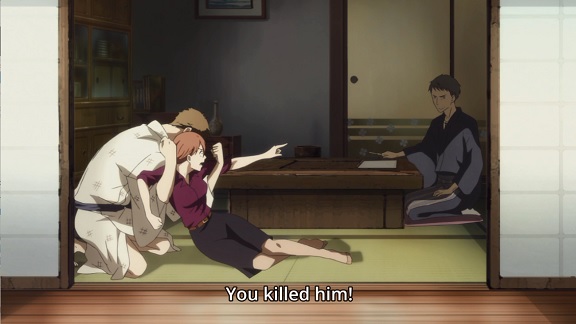
That first episode, in which a young man just out of prison becomes the apprentice of a famous rakugo performer, gets obsessed with the rakugo of said performer’s late partner through the influence of the late partner’s daughter and has to prove the value of rakugo to his old gang boss, is actually a bit of a red herring. The rest of the series actually flashes back to the early days of his master and his late partner, in order to answer the accusation that he actually killed him. I didn’t realise this would be the case when I watched the series, so the first couple of episodes I kept expecting to pop out of the flashback; instead we’ll get a new series next season.

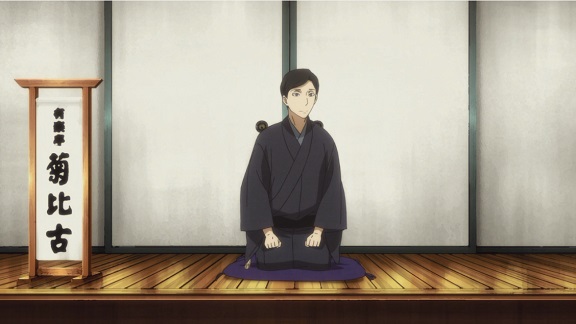
Rakugo: Kihuhiko performing

The series therefore only starts from episode two, in which Bon, the young son of a geisha who had become crippled in an accident, is apprenticed to Yakumo Yurakutei VII, the Seventh Generation rakugo performer to use that name — with Bon ultimately having become the Eight Generation as he is in episode one. Bon is given the name of Kikuhiko by his new master and likewise another boy who’s also apprenticed on the same day is christened Sukeroku. Whereas Kikuhiko is stiff and uptight and only coming to rakugo because he has to, Sukeroku is brash and easygoing and already loves it. They become friends and fellow performers and the series follows them until that faithful day that Sukeroku died. All of which happened some thirty-forty years before the present of episode one, which is the early seventies, starting before the war, with Sukeroku’s death some twenty years before episode one.

Rakugo: Sukeroku performing

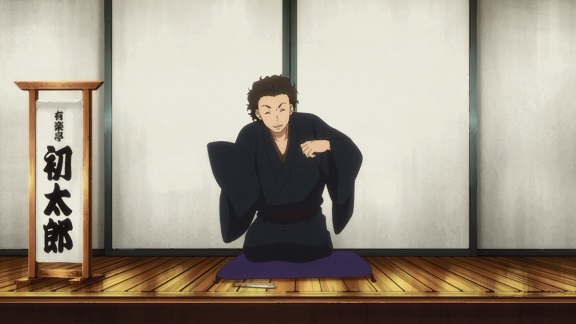
At the heart of the second episode are the first performances of Kihuhiko and Sukeroku: the former is stiff and has memorised his performance, but brings no live to it, while the latter is funny and full of character. Much of the tension between the two friends revolves around this, about Kihuhiko’s perfectionism against Sukeroku’s much more lax but more interesting performance, with Kihuhiko at first chasing Sukeroku, groping towards finding his own style of rakugo to be able to get a similar response from the crowd as he does. Most of this is shown from Kihuhiko’s point of view, as he’s the one telling this story. It’s clear that he both envies Sukeroku and loves his rakugo.

Rakugo: Sukeroku performing

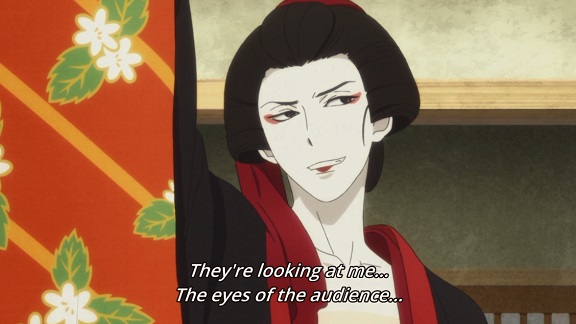
Performance is at the heart of Shouwa Genroku Rakugo Shinjuu and the series is never afraid to show complete performances. There’s little of the trickery that can be done to keep an audience’s attention when you’re afraid what’s on stage isn’t that interesting. Instead it makes full use of the capabilities of anime to show exactly the right gestures, eye movements and other subtle cues to keep you on your toes; this is not a series that could be easily reproduced as live action, even if it doesn’t start giant robots. If you want to judge for yourself, the series is available at Crunchyroll.

This was day twelve, the last day of the Twelve Days of Anime.

Day 11: race war, grief and fanservice with Grimgar


Perhaps it’s not entirely accurate to call Hai to Gensou no Grimgar overlooked, but it did sort of get snowed under by first KonoSuba and then Re:Zero in the Trapped in Fantasyland genre. I’ve talked about Grimgar before. For me it was one of the best series this year for its treatment of grief, fanservice and what it would actually be like to be transported to a fantasy world. It helps that the animation itself is gorgeous, the background scenery especially, but also the fight choreography as shown above.


Grimgar‘s plot is fairly simple: a group of people is transported to a magical world, losing most of their memories in the process and are immediately drafted to fight in a low level race war against goblins and other fantasy monster races. Most of the competent people go off on their own, leaving our group of six losers to band together to try and survive, having to kill monsters to earn money to pay the rent. And this not a sterile exercise of monster slayers: the goblins they encounter are clearly thinking, feeling creatures fully capable of feeling fear or pain when they’re chased down, as above. This theme is mostly prevelant in the first four or so episodes, before the story moves on to other matters

The death of Manato from Hai to Gensou no Grimgar #4

The reason the story moves on is the death of one of the original crew: Manato, the defacto leader who kept the team together. His death hits the team hard, as you might expect and the rest of the series, but especially episode four and five explore his death and the grief felt by his team mates. At first there’s anger and denial, a refusal to believe he really is dead and it is only after they were forced to cremate him that anger makes way for a dull acceptance. The party is splintered, robbed off its heart, each of them alone and lonely and only capable of thinking of their own grief, something the opening scenes of episode five make painfully clear. What makes Manato’s death especially hard to deal with is that it was avoidable: the party got caught up in its own hubris, became careless, took one too many risks. And thanks to pre-existing tensions in the team, they find it hard to overcome their grief and come back together.

Grimgar: fanservice

The reasons for the tensions can mostly be summed up in one word: Ranta. The redhaired, impulsive sword fighter of the team, from episode one Ranta has been sexually harassing the girls in the team, with the three other boys neither joining in but at first not stopping him either. Because these are strangers needing each other to survive rather than friends, there is this tension between wanting to shut him up and not wanting to risk his temper because they need him. That this takes its toll on the two girls is less recognised, at least at first. It needs Manato’s death to be resolved. Grimgar makes it clear that the usual anime light sexual harassment antics are actually pretty disgusting and upsetting to the people on the receiving end. Unfortunately the camera hasn’t gotten the message and the focus on the female characters far too often rests on their butts, breasts or legs, undermining its own message.

This was day eleven of the Twelve Days of Anime. Next: Showa Genroku Rakugo Shinju.