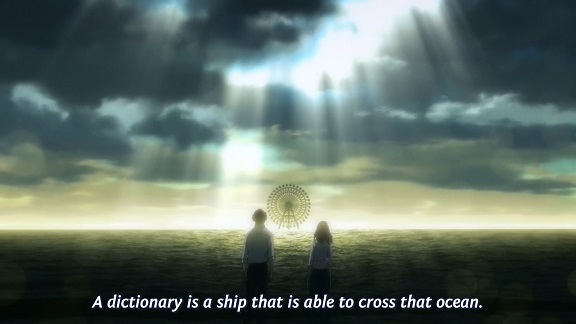
Day 10: Dictonary bros — Fune Wo Amu

Fune Wo Amu: the ocean of words

It’s a shame that one of the best series this year has had so little opportunity to finds its audience. As you know Bob, earlier this year Amazon signed a deal to get the exclusive rights to the Noitamina block of anime. At first this worked out great for them as the first series under the deal was Koutetsujou no Kabaneri, made by the studio behind Attack on Titan with a similar concept, which got a lot of attention. But then the next series was Battery, ostensibly a baseball series but actually about coming out as gay in small town Japan, which for some reason was much less popular. And the series after that, Fume Wo Amu was even less designed to get a mass audience: who’d want to watch a series about creating a dictionary? Especially if you have to get a subscription with yet another streaming service for it?
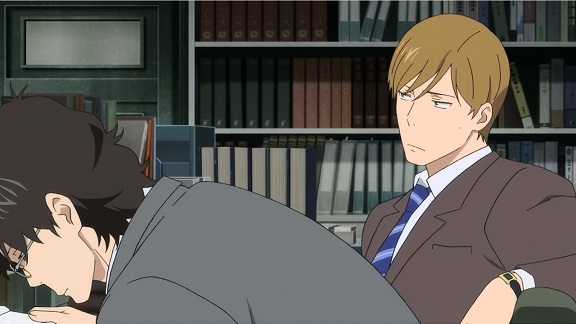
Fune Wo Amu: a good team

Which is a pity, because Fune Wo Amu is indeed one of the best series this year, a thoroughly mature workplace drama that is subtle in a way that anime often isn’t in depicting conversations and relationships. And the main relationship is the one between the two dictionary bros, the protagonist Mitsuya Majime and the man who recruited him for the dictionary editorial team when he saw he was a lousy salesman but had an unique way with words, Masashi Nishioka. The former has some form of mild social anxiety, finding it hard to talk to people, but being very precise with words while the latter is cocky and confident, if a bit unhappy to work in such an unpopular publishing department. You can see their personalities in everything, from how they sit to how they walk and talk. And though both change and find common ground in their work on the dictionary, the series never presents either one as wrong. Their personality is what it is and that’s alright.
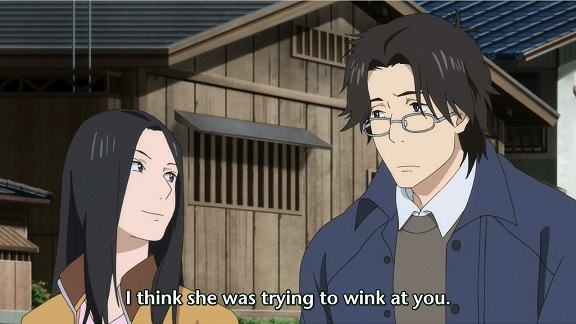
Fune Wo Amu: shipped by grandma

The other important relationship is the budding romance between Majime and the granddaughter of his landlord –who ships the two outrageously– Kaguya Hayashi. Hayashi is a Japanese chef in training when she first meets Majime and throughout the series she keeps her career going, eventually getting her own restaurant. I really like the way she and Majime interact, once they are in a proper relationship together: it feels natural, mature. With the usual anime romances being between high school students taking thirteen episodes to decide to hold hands, it’s nice to get a more adult version. Even if Majime still ends up writing her a love letter to confess. Which actually is so dense and literary written that it takes Hayashi an entire day to figure out it is a love letter.
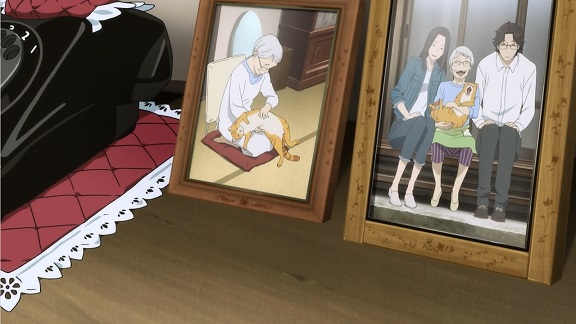
suddenly thirteen years later

With episode eight, the series makes a thirteen year time leap. It’s an interesting decision and not one you expect in an eleven episodes series. It means skipping over all of the plot developments that were set up in the previous seven episodes, going straight to their resolution. Which means we missed most of the sweet romance building between Majime and Hayashi, going straight to them having been married for several years already, with both Hayashi’s grandmother and her cat having died in the meantime (we also don’t find out what happened with Nishioka and his girlfriend until the last episode). Disappointing as this is, it does pull the focus back on what the series is really about: the work on the dictionary. Having skipped the years of hard slog through the Japanese language collecting the words for inclusion, it means the series can now concentrate on the end spurt.
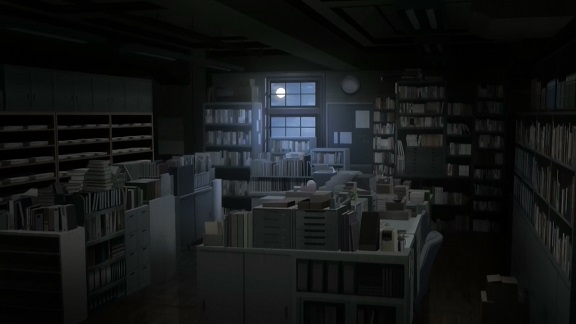
Fune Wo Amu: the end of the road

Which means that in the series we get to witness the entire birth process of a dictionary and find out why it is important, why the people working on it find it important. For any book nerd like me this is something that hits close to home, even if I’m not particulary interested in dictionaries myself. Fune Wo Amu for the most part manages to do this without preaching, just through showing the various people working on it go on about their business, dealing with minor crisises. This is one anime which truly believes in show, don’t tell, isn’t afraid to let viewers draw their own conclusions. That’s why it’s in my top five shows for this year.

This was day ten of the Twelve Days of Anime. Next: Hai to Gensou no Grimgar.

Day 9: melancholy

She and Her Cat

Melancholy is underrated as an emotion in fiction. Used properly, it can be immensely powerful, but the danger is always that it’ll slide into sentimentality. There were two shows this year that attempted to walk this tightrope and both managed to succeed. Of the two, She and Her Cat: Everything Flows was always the most likely to succeed. It is after all based on an Makoto Shinkai short movie, who you may know from the recent mega hit movie Your Name. The series takes the overall story of the movie and expands on it, taking a four minute film and turning it into four seven minute episodes.

She and Her Cat

As the title indicates, this is the story of a young woman and her cat, living together, as told from the perspective of Daru, the cat. It starts when the woman has just started her first job after college and the cat is already at an advanced age. Which means you spent the whole series anticipating and dreading Daru’s death. It’s the nature of cat stories and it is what gives this series its melancholy mood, underscored by Daru’s reminiscences about the past with Her. Available over at Crunchyroll, watching it will take you less than half an hour but if you’re a cat person like me it will leave you an emotional wreck the rest of the day.

Planetarian: moe meets Junker

Planetarian tackles a more grandiose sort of melancholy. Set in a post-apocalyptic world, a man who calls himself a Junker wanders into an abandoned city only populated with killer robots to scavenge for supplies. Chased by one such robot, he ends up at an old department store and when exploring it comes across the store’s old planetarium and its caretaker android, still functioning thirty years after the staff evacuated. Said android is incredibly moe, cute and cheerful, but the Junker is not impressed. Too young to have know life before the war, he has no use for planetariums, cute robots or anything not related to survival. The android, Hoshino Yumemi, on the other hand knows nothing but the planetarium and doesn’t realise why no customers have visited in 29 years and 81 days.

Planetarian: in her element

Needless to say, the junker’s attitude gradually softens over the course of the five episode series, helping Hoshino restore the Zeiss projector and get the planetarium up and running again for one last show before the emergency power that had kept it and Hoshino active runs out. Hoshino gets her show in episode three and it’s the heart of the series. Here we are, in the middle of an abandoned city on a planet torn apart and devastated by war, where survival is all that people are capable off, being shown everything humanity lost by an android that was the peak of human achievement, unaware of the depths her creators have sunk to. It’s a poignant scene that echoes through the rest of the series. As with She and Her Cat, you know Planetarian will end in tragedy but even if Hoshino died, it was enough that she got to play that final show for an audience she could never have expected to have.

This was day nine of the Twelve Days of Anime. Next: Fune wo Amu.

Day 8: exceeding expectations with AoKana and Alderamin


There are no phrases that make me readjust my expectations of a new anime downward faster than “light novel adaptation” or “based on a visual novel” (well, perhaps, “inspired by a mobile game”). In the former case because nine out of ten of them seem to be utterly mediocre “only boy in magic school” series, in the latter because nine out of ten of them are equally mediocre harem series. Both types of adaptation can lead to true classics (Monogatari series, Steins;Gate) but usually that’s not the way to bet. So in the case of Ao no Kanata no Four Rhythm (visual novel/dating sim) and Alderamin on the Sky (light novel) I went in with few if any expectations. And found that for once, they were exceeded.

AoKana: the first flight of Asuka

Ao no Kanata no Four Rhythm first. This was originally a visual novel loosely based around a future sport called Flying Circus, in which you use anti-gravity shoes to fly and race around a circuit, in which you played Masaya Hinat, your average sad sack protagonist with a dark past who encounters various girls, helps them overcome their problems to ultimately bang them (or even lewder, hold hands with). The anime improves on this with one simple change: completely losing the dating aspects to focus fully on the Flying Circus antics, downgrading the protagonist to a supporting character in the process and focusing instead on the main heroine, Asuka Kurashina, who’s new to the sport and whose story makes for a decent sports anime arc.


Which is basically what AoKana turned into: a sports anime that follows Asuka’s rise from rank amateur to the top of the sport, overcoming various obstacles and crisises of faith along the way. Instead of Masaya overcoming his past trauma while helping various girls overcome theirs, they do it themselves while realising or re-discovering their love for Flying Circus. It follows the standard training – tournament – more training arc of a sports anime, with as climax Asuka winning the big Fall Tournament. To be honest, most of the actual battles are somewhat boring, but on the whole this was a series that was incredibly enjoyable week by week, because the characters were so much fun, especially Asuka, who’s bright, cheerful and full of enthusiasm. It’s available for legal streaming at Crunchyroll.

Alderamin: Ikta and Yatori

Alderamin starts off looking very much like your run of the mill light novel adaptation. There’s the world itself, a mismatch of steampunk and medievaloid fantasy elements. There’s the black haired, talented, rather be lazy than tired, lecherous hero, Ikta Solork, who has reluctantly agreed to join the military to help his childhood friend, the talented, redhaired swordswoman Yatorishino Igsem. She has the required tsundere traits: punishing him when he gets too frisky with another girl and such. When the ship they’re traveling to the military academy on sinks, they’re shipwrecked together with four classmates — inlcuding Chamille Kitra Katvarnmaninik, the third princess of the Imperial Family, who is saved from drowning by Ikta. The six become heroes, with all of them knighted (except the princess of course), after they escape from behind enemy lines, thanks to Ikta’s plan. Off they’re packed to the military academy, to learn how to become proper officers.


So far, so generic, but that’s only the first four episodes, setting up the characters before the real story starts: episodes six to thirteen form one continuing story — and it’s based on the Indian Mutiny of 1857! Ikta and company are shipped off to the northern mountain range, where the empire rules over the mountain peoples much in the same way the British ruled the North-West Frontier in India. As in the real life mutiny, religious tension ultimately leads to rebellion, which turns out to have been provoked by foreign agents in order to justify an invasion. It’s Ikta who, from his low position as just another rookie officer, has to guide the empire’s defence as much as he can. Despite the inevitable outcome (and the introduction and killing off of a new character just to provide Ikta with some personal motivation and angst) this was still one of the better depictions of war in anime, using proper tactics and actual strategy rather than just punching harder. All of the cast gets to show off their talents, especially Yatori, as shown above.

Alderamin: Yatori will kill herself before killing Ikta

Yatori is the other reason Alderamin stands head and shoulders above other light novel adaptations. In other series she would be the obvious love interest, but here she and Ikta are something else entirely. They trust each other completely, they clearly love each other, but they’re not in love. Yet for each, the other is the most important person in their lives. Yatori is extremely duty and honour bound, having grown up as the only daughter of a prooud military family, but when contemplating whether her honour could even go so far as to kill Ikta if the empire asked for it, her answer was that she could, but only if she killed herself first, removed every trace of Yatori from herself and leaving only a killing machine. the crux of their relationship is shown in episode five, a flashback to when they first met as children and how together, with Ikta’s tactics and Yatori’s sword skills, they managed to fight off a gang of wild wolves.

Alderamin: save the country, lose a war for me

A compelling war story as well as a strong and almost unique friendship between the male and female leads are two ways in which Alderamin is better than most light novel adaptations, but it also manages to avoid one particular weakness of such series. Because they’re usually based on still ongoing series of novels, such anime are often unable to present a complete story. Alderamin could’ve suffered the same fate, if not for one small change it made, by moving a crucial scene back. In the last episode, after Ikta has suffered through the war and seen how fragile the empire is, the princess asks him for a favour: to rise to the top of the military and then lose a war, to shake the country up and make space for renewal. Had this scene happened when it did in the manga version, just before they went off to the military academy, the rest of the series would’ve felt incomplete, because that goal could never be reached in thirteen episodes. But coming as it does at the end, it’s now a conclusion, not a setup.

Alderamin is available from Crunchyroll. This was day eight of the Twelve Days of Anime. Next: Planetarian and She and Her Cat.

Day 7: the pleasure of having read a book

Bernard Jou Iwaku: the secret of reading

Bernard Jou Iwaku is not afraid to tackle the big issues: how to read books if you don’t want to read them, just want to have read them. The courage to read the Wikipedia plot description. Miss Bernard — actual name Machida Sawako — is the sort of poseur you’ll find in any book club or fan group, somebody with an opinion about anything whether she has read it or not. Not a bad sort at heart, if a bit obnoxious and smug.And to be honest, if you’re a reader, there will have been moments when you’d rather not want to read the book you want to have read.

Bernard Jou Iwaku: what to recommend

On the other side of the spectrum is Kanbayashi Shiori, who’s not just enthusiastic about reading books, but really enthusiastic about sharing her favourite books with others — though she has some difficulty in deciding which book to share. She and Machida regularly clash when she gets infuriated by the latter’s idiocy, but in the end Kanbayashi needs her as somebody to talk books with. They’re both book geeks so despite their differences, they need each other.

Bernard Jou Iwaku: geeking out

The series itself is pleasantly nerdy about reading as well and seems to be especially fond of somewhat obscure (American) science fiction authors. In a time when young people reject even the classics it’s amazing that Kanbayashi doesn’t just name drop Egan, Asimov, Heinlein, Tiptree and Clarke, but also much less well known writers like Avram Davidson, Theodore Sturgeon, Olaf Stapledon, not to mention Manly Wade Wellman? I’m seriously considering entering Bernard Jou Iwaku for the Best Related Hugo.

This was day seven of the Twelve Days of Anime. Next: Alderamin / Ao no Kanata no Four Rhythm.

Day 6: mecha-nised warfare

Kuromukuro: smart mecha action

2016 was a pretty decent year for mecha anime. We got several Gundam series and specials of course, but also the latest Macross installment, a glimpse at the upcoming Patlabor reboot as well as several new mecha series. Of those, Active Raid (police in powered suits) and Schwarzenmarken (East German robots fighting off an alien invasion in 1983) were pretty meh while Bubuki Buranki (five kids combine to form a super robot and fight a worldwide conspiracy) redeemed itself with its second season. But the series that impressed me the most this year were Kuromukuro and Regalia: The Three Sacred Stars.

To start with Regalia, this is what you might call a super robot show, with immortal lolis piloting giant magical mecha fighting an immortal shota piloting an even bigger magical mecha. It started off well, but then ran into production problems and instead of finishing its run in Summer, was instead reran this Fall season. Perhaps that’s why it got relatively little attention. Which is a shame, because this was quite a nice, if simple series. What’s more it’s mecha fights are 2-D animated, a rarity in modern mecha series, as most are now CGI, like Kuromukuro.

Regalia: Rena and Yui

The story revolves around Yuinshiel “Yui” Asteria and her adopted sister Rena Asteria. Yui is actually the empress of Enastoria but for the most part lives like an average school girl. When a giant robot pops up to kidnap Rena, Yui discovers that her loli sister is actually the soul of a magical mecha herself and she needs her to fight together. From there on several other Regalia pairs pop up, some friendly, some not so much as Yui’s country is put under siege and the disaster that happened to a neighbouring country twelve years ago threatens to repeat in Enastoria. Throughout the series emphasises the importance of family and female friendship as counterweight to the very masculine sort of power seeking of the male villain: Yui and Rena may be overpowered by him, but thanks to the friendships they make they still have a fighting chance. Not a new idea, but well executed here and always a pleasure to see among more cynical series.

Kuromukuro on the other hand is the story of a four hundred year old samurai and a modern school girl piloting a giant sword wielding mecha to fight off an alien invasion. This was everything you might want from a mecha series: great fights, good mecha designs, a decent plot that actually manages to answer most of the questions it raises, likeable characters, sword fights and gorgeous animation. But again, it got less attention than I expected. Perhaps because this was a Netflix exclusive and released in two thirteen episode batches at the end of the Spring and Summer seasons respesctively. In an age where every other series is streamed immediately after an episode is shown on Japanese television and anime fans have gotten used to discuss anime on a week by week basis, this may have hindered it from finding an audience.

Yukina Shirahane is visiting her mother, who is the director of a huge research lab looking into buried alien artifacts discovered sixty years ago, just when the lab comes under attack from a series of mecha. She finds herself being shot at by one of the mecha which had managed to enter the building she was in, only to be saved by a buck naked samurai she just freed from one of the artifacts. The samurai turns out to be Kennosuke Tokisada Ouma, whose last memories are of a battle over four hundred years ago. He thinks she is his clan’s princess and vows to protect her, while she is slightly flabbergasted by it all. Circumstances force them to pilot the Kuromukuro (“Black Relic”) together and because of this they’re drafted to fight against the invading alien mecha.

Kuromukuro: family

With twentysix episodes to play around in, Kuromukuro has the room to breathe and give some attention to the daily lives of its characters inbetween the battles. So of course Kennosuke transfers into Yukina’s class and hangs around with her friends. As Mage in a Barrell noted yesterday, the first half of episode one just follows Yukina on her daily routine before all hell breaks loose and the series repeatedly returns to the increasingly turned up side down familiarity of day to day life. Some scenes could just as easily have fit into any of P. A. Works other slice of life series. This gives it a charm that reminded me of e.g. Eureka Seven or Xam’d Lost Memories.

Kuromukuro: smart mecha action

Nevertheless the real attraction is of course the mecha action and Kuromukuro doesn’t disappoint. For once the conventional military forces aren’t entirely useless in fighting robots. Though not up to facing the enemy’s super mecha, the smaller ones can be destroyed by tanks or the JSDF’s own mecha. It’s not just a series of showy one on one battles: both the invaders and the defending forces do have some sense of tactics. And while some of the ways in which the aliens fight make little sense at first and the same goes for their motivations, these questions are satisfactorily answered by the end of the series as is the question why if these are aliens, they look so damn human.

TL;DR: Kuromukuro is a great series you should check out if you like mecha, science fiction or samurai and if enough people do so we may get a second season.

This was day six of the Twelve Days of Anime. Next: let’s look at some short shorts.