Hibike! Euphonium


When I started watching anime back in the eighties, it was for the science fiction adventure and jiggling cartoon boobs, so I’m just as surprised as you to have found myself watching and enjoying a series about a high school band and their struggle to improve. It’s not like I was a band geek in high school or something; in fact high school bands are rare to non-existent in the Netherlands. There are marching bands (fanfares) but those usually are independent clubs or societies. Perhaps it’s just that, like Shirobako, this is about competent, passionate people pursuing their dreams. There’s also that slightly fannish thrill of having the basics of an unfamiliar craft or profession explained to you.

The plot itself is fairly straightforward. Our protagonist, Kumiko Oumae, is a first year student at Kitauji high school, who used to play in her middle school’s band and has selected kitauji to make a fresh start and reinvent herself. She’s definately not going to play in her new school’s wind ensemble club, especially since it’s not very good, to be polite. Whereas her former school managed to get gold at the prefectural competition, though didn’t advance to the next stage, Kitauji never managed higher than bronze, with the current band members largely demoralised. So obviously Kumiko isn’t going to join. And if her newly found friends convince her to do so anyway, clearly she isn’t going to play the same boring old euphonium she played through middle school, right? Then again the series is called Hibike! Euphonium so perhaps Kumiko’s wishes don’t quite come through.


As Kumiko gets sucked into band life again, the new advisor and music teacher Noboru Taki puts a simple question to them: do they just want to have fun, or do they want to get serious and aim for the nationals? It has to be the second choice of course for a series like this, as we follow the band as it gets serious, straightens itself out and takes its first steps on the road to the nationals. With just thirteen episodes in its first season and taking a leisurely pace, we don’t get there. The climax of the series is the prefectural competition, where we get to see if Kitauji for the first time ever can advance to the next stage. It’s very much like your typical sports competition movie, except that here there’s no rival school to fight against.


An anime series about music of course stands or falls with not just the music, but with the depiction of the music. Especially in a proper high school band setting, you cannot cheat. Every time an instrument is being played it has to be done correctly, mirroring the music being played and when you have several dozen people playing a dozen or more different instruments simultaneously, it becomes complicated. Hibike! Euphonium pulls it off though, as you can see from the clip at the top of this post. But it does more.

This is after all the story of a high school band that starts out bad and improves. Which means that not only do you need to see them play music, you need to see them play music badly and getting better. Compare the clip one paragraph above with the one below: the same piece of music played with the difference of time spent learning to play together as an ensemble. Even for a lay person like me the difference is clear. And it’s an earned difference: there are magical breakthroughs or genius individual musicians, just people determined to get better and working hard to do so. Hibike! Euphonium continually drives home the point that improvement requires graft and talent, not just the latter. As such therefore you’ll hear a lot of repeated snippet of music as the individual musicians and sections rehearse, then watch it all come together in the performance. The care and attention with which Kyoto Animation, the studio responsible for the series, put into animating this really pay off.


Kyoto Animation has of course a reputation to uphold, having a proud history of producing quality anime. It’s therefore not surprising to see the same sort of care lavished on the cast. This is not just the Kumiko show, as the show regularly checks in with other characters too, even if most of the series is seen through her eyes. Apart from her friends in the bass section, which include the wind ensemble’s vice president, there’s also her childhood friend who now plays trombone and several of the second year students left over and desillusioned from their experiences the previous year. Each of these is fully fleshed out even when we’re only seeing them for short periods at a time. Hibike! Euphonium is first and foremost an ensemble show.
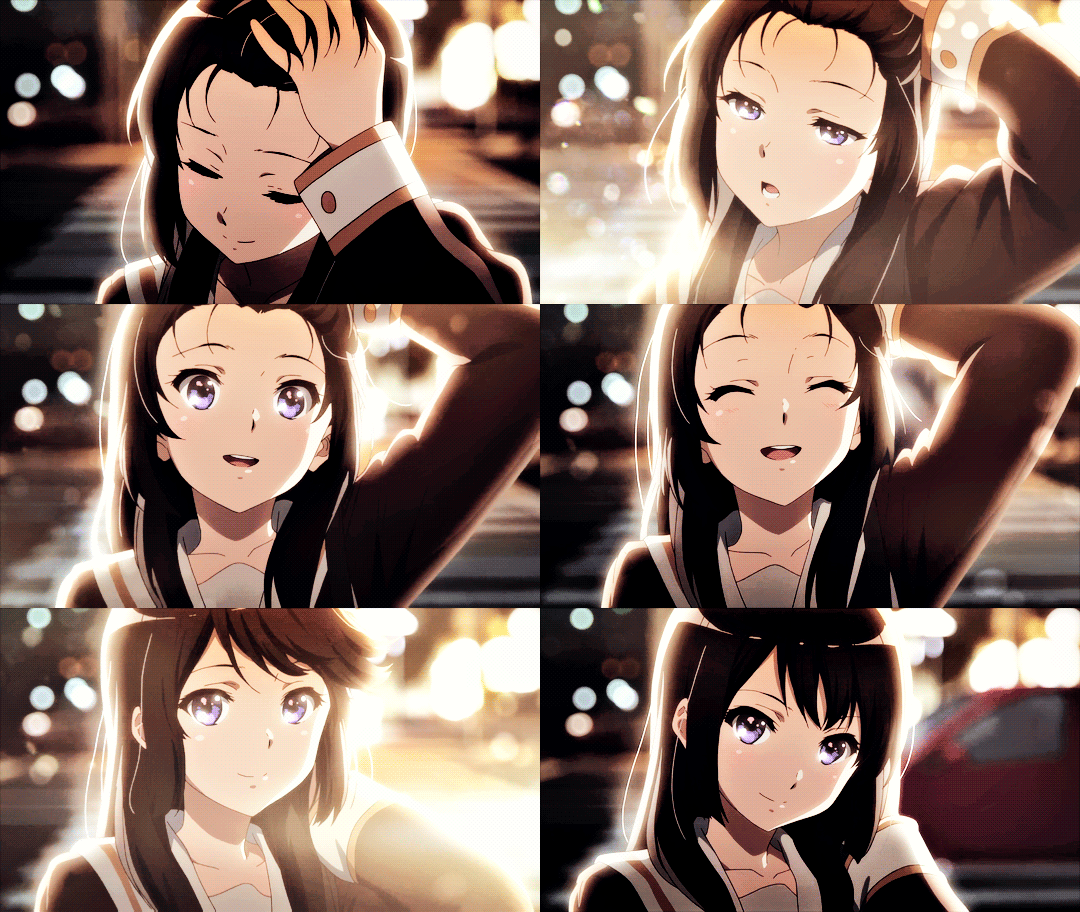
the hairflip that launched a thousand ships

But at the heart of it is the relationship between Kumiko and an old middle school classmate of hers, Reina Kousaka, who is introduced along Kumiko in the very first scene of the series. Reina is ambitious and determined to be the best, with a seemingly cold personality, whereas Kumiko is good natured and inclined to go with the flow. She has one flaw though, a tendency to speak her mind at importune times, as she does in that first scene when Reina is disappointed at their school not going through to the next round and Kumiko is surprised she thought that was even possible with their band. This sets up their dynamic in high school, as Kumiko regrets her words and is slightly in fear of Reina, wanting to apologise and make up but not quite sure how. As it turns out, she needn’t have worried.
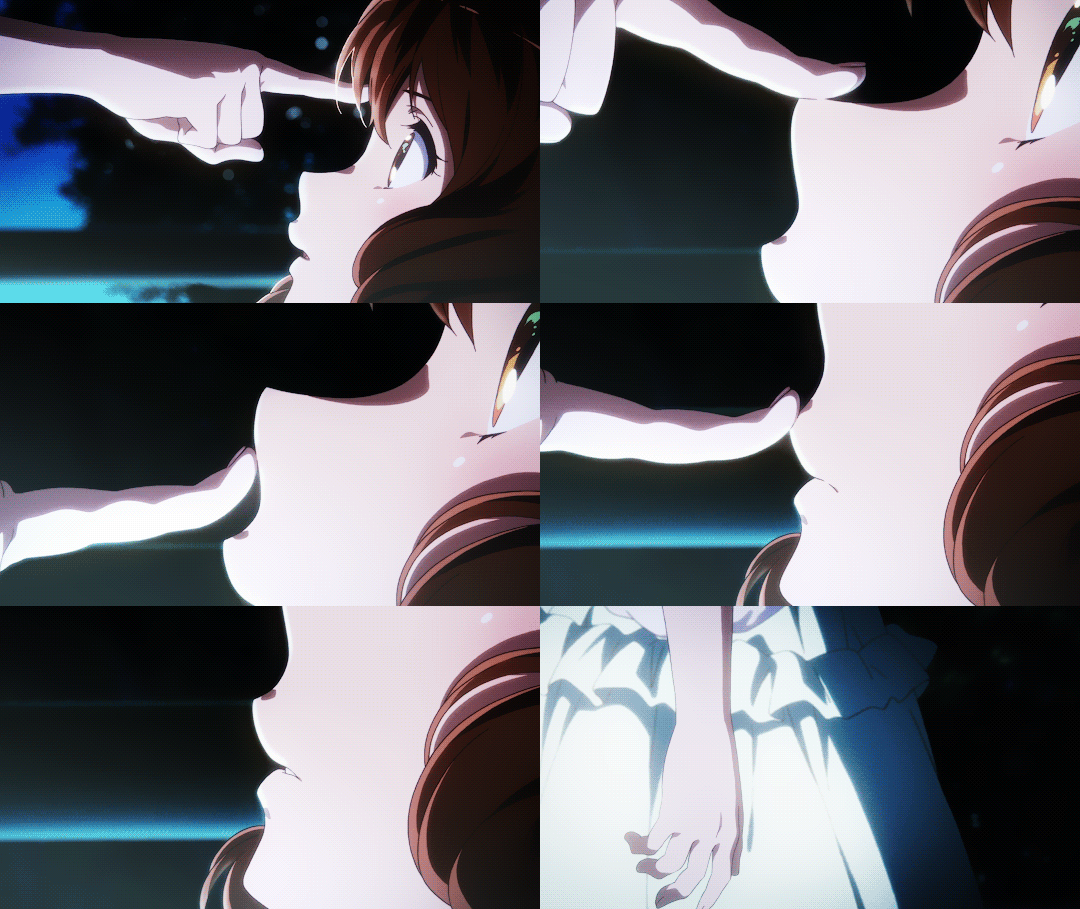
Reina loves Kumiko

Because it’s pretty clear that the tension between Reina and Kumiko is based on more than just ill feelings… Though in the thirteen episodes so far it’s been teased more than explicitly stated, both have made love declerations. Episode eight in particular, in which Kumiko denies wanting to date her childhood friend and instead asks Reina to go to the Agatha festival with her, is food for shippers. The Reina x Kumiko slow burn romance is one of the best I’ve ever seen in an anime series because it’s so believeable and sweet, rooted in their personalities. Reina’s passion for being the best trumpetist she can be is what attracts Kumiko while Reina is curious about Kumiko’s real personality behind her good girl mask, as it comes out through her habit of making thoughtless, snarky remarks. Their romance doesn’t take away from the larger story, but is bound in with it.

So yeah, a series about a school band is the best series of 2015 for me, one of the best series I’ve ever watched. If you want to try it for yourself, it’s available on Crunchyroll.
The Puppies lost the Hugos. Again.

The Hugo Award winners:

  • Best Novel: Three Body Problem by Cixin Liu, translation by Ken Liu (Tor Books).
  • Best Novella: No Award
  • Best Novellette: “The Day The World Turned Upside Down” by Thomas Olde Heuvelt, translation by Lia Belt in Lightspeed Magazine, April 2014
  • Best Short Story: No Award
  • Best Related Work: No Award
  • Best Graphic Story: Ms. Marvel Volume 1: No Normal written by G. Willow Wilson, illustrated by Adrian Alphona and Jake Wyatt (Publisher).
  • Best Dramatic Presentation, Long Form: Guardians of the Galaxy written by James Gunn and Nicole Perlman, directed by James Gunn (Marvel Studios, Moving Picture Company)
  • Best Dramatic Presentation, Short Form: Orphan Black “By Means Which Have
    Never Been Tried” written by Graham Manson, directed by John Fawcett [Space/BBC America] (Temple Street Productions)
  • Best Editor, Short Form: No Award
  • Best Editor, Long Form: No Award
  • Best Professional Artist: Julie Dillon
  • Best Semiprozine: Lightspeed Magazine, edited by John Joseph Adams, Wendy N. Wagner, Stefan Rudnicki, Rich Horton and Christie Yant
  • Best Fanzine: Journey Planet, edited by James Bacon, Chris Garcia, Alissa McKersie, Colin Harris, and Helen Montgomery
  • Best Fancast: Galactic Suburbia Podcast, Alisa Krasnostein, Alexandra Pierce, Tansy Rayner Roberts (Presenters) and Andrew Finch (Producer)
  • Best Fan Writer: Laura J. Mixon
  • Best Fan Artist: Elizabeth Legget
  • The John W. Campbell Award for Best New Writer: Wesley Chu

Like last year, it has once again been proven that slate nominations can succeed but cannot win the Hugo Awards, yet do poison and disrupt them. We’ve had five No Awards votes previously; this year doubled that as voters rejected slating and the inferior works forced on the ballots that way. But it still meant that deserving people like Eugie Foster, for whom it would’ve been her last shot at a Hugo, were cut from the ballot to make way for assholes and chancers not good enough to get nominated on their own merit.

It also makes for mixed feelings about the first ever win of a Dutch person, Thomas Olde Heuvelt, whose story was …not good… to put it politely and somewhat on the sexist side and who won by default as the only non-Puppy nominee in that category. I wish i could celebrate his victory with a clear conscience and I’m happy for him, but going up against real competition there was no way he could’ve won.

Last year when the results had been made known i was convinced that the Puppies would’ve learned to leave well alone, to have realised that slating could get them nominated but not win the Hugos. This year I know there will be more shit, but fandom is mobilised now. Hopefully this means next years nominations are less of a trainwreck.

UPDATE: looking at the nominations data (PDF) makes clear what a waste the Puppies made of the Hugos. Just scroll through the short story, novelette and novella categories to see what could’ve been. For one thing, they cost Eugie Foster her last possible nomination.

Worldcon 75: Helsinki

It’s official: Worldcon 75 will be held in Helsinki, as it should be. Even if the North-American vote hadn’t been split between Washington and Montreal, Helsinki would’ve won. Barring accident, it’ll be the second worldcon I’ll be going to, but I wonder how hard it would be to do by train from Amsterdam to Helsinki?

Shirobako redux

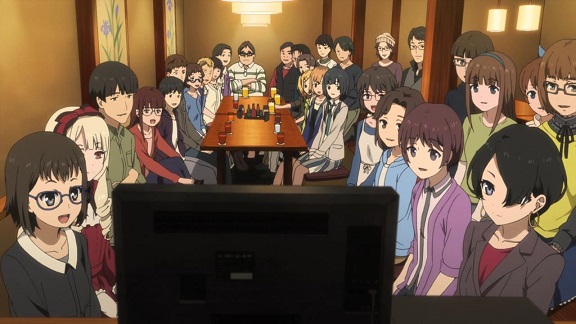
watching the broadcast of the final episode

Remember when I said Shirobako was too good to watch quickly? I lied. instead, what i did was basically inhale the entire twentyfour episode series over the course of a weekend because it was just too good not to. This is one of the best, if not the best anime series I’ve seen in a long time, perhaps only matched by Ghost in the Shell: Standalone Complex which I binge watched earlier this year.

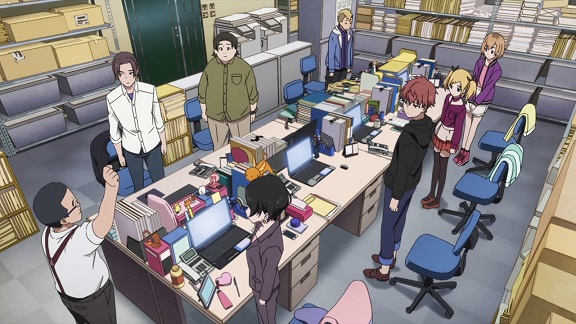
The Shirobako production staff holding their daily standup

Three reasons why I liked this so much: 1) its love for anime as a profession and medium, 2) its great, female centered cast (without the usual sexist bullshit of a lot of female centered anime) and 3) it’s a properly adult story about doing a job you love in an industry you love, with all the ups and downs that entails, that manages to be upbeat without losing sight of the realities of working in an industry build on exploiting the dreams of the people working in it.

the Exodus protagonists visit their creator

To start with the last, Shirobako follows the production of two successive anime series put out by Mushashino Animation, a smallish studio that has seen better years, mostly through the eyes of Aoi Miyamori, a production assistant, who vowed to break into the anime industry when in high school, together with her four friends of the anime club. Any notion of glamour though is largely forgotten under the pressure of getting Exodus, Mushashino’s first big new series in years, onto the television screen in time. Much of Miyamori’s work therefore consists of her running around between the various people involved in making anime, both in the studio and as freelancers: animators, 3D designers, colourists, sound production, etc, to get the work that needs done for the episodes she’s responsible for.

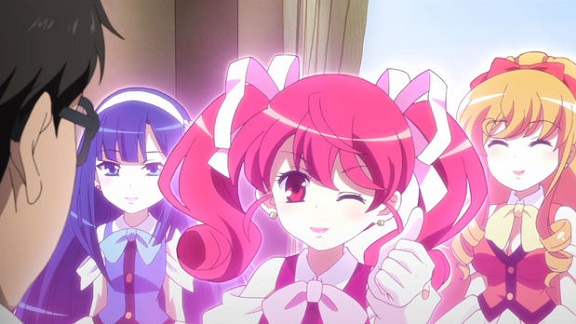
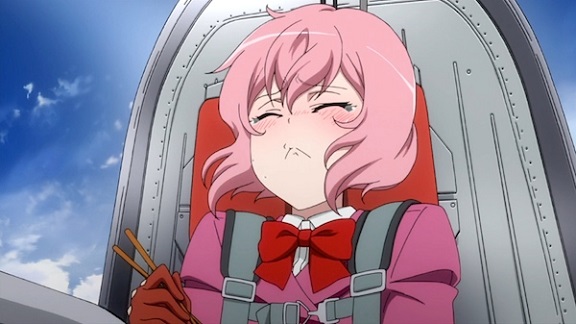
Aria Hitotose enjoying a sour plum from Third Girls Aerial Squad

That felt really familiar from working on big software projects, especially the frantic search for solutions when deadlines come close and things go wrong. In the second part of the series this gets even worse, as Miyamori is promoted to production desk, now responsible for coordinating the entire series of the new anime, The Third Girls Aerial Squad, rather than just individual episodes. Interestingly, it’s this part of the series which has most of the “as you know, Bob” explanations you’d expect earlier, somewhat justified by Miyamori learning the ropes of her new role, while the first few episodes instead almost drown you with jargon and the introduction of the many, many, people you need to make an anime.

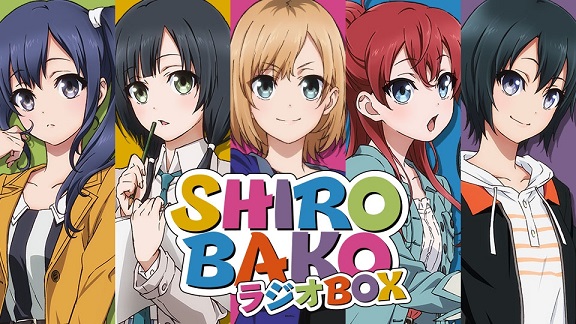
the five protagonists of Shirobako

Which brings me to the second reason for why I like this series so much: its great cast. It’s centered around five high school friends who all are now either working in the anime industry or trying to break into it. Besides Miyamori, there’s Ema Yasuhara, working as a key animator at the same company, Misa Tōdō, working as a 3D computer graphics animator at a company specialising in doing cars, Shizuka Sakaki, an aspiring voice actress and Midori Imai, still in university and who wants to become a script writer. Miyamori is the series protagonist, with the other four regularly checked in on. They made a vow together back in high school, that one day they’d all work on their own movie and they’re hard at work realising their dream.

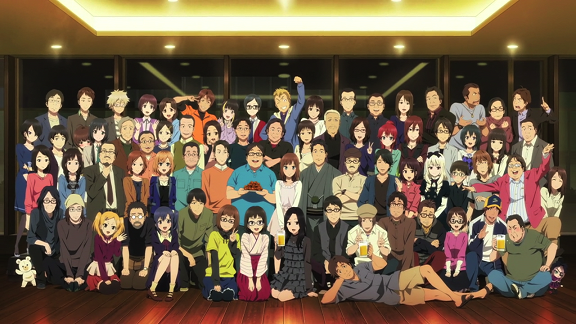
the Mushashino Animation crew

But that’s only a small part of the total cast, as Shirobako, especially in the first several episodes makes a point of hitting you over the head with how many people it takes to make one anime series. That picture above shows the staff of Mushashino Animation, which in itself is only a smallish studio. You’d think you’d drown in such a large cast, but the series is actually quite good at giving almost everybody their own personality. Though the focus is on the main five friends and especially Miyamori, the rest of the cast isn’t neglected either.

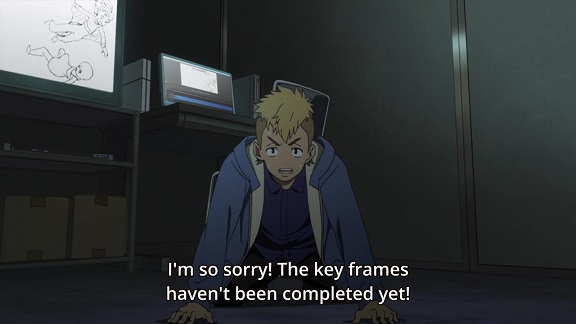
Tarō Takanashi having to apologise for one of his fuckups

As you expect in any workplace, there are personal conflicts, people agonising about their career choices, slackers, high achievers, careerists and dropouts. What’s noticably absent are the office romances. That’s refreshing; so many supposedly work based stories treat work as just the background activity to focus on romance. Yet there is pleasure in seeing competent people work together to resolve real problems and Shirobako proves that this makes for just as gripping stories as a more conventional romance story would be. What’s also refreshing is that there are no out and out villains here: even a screwup like production assistant Tarō Takanashi, pictured above, who was responsible for some of the biggest crisises in the first half of the series, learns from his mistakes and gets better. (Note: apparantly some of this is inspired both by the director Tsutomu Mizushima’s own past mistakes as well as the experiences P.A. Works had making Girls und Panzer, which twice had to resort to recap episodes due to screwups.)

With Shirobako‘s focus on Miyamori and her work as production assistant and then production desk, most of the plot therefore revolves around the production process of the two series, but her friends go through their own crisises too. Ema Yasuhara has to grow as a key animator to be able to keep up with the work demanded of her, while Misa Tōdō is well appreciated by her company and good at what she does, but is conflicted in whether she’d be better off moving to a 3D graphics company that does more varied work. Midori Imai meanwhile sort of gets her wish of breaking into the industry by becoming a researcher at Mushashino Animation, while Shizuka Sakaki struggles for most of the series getting even bit parts voice acting. It all works out in the end though, as the five get their wish to work on an anime series together. Sort of.

animators bonding over their shared love for Space Runaway Ideon

And of course at the heart of the series is the love of anime . While people have doubts, fail, burn out and recover, underneath it that love remains. So when a key animator and a CGI creator — after meddling by Tarō Takanashi again– fall out over who gets to do a key scene, it’s no surprise its their shared love of a thinly disguised Space Runaway Ideon which reconciles them.


Another example is the series that got the main protagonist Aoi Miyamori interested in anime and a career in it: Andes Chucky, a shoutout to the real life Rocky Chuck. In one of the early episodes we see her hum the theme tune walking home after having gone out with her friends one night. In episode 19, we get the full ending credits as a replacement to the normal ending song. In between it turns out one of the key animators on the series is still working at Musashino Animation, who becomes somewhat of a mentor to Ema Yasuhara.

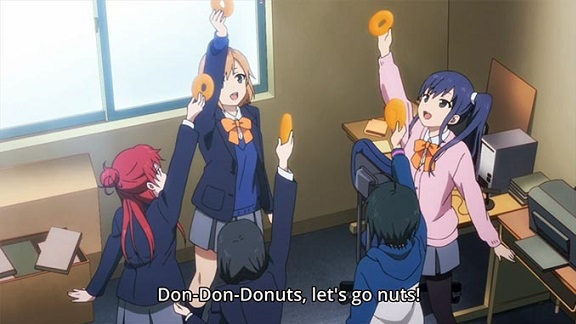
Don-Don-donuts, lets go nuts

You could argue that Shirobako paints a rose tinted picture of the anime industry, even with all the problems and stress shown, especially in how the five high school friends in the end all seem to have made it in the industry. Yet on the other hand it’s not unknown for such a cluster of talent to make it through in real life, while especially Shizuka Sakaki barely has her feet on the ladder. It is self mythologising, but it’s well done and far from saccharine so I don’t care.