Stop trusting Lou Antonelli to mend his ways

Lou Antonelli is the perfect example of why you should be wary about accepting apologies from serial abusers. Because doing so enables them in their abuse.

Lou Antonelli is one of the lesser Pups, a minor science fiction writer who’s been busy cheerleading the rightwing campaign to take over the Hugo Awards. He’s also been busy harassing people who have the temerity to disagree with him or oppose him, specialising in a less direct form of swatting, by threatening to out them to their employers, or get the police involved. He’s been getting away with it for seemingly years, mainly due to SFF fandom’s well established tendency to forgive easily. this time however Antonelli was still apologising for attempting to sic the cops on David Gerrold with various people praising him for this apology when he was caught sending his fans out to harass Carrie Cuinn. A more on the nose version of the abuse-apologise-abuse cycle of professional bullies like Antonelli is hard to imagine.

What tripped up Antonelli this time is not just that he was caught trying to get David Gerrold in trouble, but that this was David Gerrold, a well respected, well established elder statesman within SFF and fandom. Usually he picks fights with much less high profile people, random fans, authors just starting out, those who can’t hurt him or his career. He only apologises when he’s forced to, when he can’t get away with it, then as here uses this apology as a whitewash as well as a weapon to attack his next victim with.

But he’s not the sole person to blame for this. If Antonelli is the abuser, fandom is his enabler. What makes Antonelli cabable of repeating this pattern again and again is that his victims, like Gerrold, are too quick to forgive and forget. This isn’t to fault him for this, it’s an inbuild instinct of civilised people who haven’t been exposed to repeat harassment, but fandom as a whole needs to learn not to do this and learn to pay attention to when Antonelli (or others like him) does it to lower profile victims.

Not a problem unique to us of course, but made worse by the fannish phobia for social exclusion. People are willing to forgive a serial harasser like Antonelli because excluding him from fandom would be a worse crime. As long as you’re part of the incrowd, you can do a whole lot of damage before you’re finally chucked out. This is incidently the real reason why Antonelli is treated differently from Benjanun Sriduangkaew/Requires Hate: she was always an outsider. Race and gender play their inevitable roles in this as well of course, but at the heart of the difference still is the simple fact that Antonelli is part of fandom and Sriduangkaew …isn’t.

We need to change this. We cannot let people like Antonelli get away with harassment over and over again just because they have the instinct to occasionally apologise in time. Just because we haven’t been harassed personally shouldn’t be a reason to not pay attention and know when to forgive and when not to.
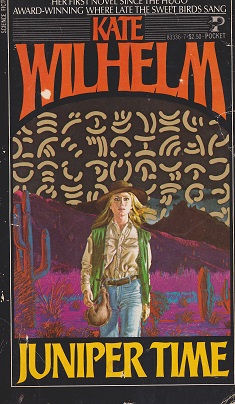
Juniper Time — Kate Wilhelm

Cover of Juniper Time


Juniper Time
Kate Wilhelm
296 pages
published in 1979

This got easier to read after the rape, which happened on page 88 but I could see coming from almost the first page. A late seventies science fiction novel, with a female protagonist and a near future setting in which America is suffering a long term hypertrophied economic depression, in a stalemate with the Russians and sliding off to an autocracy (aka standard seventies dystopia #1)? Yeah, there’s going to be a rape. It’s depressingly predictable and while it’s not the worst sort of plot motivating rape I’ve ever read and you could even argue that this time it’s truly essential to the plot, it’s still disappointing to see it used. But once it was out of the way it was much easier to enjoy what is otherwise an extremely interesting novel.

Juniper Time is a novel I first read sometime in the eighties, in Dutch translation, because of the recommendation in an old issue of the Holland SF fanzine. I remember liking it well enough at the time, but also that after I’d discovered cyberpunk, it struck me as the poster child of everything in science fiction the cyberpunks revolted against, as per Bruce Sterling’s introductions to Burning Chrome and Mirror Shades. It’s a political novel, a feminist novel that’s more focused on Earthbound matters than the conquest of space, slow moving and presenting a world that’s Disco Era America writ large, depressed, crime ridden and worn out. I can well understand how dated it superficially must’ve looked after Neuromancer came out. Thirtyfive years on, cyberpunk is just as dated, the glamour has worn off and it’s easier to see Juniper Time‘s strengths.

Read more…

Books read July

Really? i only read four books this month? Damn, that’s what you get for playing too much Europa Universalis IV and watching too much anime. Not so much that I spent more time watching that than I’d normally spend watching television, just that I can’t multitask while doing so. Dubbed anime is awful, so I need to watch subbed versions, which means I need to keep watching to follow the plot and cannot just listen and come in at the interesting parts like I can with english language shows… that seriously cut into my reading time.

But there was also a bit of Hugo fatigue this month. So much this year has been spent in reading for Hugos, reading about the Hugos, getting upset about all the assholes attempting to crap all over them, took a lot of energy and left little pleasure in reading science fiction for a while. If it takes me over a week to read a simple 200 page novel, I have to worry.

Soldiers of Paradise — Paul Park
An author I started reading because Ian Sales rates him, this reminded me of Gene Wolfe

The City, Not Long After — Pat Murphy
After the end of the world, what’s left of San Francisco hippiedom has to defend itself from invasion by a self proclaimed general wanting to remake America, his way.

Christendom Destroyed — Mark Greengrass
Part of the Penguin History of Europe, this looks at the roughly 150 years in which Christendom was transformed into Europe, as Protestantism established itself.

Lest Darkness Falls — L. Sprague De Camp
A classic time travel/alternate history story as a modern historian travels back to the sixth century and tries to prevent the Dark Ages from happening.

Shirobako

Shirobako is anime getting meta, an anime series about making an anime series, about five high school friends who were in the anime club together going to Tokyo and trying to make it in the industry. On one level it’s pure wishfullfillment of course, a little rose tinted perhaps, but that barely matters because the first three episodes I watched were sooo good. This is the sort of series I both want to race through to continue the story and want to saviour because there’s so much in each episode.

Its main attraction is not just the insider’s look into how an anime studio really works and the crises they face, but seeing competent people at work, in an environment familiar to anybody who has worked on time critical projects. Much of the first three episodes consisted of having scheduling conflicts, deadline issues and project managers changing their minds about mission critical features at the very last minute. Not to mention co-workers dropping the ball and having to pick it up yourself. Funny too, in a relatively understated way for anime.

What also makes it interesting for me is to see the differences in office culture between here and Japan; much, much more formal in the latter if this is an indication. (Though of course office politics are similar in most countries.) If you like to check it out, it’s available for free streaming from Crunchyroll.

What if Peter Parker was black?

what if Spider-man was black

This is a great idea that I wouldn’t trust Disney/Marvel to not fuck up if they tried it:

I keep thinking how much more powerful the Spiderman origin story would be if Peter Parker was an African American kid, whose Uncle Ben was shot by police while being arrested for a minor parking infraction. There is no formal investigation, and Peter decides to put himself on the line to prevent it happening again. He tackles the white crimes that go unpunished, punishes POC criminals fairly. He is the leveler, always fighting to be without bias, to be just. To protect people like his uncle.

But oh the stories you could tell. You’d need to be careful though, it’s so easy, especially for non-African-American creators, to fall into the stereotype trap. (Which is why I have issues with Noah Berlatsky’s proposal for a black Antman). Take Peter’s origin frex. Most of that could stay of course: bitten by radioactive spider, a loner and nerd in a high school that doesn’t appreciate it (but careful there, don’t get into anti-intellectual black stereotypes), Peter gets his superpowers and want to use them for his own benefits, uncle Ben can still give his speech, but you cannot make Peter responsible for his death in even the indirect way he was in his real origin.

Because that undermines the point you’re trying to make, that the system is broken, that black Americans are always at risk of being murdered by their own police forces regardless of how they behave. if Peter was involved in an altercation with the cop who murdered uncle Ben earlier, that provides an out to explain why it wasn’t really a murder. Nobody would argue that uncle Ben deserved to be killed because Peter let the burglar escape; but as real life proves, a lot of people would argue that Peter giving lip to a cop explains why his uncle was shot.

Spidey accuses Jameson from haunting him because he is black

The other thing is: would it be general knowledge that Spidey is black? Because occassionally that does come up as a throwaway gag like the above with the real Spider-Man, that because he wears a full body costume people cannot tell his ethnicity and so he can pretend to be black. Does anybody buy that? It would be interesting if he was, as such a cornerstone of the Marvel Universe, though wildly feared and mistrusted at the same time by the public at large and some of his fellow heroes, even when white: how much more so if he’s black?

Or the murder of Gwen Stacey, if she remains white? And what about the Punisher, who must look very different from a black Spider-Man’s perspective than a white one, with his killing sprees of mostly street level criminals and drug dealers? Or his relationship with J. Jonah jameson and The Daily Bugle? The easy way there would be to make Jameson just another racist, but the interesting thing about him was always that he was highly principled even if obsessed with Spider-Man and at times you could argue that he had a point about the menace of superheroes. Not to mention Robbie Robertson, the Bugle‘s black longtime editor, often the voice of reason arguing against Jameson’s crusades. He could be a great viewpoint character for a more conservative black view of Spider-Man, a counterpoint to Peter’s radicalism.

So much interesting stuff there, but it would’ve to be done as fanfic, cause I can’t see Marvel ever going for it. Or doing a good job if they did.