In the category of looks like a naff but decentish idea for about two seconds until you imagine what’ll happen the first time kitty will have to use the litter box. Music is earwormy though.
Can fandom change society?
No. It’s just a goddamn hobby.
Well, not in the way that the title and some of the content of this high level introduction to the wonderful world of modern fandom(s) implies. Fandom in itself is not a political act, but it is a way of interacting with the media we consume in a more healthy way than just passively receiving it.
Your Happening World (April 15th through July 15th)
- “Science-Fiction Fandom in United Berlin” by Sonja Fritzsche | World Literature Today – On November 9, 1989, the night the wall fell, several Andymon members crossed over the border into West Berlin to celebrate. Lost on a side of Berlin they had never seen, they decided to contact one of the West Berlin fans from their earlier visit. Luckily, they found her, and this second meeting, now on the other side of the border, helped to cement a future collaboration between both Berlin fan clubs.
- Rachel Dolezal and the Trouble with White Womanhood – racismreview.com – “The commodification of Otherness has been so successful because it is offered as a new delight, more intense, more satisfying than normal ways of doing and feeling. Within commodity culture, ethnicity becomes spice, seasoning that can liven up the dull dish that is mainstream white culture.”
- ladybusiness | Hey, Mainstream Venues! Your SF Summer Reading Guides are Boring. Here’s 25 Rad Suggestions. –
- Six ways Nick Clegg steered the Liberal Democrats to disaster | David Steel | Comment is free | The Guardian – Holding the coalition together is less praise worthy than David Steel thinks it is, considering the damage it has done to the UK and the poorest and most vulnerable people in it.
- Pacific Rim and Lessons in Positive Masculinity – Paging Dr. NerdLove – But when you look even a little deeper, it’s almost gleefully subversive of action movie tropes. It’s the woman of color who gets the full Campbellian journey rather than Johnny Action Hero and the hot-shot maverick pilot who doesn’t play by the rules… doesn’t exist, actually. In fact, Pacific Rim is one of the best examples of what non-toxic masculinity looks like.
Kiki’s Delivery Service
Feeling under the weather enough today that I had to stay home from work and what better way to recuperate than with tomato soup and a Hayao Miyazaki movie? I hadn’t seen Kiki’s Delivery Service yet though it was released in 1989 and I’d had it in my collection for donkey ages. It seemed the perfect movie to curl up on the couch with a cat for.
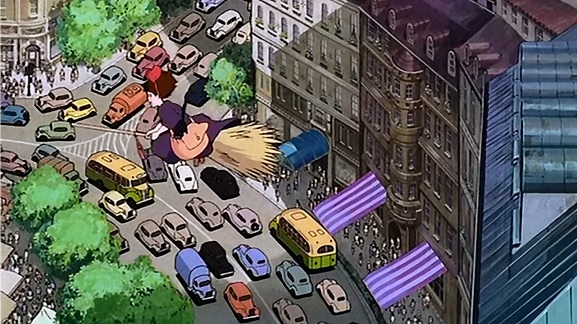
Kiki is a thirteen year old girl who wants to fly in her mother’s footsteps and become an independent witch; thirteen is the traditional age for a witch to do so. So she packs her bag, takes her cat and sets out on her mother’s old broom to fly to a new team and be a witch in training for a year, during which she’ll have to discover her speciality. She ends up in the port city of Koriko, which is somewhat inspired by Stockholm but apart from that is an undetermined Europeanesque city in an unnamed country in an unspecified but slightly old fashioned looking time period. I love that aspect of Miyazaki’s work, of how here and in Howl’s Moving Castle he creates a world that’s certainly not modern, but can’t quite be pinned down to one period either.
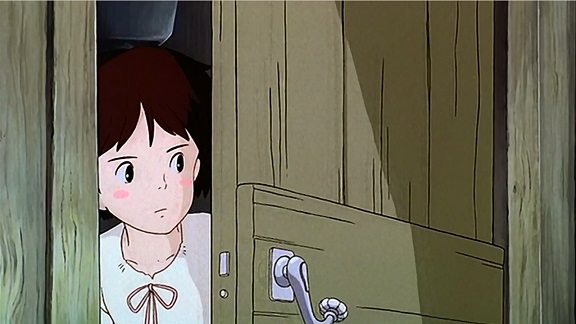
What’s also great are all the subtle character touches: the way her cat behaves and his body language, the way Kiki herself is apprehensive going to the outside toilet in the place she’s staying in for her first night in the big town. She’d been taken in by the proprietor of a bakery at the outskirts of town, who is very friendly, but her husband is the strong and silent type and when Kiki nearly runs in to him when she’s going to the toilet and he’s starting work, it’s clear she’s uncomfortable and wants to avoid him, in a way you would be staying with a strange family for the first time.
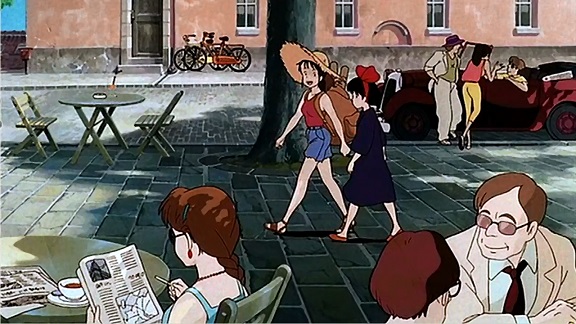
But what struck me the most watching this was how many strong and strong in different way women there were in it. It’s not just Kiki: there’s Osono the baker, who gives Kiki room and board and inspires her to start her flying delivery service. There’s Ursula, the painter, seen above, who Kiki meets on her first, not very succesful assignment and who is crucial to help her overcome her crisis of confidence in the last third of the movie. There are others, like the witch she first meets on her way to town and who gives her advice on how to spent her year in training, or the elderly customer and her servant whom Kiki helps and who help her in turn. This is a movie that passes the Bechdel test with flying colours and is full of women who help each other, rather than being rivals for a male protagonist’s affection. Not to mention men who are supportive of them, not wanting to put them down, like Osono’s husband and Kiki’s friend Tombo, who she has to safe (and does) in a genuinely tense climax.
It’s something that shouldn’t be special, should not be so noticable but it does seem sometimes like we backslid quite a lot from the eighties, in that we may be lucky to have two women in a given movie, let alone half a dozen not defined by their relationship to a man.
Snowcrash as written by Reddit
MetaFilter has fun kicking around Ernest Cline’s latest nerd pandering novel. To be fair, it does sound awful:
We’re also told the government has been tracking the habits of its elite players, and when they arrive at their virtual battle stations, they find their favorite snacks waiting for them, their favorite songs queued up to accompany their virtual space fights, not to mention a “special strain of weed that helps people focus and enhances their ability to play videogames” that’s been cultivated just for them. In one revealing moment, Zack calls his mom in midst of the alien invasion and says the words that burn in the heart of every gamer who has ever felt demeaned for the hours they lavish on their favorite hobby: “All those years I spent playing videogames weren’t wasted after all, eh?”
Ugh.
But what struck me the most was this:
Armada is a book designed entirely around getting the reference—high-fiving the readers who recognize its shoutouts while leaving everyone else trapped behind a nerd-culture velvet rope of catchphrases and codes.
Now that’s, as both the MeFi discussion and the original article acknowledge, something that’s deeply ingrained in nerd culture, but Cline’s use feels off. It’s not just that he has contemporary teenagers (or future ones, as in his first novel) obsessed with the pop culture, all the pop culture, of their fathers and grandfathers (mothers not featuring so much), it’s the way in which they do so. Cline’s protagonists are consuming pop culture, not creating it, taking pride in collecting it and showing off their skills in doing so by constant name checking and referencing it.
It’s a very pre-internet view of geekdom, from a time when such knowledge was hard to come by, when it was sometimes genuinely difficult to find a piece of pop culture ephemera if you hadn’t picked it up or seen it when it first came out. This is no longer the case and hasn’t been for at least a decade or two, so that attitude in people who supposedly grew up in the internet age jars. Not only their obsessions are too old for them, but the ways in which they express them are too. Ultimately this is what makes Cline a bad writer, this simple failure to understand that 21st century teenagers wouldn’t have the same hangups as him.
(Title courtesy of Artw.)