World Fantasy Awards 2015 ballot is out

The 2015 World Fantasy Awards shortlist is out, the last major SFF award to do so. In the novel category this is the ballot:

Updating my 2014 noticable SFF novels list I saw that there was only one new entry, David Mitchell’s The Bone Clocks. This had a lot of buzz last year as a literary type of fantasy that might do well with the more, ahem, broad minded SFF awards but disappoints to have only be nominated for the WFA. The same also goes for City of Stairs, now on two nominations, this one and the Locus Awards. The other three all have won one award each: a Locus Award for Addison, a Nebula for VanderMeer and a Tiptree for Walton.

With all the awards now having announced their shortlist, it’s possible to take a quick look at which novels are “winning”. Only Ann Leckie so far has won more than one award with Ancillary Sword and in total twelve novels share eight awards (with a joint Tiptree winner and both the Kitschies and the Locus award having multiple categories. Four more awards still need to report a winner (the Lambdas have announced but didn’t have a novel win their SFF category): the WFA, Gemmel, Prometheus and of course the Hugo Awards. It will be interesting to see if Cixin Liu will win either the Hugo or the Prometheus, otherwise it will be a bit disappointing to not have it win anything after all the hype.
Best Novel Hugo vote 2015

I don’t have to telly you I won’t be voting for any Puppy candidates, right, so the question becomes which of the three non-Puppy candidates will get my vote. Even diminished, this is a great shortlist:

    The Goblin Emperor — Katherine Addison.

    The Goblin Emperor at heart is a very traditional power fantasy, about the boy of humble origins who becomes emperor by happenstance and now has to very quickly learn how to survive in a world of political intrigue he’s completely unprepared for, filled with people who either want to manipulate him or replace him with a better figurehead. It’s one of those fantasy scenarios other writers can write multiple trilogies about to get to that point, but Katherine Addison has her goblin hero confirmed as the emperor within five pages, the rest of the novel being about him getting to grips with his new job, woefully inadequate though he feels.

    The Three-Body Problem — Cixin Liu

    What makes The Three-Body Problem almost missing out on the Hugo shortlist deeply ironic, is that it’s exactly the kind of oldfashioned hard science fiction the people behind this year’s vote rigging were supposed to be all in favour of. It revolves around the mystery of why all those physicists are killing themselves, the answer to which seems to be that fundamental principles of physics are broken… There are some great moments of sense of wonder, of conceptual breakthrough in it, as well as some characters Asimov would think were a bit two-dimensional.

    Ancillary Sword — Ann Leckie

    Ann Leckie’s debut novel, Ancillary Justice, won about every major science fiction award going: the BSFA, the Clarke, The Nebula and the Hugo, the first time any author won the four most important awards in the field with the same book, let alone with their debut novel. Anticipation has therefore been high for the sequel, not least on my part. Would Leckie been able to keep up the high standard of her debut? Would Ancillary Sword build up on it or be more of the same? Is Ann Leckie really the major new sf talent she seems to be or just a flash in the pan?

    I will be happy to see any of these three novels win, but this will be my voting order. Ann Leckie has had such a good year already I’d rather see either Addison or Liu win, but Addison slightly more just because how much fun The Goblin Emperor was.

The Three-Body Problem — Cixin Liu

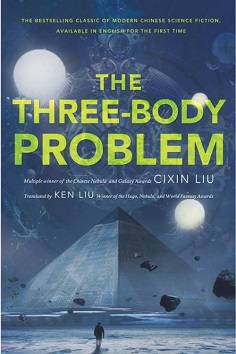
Cover of The Three-Body Problem


The Three-Body Problem
Cixin Liu
Translation by Ken Liu
302 pages
published in 2008 (English 2014)

If it hadn’t been for Marko Kloos doing the honourable thing and withdrawing his nomination, The Three-Body Problem wouldn’t be on the ballot for this year’s Best Novel Hugo. And that would’ve been a shame, since The Three-Body Problem is the first translated novel to make the shortlist. The start of a trilogy, it originally came out in China in serialisation in 2006, with the novel version coming out in 2008. The English translation was done by Ken Liu, who has won a Hugo Award himself. The sequels will come out this year and next.

What makes The Three-Body Problem almost missing out on the Hugo shortlist deeply ironic, is that it’s exactly the kind of oldfashioned hard science fiction the people behind this year’s vote rigging were supposed to be all in favour of. It revolves around the mystery of why all those physicists are killing themselves, the answer to which seems to be that fundamental principles of physics are broken… There are some great moments of sense of wonder, of conceptual breakthrough in it, as well as some characters Asimov would think were a bit two-dimensional.

Read more…