The Fall of Chronopolis — Barrington J. Bayley

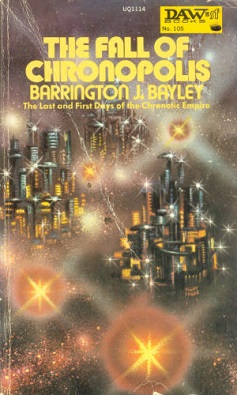
Cover of The Fall of Chronopolis


The Fall of Chronopolis
Barrington J. Bayley
175 pages
published in 1974

I’ve always been a sucker for time war novels, starting with Isaac Asimov’s The End of Eternity, Fritz Leiber’s The Big Time and Keith Laumer’s Imperium series. I like the grand scale on which these stories play out, the whole idea of the impermanence of time itself, something that undercuts our most basic of securities, the idea that the past we remember is the way that past has always been, making literal the idea Orwell put forth in 1984: he who controls the past, controls the future. Which explains why The Fall of Chronopolis was one of the first bought at Eastercon novels I finished, even before the convention itself was over, finishing it at the Dead Dog party on Monday.

In the The Fall of Chronopolis the time war rages between the Chronotic Empire, which has steadily increased its dominion over the centuries until it rule a thousand years of human history and its far future enemy, the Hegemony, existing futurewards beyond the Age of Desolation after the fall of the Chronotic Empire. For the most part this time war has been limited, consisting of limited raids on each other’s history, but the Chronotic Empire is raising a grand fleet of timeships to invade the Hegemony directly, while the latter had developed a time distorter which can warp history directly. But this is only the surface story; there’s a lot more going on

Read more…

Books read April

Eight books read is only two per week, which isn’t quite the tempo I’m hoping for, but I have too much fun doing other things. Quite a few books read on the way to and from Eastercon; sadly however I bought roughly ten times as much.

Behold the Man — Michael Moorcock
I read this on the way to Eastercon, the day before Good Friday. It seemed fitting to read this story of a time traveller whose entire life has prepared him to journey back into time to the Crucifixion. One of Moorcock’s early classics, starring one of his characteristic passive protagonists.

Elysium — Jennifer Marie Brissett
This was a novel I might’ve nominated for the Hugos had I read it before. A love story that takes place against a backdrop of constantly shifting alternate histories, with the protagonist and their lover switching gender, sexuality and relationship with each shift, as the world increasingly takes a turn for the strange. Found via James Nicoll, as so much else.

Lost Things — Melissa Scott & Jo Graham
Another James recommendation, who called it “Jazz Age Occult Adventure” which suits this very well. A group of flyers get involved in an occult conspiracy, not entirely by accident.

The Fall of Chronopolis — Barrington J. Bayley
I’m a sucker for this sort of time war, dueling timelines story and Bayley has written a jewel here. Written with a pulpy jauntiness, but much denser than it first looks.

Strata — Terry Pratchett
Sometimes described as a Discworld prototype, this is both a serious sensawunda sort of space opera, Big Dumb Object story and a parody of same, especially Larry Niven’s Ringworld.

The Goblin Emperor — Katherine Addison
Political wishfullfilment fantasy of the benign kind, nominated for a Hugo and so far my pick for the winner. This may change once I’ve read The Three Body Problem.

The Race — Nina Allan
I had just bought this at Eastercon, after seeing the usual British suspect rave about it, when the author herself walked into the room, so now it’s a signed copy. A great novel, which shifts perspective in unexpected ways and does so with great skill. One plot point in the middle of the novel though had me stopped in my tracks, of which more once I review this properly.

Herfsttij der Middeleeuwen — Johan Huizinga
Classic history book by a Dutch historian, first published in 1919 and better known in English as The Waning of the Middle Ages. This is a history of 15th century Burgundy & France, in which the worldview of that period and region is put centre stage, a worlview that according to Huizinga was in the autumn of its existence, tired, wornout and in need of replacement.

“strange and seductive stories”

Sofia Samatar reviews Carmen Maria Machado’s “The Husband Stitch” and her other stories in the LA Review of Books:

The trope of the woman with the ribbon around her neck is an urban legend familiar to many American kids, exchanged at slumber parties or summer camps in the spooky glow of a flashlight. “The Husband Stitch” is full of tales from this genre, pressing lightly through the dominant narrative. There’s the one about the couple in a parked car who listen to a radio broadcast about a hook-handed escaped killer, only to hear the scrape of his hook on the door. There’s the one about the girl who takes a dare to spend the night on a grave, plunges a knife into it to prove she was there, and then, having pinned her own skirt to the ground, dies of fright. Freud’s definition of the uncanny — something familiar that ought to have remained hidden, but has come to light — helps explain the urban legend’s relationship to “The Husband Stitch.” While the narrator tells of sexual awakening, marriage, and adulthood, the ribbon around her neck (which she will neither remove nor explain) recalls the terrible buried knowingness of childhood. Campfire chillers draw their energy from the fact that everyone knows the ending will be horrible, and the teller knows exactly how. In choosing this form for “The Husband Stitch,” Machado represents heterosexual marriage as a horror story whose ending we all pretend we don’t know.

I found “The Husband Stitch” good enough to nominate it for the Hugo, but I hadn’t noticed how much Machado used actually existing urban legends in her story. The urban legend genre is a lot less known on this side of the pond and I hadn’t encountered the examples she apparantly gave in her story. Interesting.

Sofia Samatar is a thoughful, thought provoking reviewer and Carmen Maria Machado’s work is strong enough to reward such reviewing.

(One of the side effects of the whole Sad Puppies mess is that it swallows up a lot of fandom attention that should be spent on making our fandom and science fiction more diverse and open, leaves less room for new initiatives to get attention. Therefore I’ve decided to write one positive post showcasing some book, project or thing that makes science fiction more diverse.)

Puppies think all children should get prizes

So there was a bit of Puppy mocking doing the rounds on Twitter over the weekend, started by Catherynne Valente (as far as I know) after finding herself dragged deeper in the Puppy mire after being described as the “queen bee” of Social Justice Warriors by Turgidsen; because we’re all still in high school apparantly. What she and others took aim at was perhaps the most sensitive spot of the Puppy movement: their belief that just by showing up they deserved Hugo Awards. Hence the talking about Hugos not won, or nominations not gotten, as Wesley Chu below.

Because for a bunch of tough, rootin-tootin cynical internet hard men (and women) wise in the ways of the world, these people sure are behaving like the middle school teachers of many a rightwing anecdote and expecting every child to get a prize. It’s visible as far back as Larry Correia’s original report on the 2011 Worldcon. Both Larry and Brad are incredibly quick to start wallowing in victimhood when they don’t get what they think they’re entitled to, although they’re — as they never tire of pointing out — succesful, bestselling writers and don’t need the Hugos or Campbell Awards.

Now consider. Campbell eligibility last two years after your first publication, which means that with a slot of five nominees each year you have ten shots at being nominated, in a field that sees many dozens of new writers each year, especially in the last decade. For any Hugo category too there are only five spots, again in a field that sees countless metric tons of short fiction each year and upwards of 1,000 new novels published. The odds that you as a writer are good enough, visible enough to be nominated are small and not being nominated is not a slur against you: plenty of better writers weren’t. Being nominated puts you already in an elite position compared to almost all your peers that year: why gripe that you didn’t win?

It’s just being a sore loser and having to invent conspiracy theories as to why you didn’t win because you cannot imagine not winning, only makes that impression worse. Not all children can get prizes.

Make my funk the steamfunk


Steamfunk is, as author/publisher Milton Davis says here, “steampunk from an African, or African-American perspective”. It’s one response to some of the wasted potential of the steampunk genre, which so often doesn’t escape its neovictorian roots, remains mired in the unconscious attitudes that shaped the real 19th century. As P. Djeli Clark puts it, steamfunk attempts to correct that:

One of the ways speculative fiction can work against racism and decolonization is to re-imagine our past, altering the power dynamics that we are accustomed to in order to illuminate hidden histories and silenced voices.

The Steampunk genre, with its retro-futuristic focus, seems especially suited for this. Set in an era of gender inequity, colonialism, slavery and other defining elements of the Victorian Age, one would expect Steampunk to be a fertile ground for such explorations. Only for a long time, it hasn’t been. Mainstream Steampunk seemed content in dressing up in bustles and colonial pith hats and even Confederate gear, without nary a thought about the larger issues of the time. What did it mean to be Native American in a 19th century Steampunk America? What was it like to be woman of color, or poor, or LGBQT, or ALL of those at once, in the Old Weird West? What was it like to live in a China beset by steam-powered English and French opium dealers? How would a Sepoy Mutiny shake up the oppressive Raj in a Steampunk British Empire?

That sounds both like a worthy goal as well as a recipe for more interesting stories than you might get with standard steampunk; truly they had me at steamfunk. So once I stumbled across this nascent genre, the first thing I did was buy Milton Davis’ novel From Here to Timbuktu:

The year is 1870. As the young country of Freedonia prepares to celebrate fifty years of existence, a young bounty hunter by the name of Zeke Culpepper is hired by a wealthy businessman to find a valuable book. In the kingdom of Mali on the continent of Africa, veteran warrior Famara Keita has been assigned to find that same book and bring it back to its rightful owner. And in the newly formed nation of Germany, an ambitious Prussian officer seeks the book as well for its secrets that could make Germany the most powerful nation in the world. The result is an action adventure like no other!

Doesn’t that sounds like a book you want to read?

(One of the side effects of the whole Sad Puppies mess is that it swallows up a lot of fandom attention that should be spent on making our fandom and science fiction more diverse and open, leaves less room for new initiatives to get attention. Therefore I’ve decided to write one positive post showcasing some book, project or thing that makes science fiction more diverse.)