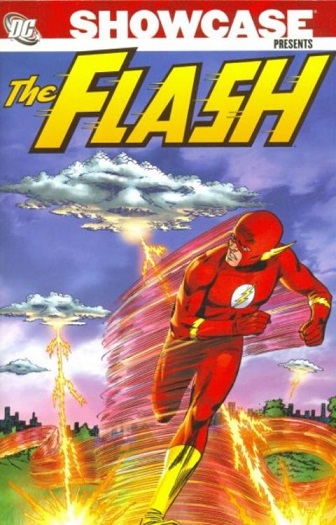
Showcase Presents: The Flash, Volume 1
Carmine Infantino, John Broome, Robert Kanigher, Joe Giella, Murphy Anderson, Frank Gaicoia, Joe Kubert and friends
Reprints Flash Comics #104, Showcase #4, #8, #13, #14, The Flash #105-119
Get this for: The comic that kickstarted the Silver Age
Once upon a time, in the cultural wasteland men call the nineties, getting to read Silver Age comics was actually kind of hard. Not as hard as it had been in the seventies or eighties, when it was basically getting the back issues themselves or hope for a reprint series to come out, but still the only really comprehensive reprint programmes were the Marvel Masterworks and their counterpart at DC, the DC Archive Editions. These were expensive, library quality hardcovers, fifty bucks for ten issues of a key Silver Age series, not very accessible for the average reader. That all changed when Marvel came up with their Marvel Essentials line, big black and white trade paperback slabs of comics, anywhere from twenty to twentyfive or more issues of a series, or comics featuring a particular character, from all parts of their history. As an idea it was of course ripped off from the way Manga publishers in Japan published their collections, by way of the Cerebus phonebooks, but it was still a great step forward in making comics history available. Longtime readers may remember I did a fifty Essentials in Fifty Days review series back in 2010.
Now DC only started its comparable reprint series in 2005 and unlike Marvel, they mostly focus on Silver Age titles. And until recently, I only had a few Showcase titles myself, not having run across them much here in the Netherlands. Comics retailers seem to dislike them for the same reasons I like them: they’re big and relatively cheap, hence less attractive to stock. However, I recently discovered a new source of cheap comics online and splurged out on a job lot of Essentials and Showcases, so I thought why not do a regular series of Showcase reviews like those earlier Essential ones? Not at the same insane rate, but why not a weekly series? Hence Showcase Sunday.
And what better title to start with than the one that kickstarted the whole Silver Age in the first place? The Flash’s appearances in Showcase, followed by his own series, numbered from the original Golden Age Flash Comics (which in fact only ended seven years before the S.A. Flash’s first appearance), is what sparked the interest in resurrecting other old DC heroes, culminating in the Justice League of America, which in turn made Marvel start a copycat title to which Stan Lee and Jack Kirby put their own unique touches, The Fantastic Four. There are other candidates for first Silver Age superhero like the Martian Manhunter, but the Flash was the one that really lit the touchpaper. It took a couple of years though: his first appearance in Showcase was in October 1956, his last before he got his own title was in June 1958, with The Flash 105 coming out in February 1959. Guess things moved slower in those days.
Reading these stories more than sixty years after first publication it’s both easy to see why these strips were so successful back and realise they’ve aged badly, much more so than their Marvel equivalents. On the whole, these are simple stories: a criminal or supervillain causes havoc in Central City, has some gimmick that defeats Flash the first time they meet, but in the last two-three pages Flash has the upper hand and explains why. Inbetween the battles there’s some soap opera with Iris West, Barry Allen girlfriend, complaining that he’s never on time and comparing him unfavourably with his alter ego. Nothing really changes in these stories and reading them back to back in a day really shows that. It doesn’t help that each issue has two 11 to 12 page stories, rather than one story per issue, as in the early Marvel titles. There’s less room for characterisation and plotting in such a limited space, let alone proper continuity, though there is a rudimentary form of it here, with villains returning for a second shot at the Flash.
Mostly though these are standalone stories, reinforced by the fact that e.g. in this volume there are half a dozen or so stories in which Flash has to deal with undersea or subterrean invaders, that none of the villains know of each other yet, or the fact that many of them have roughly the same order: criminal with engineering bend tinkers his way into supervillainy by inventing some sort of superweapon. That’s Captain Boomerang, Mirror Master, Weather Wizard, Mr Element/Doctor Alchemy and Captain Cold. All already established criminals, all inventing their signature weapon in their first appearance.
Now these are actually enjoyable stories, for all their simplicity. None of the nonsense you’d associate with Silver Age DC like in the worst Superman/Superboy stories; they are actually remarkable modern save for their approach for continuity. And what I also found noticable is that Barry Allen and Iris West are clearly adults, with adult responsibilites even if those aren’t milked for soap opera like Marvel would do. John Broome has a knack both for creating villains and for creating scenarios in which to showcase their powers, without cheating.
As for the art, if there’s one artist who is synonymous with the Silver Age Flash, the penciler on all of the stories in this volume, it’s Carmine Infantino. Now I first encountered his artwork on a much later title of his, the Marvel Star Wars series, where his elongated, rubbery characters and blocky space machinery where actually the perfect match for the movies’ aesthetic. His version of Star Wars is still the one in my head when I think about it. Here however his style is much more realistic, missing the trademark elongations and perspectives he’d become infamous for. It is gorgeous though and you can see it evolve through the stories, as well as the influence his various inkers: Joe Kubert, Frank Gaicoia, Joe Giella and Murphy Anderson have on the finished art. Joe Giella especially seems to have a positive influence on his faces, much more expressive even than with Murphy Anderson inking, no slouch himself. The black and white printing shows up the line work beautifully. Though straitjacketed in a fairly conservative page layout there’s plenty of gorgeous work to keep your interest.