Shaun Duke, one part of The Skiffy and Fanty Show, has created a Google docs survey to get non-American perspectives on the Hugo Awards. The Skiffy and Fanty Show has spent much of last year and this year looking at science fiction and fantasy outside of the Anglophone countries and is a great way of discovering new writers. Why not fill out the survey if you’re not a yank and interested in fandom?
Will 2015 see the end of the Hugo Voters Packet?
The Hugo Voter Packet is one of those ancient traditions surrounding the Hugo Awards that’s actually quite recent, instigated by John Scalzi a couple of years ago as a way to make it easier for voters to read as much of the shortlisted books and stories (etc) as possible. As a side effect, it also increased interest in Worldcon supporting memberships, as $40 could get you a shitload of books and the right to vote in the Hugo Awards. Last year was my first Worldcon and getting that packet was great, as it introduced me to a whole lot of authors I’d otherwise might’ve missed, like Max Gladstone, Sofia Samatar, Ramez Naan and others.
There was a bit of controversy over the Packet though, as Orbit, the publisher of three of the best novel nominees, decided not to include the books for reasons that basically boiled down to not wanting to give away several thousands copies of books. Speculation was that being an UK publisher, they of course sold fewer copies of any book in the first place than an equivalent American publisher and whereas for the latter a few thousand copies was doable, for Orbit it would mean giving away almost an entire print run…
This year we’re in a perfect storm. For the average non-Puppy voter, the Voter Packet is a lot less attractive with all that Puppy Poo on it, while publishers might be wary to put their books on it due to the rocketing number of supporting memberships bought since the shortlist announcement. Sasquan is on track to become one of the largest, perhaps the largest Worldcon ever and what’s more, most of the memberships are supporting, not attending.
So if voters are less eager for the Packet anyway and publishers less willing to include their books now the membership is getting bigger and bigger, does this mean 2015 will make the Packet obsolete?
Hitsugi no Chaika
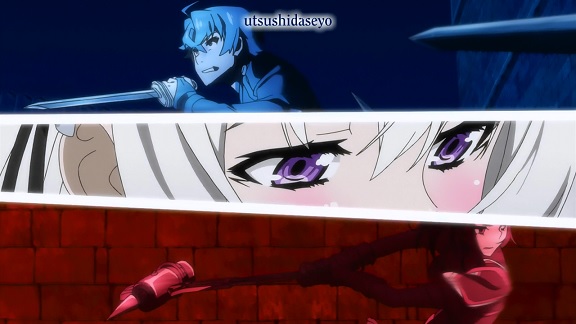
Hitsugi no Chaika — Coffin Princess Chaika is a 2014 anime series based on a light novel series, light novels being short, usually illustrated novels aimed at a youngish public in Japan. Many of those are on the formulaic side, shall we say, but they make good fodder for anime series and a lot of contemporary television anime in Japan is now driven by light novel adaptions. Light novels do have something of a reputation as making lousy animes, not helped by the glut of harem fantasy adaptations, where some bland bloke is trust into some sort of magical situation as the saviour of the world, involving lots and lots of young girls throwing themselves at him for unclear reasons. The unsatiable desire for new series leads to a lot of twelve episode animes with little to distinguish themselves.
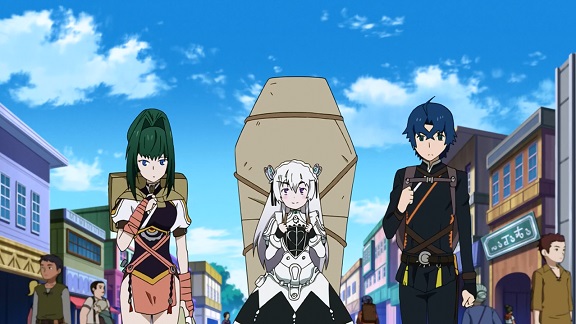
Hitsugi no Chaika could at first glance be mistaken for one of those. You got the nominal protagonist Chaika as the innocent abroad just this side of being sickly sweet, the male focus character Toru and his “sister”, Akari, prone to violent outbursts and accusations of lechery against him. All three are fairly stereotypical characters, found in every other anime series, caught up in what seems like an equally stereotypical love triangle.
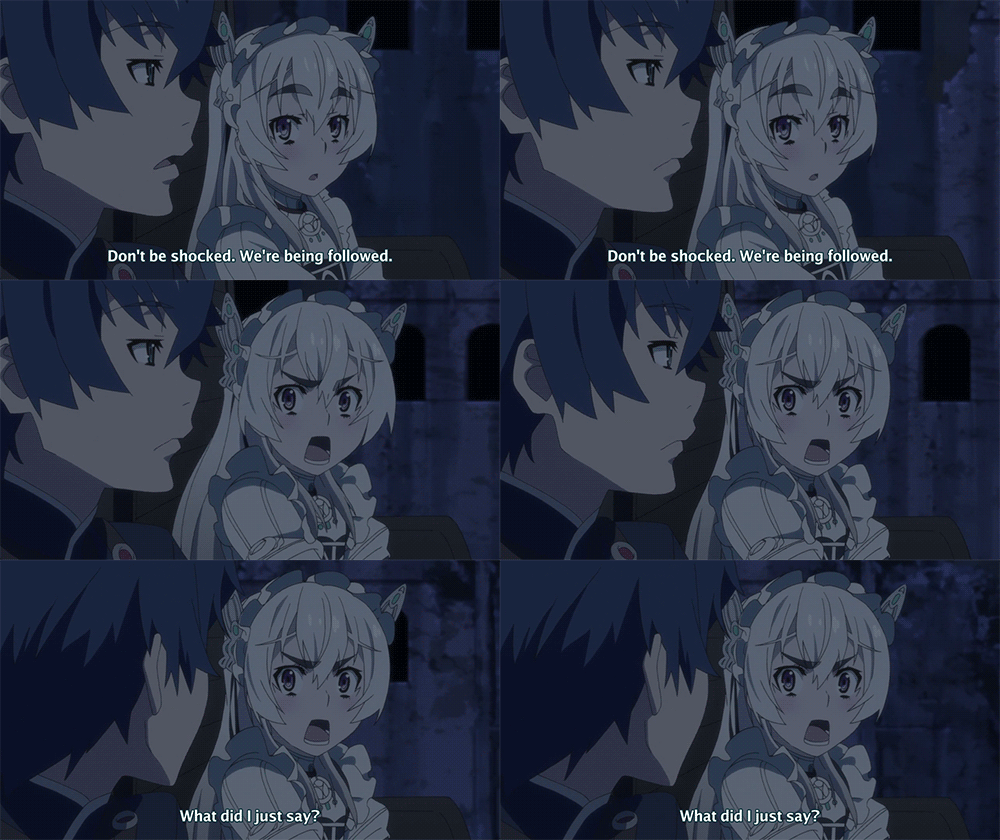
What saves it is the humour, which is a cut above the usual “hilarious” slapstick or offensive sexist japery, but is actually based in the characters and themselves. It helps that they’re all likeable people as well, including the antagonists. Chaika is a bit too cute at times, naive, innocent, but also stubborn and determined to fulfil her mission. Akari is hotheaded but not obnoxiously so and is toned down somewhat after her introduction; both she and Toru are competent, professional warriors in a world where war has ended five years ago with the defeat of emperor Arthur Gaz.
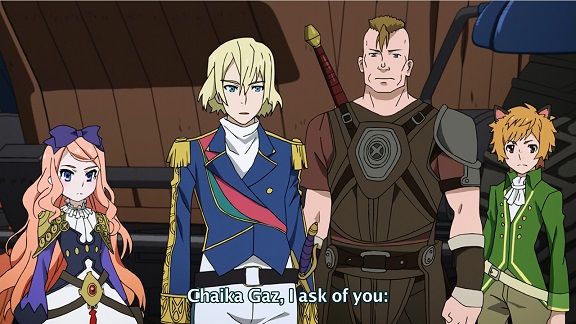
Chaika is Gaz’s daughter, lugging a coffin around the former emperor to get his remains back from the eight heroes that defeated him, to give him a proper burial. She runs into and hires Toru and Akari after the former saves her from an unicorn, set upon her by a group of agents from the current regime, wanting to stop her, fearing what she might do with the remains. These are not your usual villains, but decent people with some doubt on whether they’re in the right from time to time, especially as the cracks in the new world order start to show. I like the design of the various characters as well, especially this chap, who looks like a Jack Kirby design.
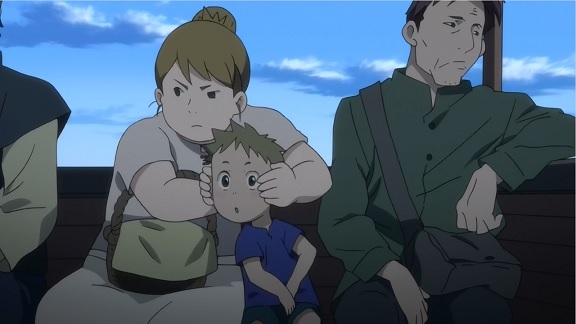
Speaking of character design, what I also found interesting was while all the main characters look pretty much in the style of modern fantasy anime, the background characters look more like they’d wandered in from a lesser studio Ghibli movie. Much less colourful, much more realistic body types. Nowhere near the quality of a Ghibli production of course, but the feel is the same.
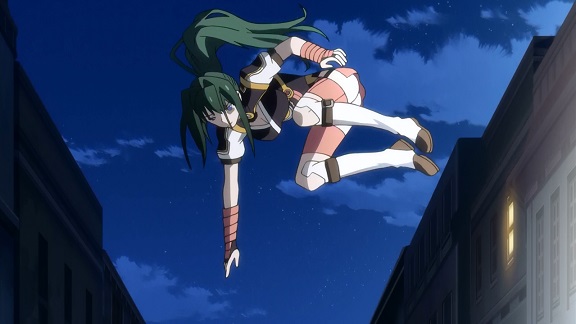
All in all Hitsugi no Chaika is an entertaining anime series much better than it needed to be. Watch it.
Chaika
My current anime obsession. I thought I could get away with just posting this, but I find myself with things to say about it.
Butcher fails where Bellet and Kloos succeeded
Jim Butcher is currently one of the most popular fantasy writers in the world, with several series being NYT bestsellers, as well as having a television series made out of one of them. Not quite George R. R. Martin level, but getting there. He’s nothing like Annie Bellet or Marko Kloos, two much more modestly successfull writers, except in one thing: all three got on the Hugo nominations list thanks to the efforts of the Sad Puppies.
Where they again differ is that Bellet and Kloos, after some soul searching, decided to withdraw their nominations. It’s hard to overstate how difficult that must’ve for them, seeing as how these nominations may be the only time they’ll actually get on the shortlist. Consider: in any given year there are only twenty places open for a professional writer, five each for Best nobel, novella, novelette or short story, while anywhere from 1000-1500 eligible novels are published each year and ghu knows how many eligible works in the other categories. You have to be an incredibly good or well known writer to have a shot at being nominated, let alone be nominated more than once. Yet they gave up these nominations because they knew they way they’d gotten them wasn’t fair.
Not so Butcher though, somebody who on his own merits could have a stab at the Hugos. He’s kept radio silence all this time and when asked point blank, this is what he said:
@senji People keep proclaiming their stance on everything, acting like politicians, and then get all shocked when things become politicized.
— Jim Butcher (@longshotauthor) April 15, 2015
I’m not sure whether his stance is naive or calculating. His presence on the Puppies ballot from the start was clearly intended as a shield, a way to give some credence to the idea behind the slate(s), that popular works have no chance at the Hugos and really, we’re only suggesting those works we really really think are worthy of a Hugo. By neither withdrawing nor speaking out against the Puppies, Butcher gives tacit approval to their slate voting, validates their political beliefs because surely this means Jim Butcher himself thinks he can’t win a Hugo otherwise?
The same goes of course for all those other nominees used as shields: if you don’t withdraw, if you don’t speak out, I don’t care that you were put on the slate involuntarily or without your knowledge, you’ve given your retroactive consent. By your actions you help support this partisan political attack on the Hugos and I will judge you for it.
UPDATE: you know who does get it right? Black Gate.