Larry Correia: entitlement and ego

Maureen O’Danu explains something I’ve been arguing from the start: that the Puppies are driven by entitlement:

Larry Correia’s public attitude makes it pretty clear that he felt that he deserved to win and that the Hugo he was nominated for was stolen from him, rather than simply won by another contender. (Larry denies this verbally, but one of the first rules of psychology is that when there is a conflict between words and actions, believe the actions.) The subjective nature of literary awards makes this a not uncommon problem. In any award where winning is at least partially a matter of opinion instead of mathematics, the language of robbery holds sway. “He was robbed” “She stole that award” “How on earth did he take that away from her.” From ice dancing to dressage to debate to writing, any ranked creative competition is going to generate these sorts of claims.

Correia took this further, speculating on the basis of negative comments he had received from either fans or writers (he has never specified) that he was specifically denied his award because of his political views. He has said that he believes has been specifically denied because he owns a gun store, is Mormon, is conservative, or all or some combination of the above.

You could see that entitlement at work even in Larry’s 2011 Worldcon report which is slightly too full of not winning the Campbell award, when he was in a field with Lauren Beukes, Saladin Ahmed and Lev Grossman, among others, not the weakest of competitions. It’s almost as if he felt he’s owned the Campbell, which of course he does. It’s not enough to just be nominated and get on the shortlist, something most new writers never manage in their two year eligibility window, he of course deserved to win.

And you do wonder if it’s his background, conservative, gun shop owner, Mormon, with ties to the Bush-era US military that’s the problem here. Not in the way Larry thinks, with all the evil leftists sneering at these things, but that all these make him susceptible to his entitlement complex. What Larry can never get his head around was that most people, like me, had never heard of him until he started making an ass out of himself last year with the Sad Puppies. I had no clue about his politics, his background or his writing, just got to know him as an obnoxious loudmouth, a crybaby that wanted to ruin the Hugos because he felt underappreciated.

But it didn’t surprise me to learn that he was a wingnut, not even if he’d reined in the evil SJW rhetoric. This sort of entitlement, by people who already are successfull by any objective standard — how many people get to be a professional writer in their chosen genre after all and a bestselling at that — but who want everybody to acknowledge that they are the greatest, especially those they see as their enemies, is pretty much a rightwing disease. And Mormonism, with its history of persecution and theological sense of entitlement, is a religion that’s pretty good at creating this type of asshole (it’s perfectly possible to be a conservative Mormon without being an asshole, of course and millions of people manage to do so.)

American conservatism is stewed in entitlement and persecution complexes and Correia and Brad Torgersen show all the hallmarks of it. For those of us who have spent the last decade and a half looking at what we used to call warbloggers, their type is depressingly familiar. They always think they’re better than they are, they always think everybody is out to get them, that there are huge conspiracies solely there to stop them from getting their due and they’re always projecting their own actions on their opponents. It was Correia and co who introduced partisan politics in the Hugo nomination process, but they had to invent a SJW conspiracy to make themselves the good guys. Perhaps they need to do this because they just cannot help but see everything in the context of partisan politics and believe everybody else does so too.

The end result though is that Correia is a massive cock wrecking things because he feels people aren’t nice enough to him.

Eric Heuvel sketching

Eric Heuvel sketching

You may know that Ligne claire/Clear Line was a term coined by Dutch cartoonist Joost Swarte to describe the artwork of Herge and E. P. Jacobs, a style that was enormously popular in Franco-Belgian comics up until the sixties, combining strong colours, an uniform thickness of line and cartoony characters with realistic, detailed depictions of things like cars, planes and other machinery. It was appropriated in the late seventies by Swarte and others like him (Theo van den Boogaart in the Netherlands, Yves Chaland, Ted Benoit, Serge Clerc et all in France) to provide an ironic contrast between the definately adult stories they wrote and the seemingly innocent, straight forward art style, long since coded as belonging to childrens’ comics.

In the Netherlands however this resurgence in Clear Line artwork went further than just as an ironic fad. New generations of artists in the late seventies and eighties rediscovered the style as perfectly suitable for straightforward action stories, the most successfull being Henk Kuijpers, who with his Franka series produced arguably the most popular Dutch comics series of the eighties, not hindered by his habit of getting his heroine to take her top off.

Eric Heuvel is another of these Clear Line cartoonists, perhaps the best one currently active in Dutch comics. He started his aero adventure strip January Jones together with Martin Lodewijk, veteran scenario writer, in the early nineties and restarted it a few years ago, when the biweekly comics zine Eppo was resurrected. He’s one of the magazine’s most popular writers and at normal comics cons in the Netherlands there’s a huge line waiting for his autograph or sketch. At the Dutch Comic Con though, the Eppo audience wasn’t quite there, which meant I only had to wait a short time to get the sketch below and got to talk to him about his love for aeroplanes. I love his work and I love the January Jones series for having a no-nonsense, capable woman as its protagonist without any of the bagage that sometimes brings with it.

Eric Heuvel Sketch

Annie Bellet and Marko Kloos do the right thing

Annie Bellet has withdrawn her Puppy slated story from the Hugo ballot:

I am withdrawing because this has become about something very different than great science fiction. I find my story, and by extension myself, stuck in a game of political dodge ball, where I’m both a conscripted player and also a ball. (Wrap your head around that analogy, if you can, ha!) All joy that might have come from this nomination has been co-opted, ruined, or sapped away. This is not about celebrating good writing anymore, and I don’t want to be a part of what it has become.

So has Marko Kloos:

I also wish to disassociate myself from the originator of the “Rabid Puppies” campaign. To put it bluntly: if this nomination gives even the appearance that Vox Day or anyone else had a hand in giving it to me because of my perceived political leanings, I don’t want it. I want to be nominated for awards because of the work, not because of the “right” or “wrong” politics.

It can’t have been easy for either writer to give up an honour that few authors will get to experience even once. It’s a credit to their character that both choose the right thing to do, voluntarily withdrawing rather than profiting from an unearned nomination. Hopefully, this also means that some of the writers excluded unjustifiably from the Hugo ballot thanks to the Puppies now can be added back in.

What I found interesting in Bellet’s withdrawal is that she felt “stuck in a game of political dodge ball” thanks to her nomination. It’s clear that for those writers on the Puppy slates but not part of the hardcore loonies, there is a lot of social oprobium they have to deal with, as for some strange reason people have not greeted the slates with unadulterated joy. For the Wrights, Days and Correiras this is not a problem, they’ve burned their bridges a long time ago, but for those drafted into the slates (or gods help them, who were naive enough to volunteer), it seems there is a cost, there’s social pressure to reject the slate. If we’re lucky, now that the first two writers have done the decent thing, have gotten respect from the sane part of SF fandom for it, more will follow.

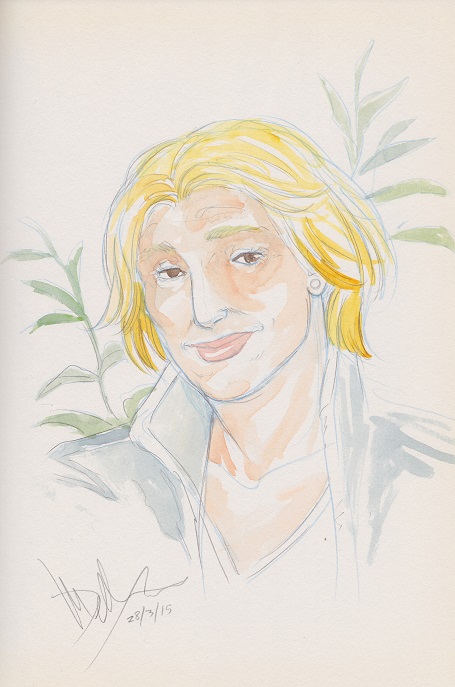
Marissa Delbressine’s sketch

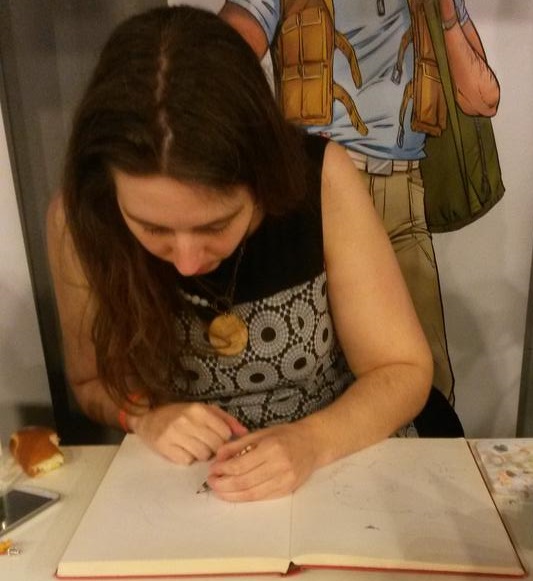
Marissa Delbressine sketching

The Dutch Comic Con was partially sponsored by the publishers of Eppo magazine, the bi-weekly comics zine that seems largely aimed at nostalgic forty and thirty something people remembering its original incarnation. As such the audience at the comic con turned out to be slightly too young for them and the artists signing at their stand were not the busiest, shall we say? Where at a normal convention you’d expect long rows of people interested in autographs or sketches, here the artists outnumbered the fans when I came round with my sketch book. Which gave me the opportunity to talk to Marissa Delbressine for somewhat longer than I’d expected, which is always nice.

Marissa Delbressine is the artist on the action adventure comic Ward which has been running in Eppo and so far has been collected in two albums. Written by veteran scenarist Willem Ritsier, it is the sort of uncomplicated adventure comic that could’ve been published three decades ago too. What I like about is that it’s so family orientated: the series may be named after the mysterious loner Ward, but the real protagonists are the Kessel family: Frank, Isa and their two children, Lonneke and Tom. It’s rare to see any sort of happy but realistic family in a comic like this and especially since the two women graduated from their professional hostage status at the end of the first story, each of the characters has come alive.


Delbressine’s art is a huge part of the appeal of Ward to me. For the strip she draws in the realistic tradition of e.g. a William Vance, but she isn’t afraid to inject a bit of cartoonish exagerration in her figures, especially the faces. What I especially like is the way her characters are immediately recognisable, none of them quite the archetypical action figure or superheroine. I like the way she shows the difference in ages between e.g. Isa and Lonneke: it’s immediately clear that the one has a couple of decades on the other, without having to fall back on the stereotypical signifiers of age like greying hair or wrinkles. Below is the sketch she did of Isa, coloured in and all. More of her work can be found at her Tumblr art portfolio.

Marissa Delbressine sketch