Marissa Delbressine’s sketch

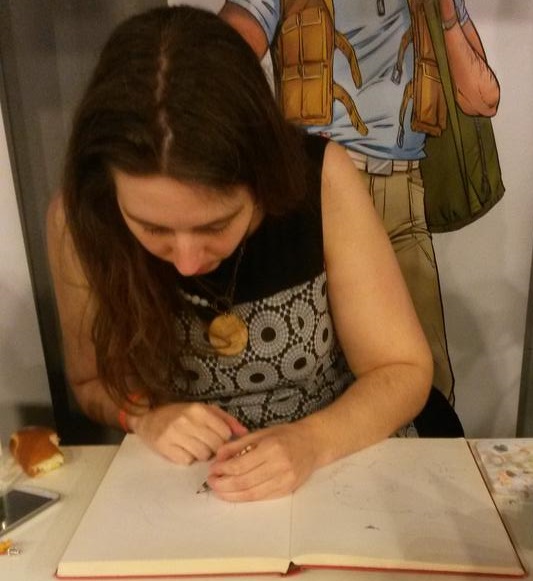
Marissa Delbressine sketching

The Dutch Comic Con was partially sponsored by the publishers of Eppo magazine, the bi-weekly comics zine that seems largely aimed at nostalgic forty and thirty something people remembering its original incarnation. As such the audience at the comic con turned out to be slightly too young for them and the artists signing at their stand were not the busiest, shall we say? Where at a normal convention you’d expect long rows of people interested in autographs or sketches, here the artists outnumbered the fans when I came round with my sketch book. Which gave me the opportunity to talk to Marissa Delbressine for somewhat longer than I’d expected, which is always nice.

Marissa Delbressine is the artist on the action adventure comic Ward which has been running in Eppo and so far has been collected in two albums. Written by veteran scenarist Willem Ritsier, it is the sort of uncomplicated adventure comic that could’ve been published three decades ago too. What I like about is that it’s so family orientated: the series may be named after the mysterious loner Ward, but the real protagonists are the Kessel family: Frank, Isa and their two children, Lonneke and Tom. It’s rare to see any sort of happy but realistic family in a comic like this and especially since the two women graduated from their professional hostage status at the end of the first story, each of the characters has come alive.


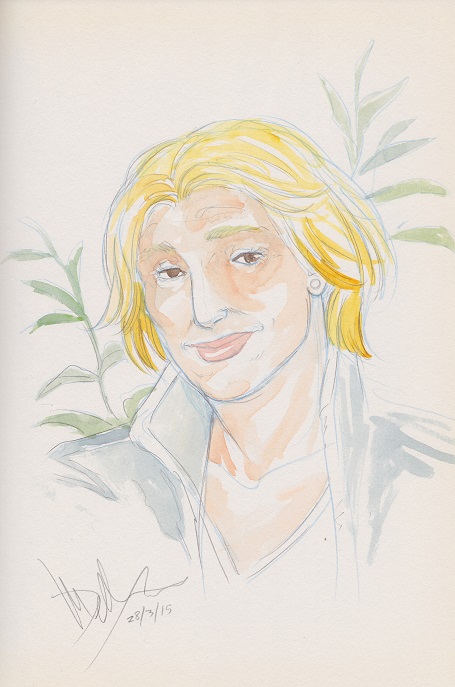
Delbressine’s art is a huge part of the appeal of Ward to me. For the strip she draws in the realistic tradition of e.g. a William Vance, but she isn’t afraid to inject a bit of cartoonish exagerration in her figures, especially the faces. What I especially like is the way her characters are immediately recognisable, none of them quite the archetypical action figure or superheroine. I like the way she shows the difference in ages between e.g. Isa and Lonneke: it’s immediately clear that the one has a couple of decades on the other, without having to fall back on the stereotypical signifiers of age like greying hair or wrinkles. Below is the sketch she did of Isa, coloured in and all. More of her work can be found at her Tumblr art portfolio.

Marissa Delbressine sketch

The Goblin Emperor — Katherine Addison

Cover of The Goblin Emperor


The Goblin Emperor
Katherine Addison
502 pages
published in 2014

One of the dirty little secrets of book reviewing is that the circumstances under which you read any given book can massively influence how you feel about it. Since I read the first half of The Goblin Emperor on a sunny Thursday afternoon while drinking a nice IPA sitting at an Amsterdam terrace and the other half sitting in my garden on the Friday afternoon following, drinking an even nicer IPA, it’s no wonder I feel quite mellow about it. But in this case I would’ve enjoyed it even had I read it during one of the grey, dull, wet afternoons that you normally get in Amsterdam in early April. This is a great novel and well deserves its Hugo nomination. It’s also the sort of novel you can’t help but read fast, a true page turner.

The Goblin Emperor at heart is a very traditional power fantasy, about the boy of humble origins who becomes emperor by happenstance and now has to very quickly learn how to survive in a world of political intrigue he’s completely unprepared for, filled with people who either want to manipulate him or replace him with a better figurehead. It’s one of those fantasy scenarios other writers can write multiple trilogies about to get to that point, but Katherine Addison has her goblin hero confirmed as the emperor within five pages, the rest of the novel being about him getting to grips with his new job, woefully inadequate though he feels.

Read more…

Books read March

Really? I’ve only read four novels this month? Apparantly so. Granted, most of the month was spent reading through this list of short fiction, but even so, this is disappointing.

Juniper Time — Kate Wilhelm
Read for Joachim Boaz’s Kate Wilhelm review series. This is one of the novels the cyberpunks were rebelling against.

Reaper Man — Terry Pratchett
I read this in the wake of the news of Terry Pratchett’s death, his most fitting novel as it revolves around mortality and DEATH.

The Shining Girls — Lauren Beukes
Serial killer horror is not my thing as it so often puts its sympathies with the killer more than with their victims; cf. The Silence of the Lambs. Beukes however keeps her sympathies firmly where they belong, showing the waste and destruction the killer engages in without glamourising it.

King’s Dragon — Kate Elliott
It’s unfair. Here I was expecting at best a compentently written epic fantasy story, but instead Elliott made me think, by never choosing the lazy option, by actually creating a medievaloid fantasy world that is more than just modern people in medieval drag. It also has one of the most harrowing depictions of the psychology of domestic abuse I’ve read in any novel.

Your Happening World (March 12th through April 11th)

  • The Westminster child abuse ‘coverup’: how much did MPs know? | Politics | The Guardian – Another day, another set of shocking headlines about allegations of historical child abuse and high-level coverups, this time a dossier being handed over by the Metropolitan police themselves to the Independent Police Complaints Commission to examine 14 allegations of Scotland Yard’s own complicity in the alleged coverup of a high-level paedophile ring.
  • On the “dispute” between radical feminism and trans people – In a world where left-wing politics has often derided LGBT identities as “bourgeois” and then accused us of splitting the movement, it infuriates me that I’ve had to take a break from writing a piece on the Tories’ “liberation” of the NHS to write 8,500 words to debunk a sexological concept that was shown to be untenable before the start of the First World War.
  • Featured news – Skeletons uncovered at Ipplepen reveals major Roman cemetery – University of Exeter – The significance of the discovery took on further importance when one of the skeletons was found to date from around 250 to 350 years after the Roman period, an era often referred to as the ‘dark ages’. These discoveries are of both national and regional value in providing a glimpse into Romano-British life and how the settlement continued into post-Roman times.
  • Minister-President over discriminatie: oplossing ligt bij slachtoffers – "Eén van de dingen die ik [van leerlingen] leer, is hoe ingrijpend discriminatie is. Dat het in Nederland nog veel voorkomt en het echt uitmaakt of je Mohammed of Jan heet als je solliciteert. Ik heb daar over nagedacht en ben tot de conclusie gekomen dat ik dit niet kan oplossen. De paradox is dat de oplossing bij Mohammed ligt. Ik kan tegen Nederland zeggen: ‘discrimineer aub niet, beoordeel iemand op karakter en kennis.’ Maar als het wel gebeurt, heeft Mohammed de keus: afhaken wegens belediging of doorgaan. Nieuwkomers hebben zich altijd moeten aanpassen, en altijd te maken gehad met vooroordelen en discriminatie. Je moet je invechten."
  • Who wants to be a millionaire? Peter Oborne on Tony Blair – But Tony Blair has made a fortune. A J P Taylor, in his masterpiece English History 1914-45, noted that Lloyd George was the first prime minister since Walpole to leave office considerably richer than when he entered it. Blair falls into the tradition of Walpole and Lloyd George (though his exploitation of the office of prime minister came after he left Downing Street).
  • Malaysian SFF writers and projects: a directory | Zen Cho – I’ve been conscious for a while that I’m no longer able to keep up the list of Malaysian SFF writers in English that I put up awhile ago — because I’m busy, but also because there are more of us than ever! I think it is helpful to have a directory for interested readers and people who want to connect with other local writers, but it needs to be updated regularly if it’s to be of use.
  • Google Bullies, Censors MintPress & AntiWar.com Over Abu Ghraib Photos – On March 12 Google AdSense contacted MintPress News threatening to disable our Google Ads if we did not remove gruesome and now infamous photos of American soldiers torturing Iraqis in the Abu Ghraib prison.
  • Miwa Hirono: my Home Office hell | Opinion | Times Higher Education – Because of this policy, I am now forced to quit my permanent position at the University of Nottingham after six and a half years of dedication and contribution to the university and to the wider policy and scholarly communities. My family and I will be removed from this country as of next Sunday.
  • Student political protest is under threat, not free speech | Comment is free | The Guardian – We are deeply concerned about the letter “We cannot allow individuals to be censored and silenced” on 15 February, which contained serious inaccuracies. For example, neither Kate Smurthwaite nor Germaine Greer were no-platformed; poor ticket sales were a factor in the cancellation of Smurthwaite’s show and Greer’s talk went ahead.
  • We cannot allow censorship and silencing of individuals | letters | World news | The Observer –
  • What is Twine? (For Developers) | Liz England –

Sad Puppies: what to do?

The more I think about the whole Puppies situation, the more I think my initial reaction during the Emergency Hugo Panel at Dysprosium this weekend is correct: the people driving the Puppy slates do not care for fandom or science fiction, even if they call themselves fans and SF writers, they’re political operators who jumped on science fiction fandom as an easy target for their kulturwars. As Nicholas Whyte succincintly said: this is a political act that needs a political response.

And the first thing to remember is that these people for all their rhetoric aren’t conservatives, but radicals. They have a vision of what they want fandom and science to be and no respect for its values or history. What the Puppies have instead are massive entitlement issues and equally massive egos. They know they’re supposed to be the popular kids, that they have a right to the Hugos, that only a conspiracies of critics and other leftists is stopping their inevitable domination of science fiction.

All of which is pure projection on their part. Because they are the sort of people who lie and manipulate to get their slate on the Hugo ballot, they naturally assume anything they don’t like is the result of similar manipulation. Their own actions therefore are done in self defence against the shadowy conspiracy of Social Justice Warriors. It’s bogstandard rightwing conspiracy thinking that’s motivating the Puppies, the same sort of logic behind the idea that Barack Obama isn’t really the president because he wasn’t born in America, all evidence to the contrary notwithstanding.

Engaging them therefore is pointless. They don’t care about anybody who isn’t like them, don’t think anybody who doesn’t share their politics is legitamite. What to do instead?

This year, all we can do is contain the damage. There are basically three short term responses to their wrecking of the Hugos: 1) business as normal, ignoring the slate and just voting on merit, as Geri Sullivan proposed at the Hugo Emergency Panel discussion and also preferred by John Scalzi, 2) No Award everybody on the slate, innocent or otherwise and vote normally otherwise, which is what I did last year with the previous slate and 3), the most radical, No Awarding everything because the intrusion of the Puppies is so massive it’s an unfair advantage for even non-puppies to get normal consideration. This is an option Erik V. Olson explained on Metafilter:

I feel that this year’s awards are fundamentally compromised, and that maybe a better solution is this.

Vote No Award on *everything*.

Why? Because if we honestly No Award every award, then, well, no awards are given in 2015. We now have a mechanism in place to fix them — the Retro Hugos. Normally, we have to wait some large number of years (50, IIRC) to do that, but the other critera is that we only do Retro Hugo’s when there were no Hugo’s awarded.

So, if we No-Award this year, and change the constitution a bit, we could run the 2015 Retro Hugos in 2017.

It’s not a perfect answer — but it could be a better answer than most. It’ll be an award for 2015. It’ll let everyone have a fair shot again. It won’t affect the next years award like an all-kill and extend eligibility would.

There’s no good answer, but maybe that’s the least bad. But I’m personally not willing to vote for the few non S/RP nominees, because they’re not running against the works they should be running against. They’re basically getting a free ride if I do that. It’s not fair to them or to the works that were shoved off by the slate.

Which I’m honestly starting to lean towards, considering how many categories have been tainted. It’s the strongest possible rejecting of slate voting and the puppies, it could provide a fresh new start, but it would depend on enough people joining in, otherwise it’s pointless.

But at the very least all puppy candidates should be No Awarded, should be taught the lesson that if you’re on the slate, you may get nominated, but never win and now your name is mud. This should be done across the board, even for things like the various movies put on the slate, even if these were only put in as a cover. The same goes for the socalled “innocent” or “pressganged” puppy nominees, be they high profile authors who could’ve arguably had a shot at a Hugo on their own like Jim Butcher, or naive fools like Kary English. They cannot win in any category, they must be rejected entirely. Fandom must show it rejects slate voting and it rejects the attempt to make the Hugos into a partisan political mud fight.

And for those who are on the Puppy slate against their will, they should do the honourable thing: withdraw themselves from consideration.