Two faces of fandom: Doc Weir & Sad Puppies

Martin Hoare with the doc Weir Award at Dysprosium 2015

During the closing ceremony of this year’s Eastercon on Monday, the Doc Weir Award was handed out to the bloke on the right, Martin Hoare. Martin is one of those people who has been active in fandom, mostly behind the scenes, for years and decades, quietly helping British fandom ticking over. There are a lot of these nutters spending their free time doing things like setting up artshows at cons, or organising real ale bars, printing newsletters, etc, all with no expectation of reward and little public recognition. The Doc Weir Award is British Fandom’s way of drawing some attention to these unsung heroes, named after somebody the majority of fans never met since he died long before they were born. Arthur “Doc” Weir was somebody who had found fandom late in life and had flung himself headlong into it. It was in his memory that the award was set up in 1963, making it more than fifty years old: hard to think of a better example of fannish timebinding and tradition. There’s no monetary part to the price, just a trophy you get to keep for a year to drink your choice of alcohol out off. For all the ongoing controversies, the day to day aggrevation fandom can stand for, it’s sometimes good to remember that this is fandom too, full of some of the nicest and hardest working people you’ll ever meet.

emergency Hugo panel with Niall Harrison, Charlie Stross, Vincent Doherty, Gaie Sebold and Kari Sperring

In sad contrast to this stood the news we got the day before, of the way in which the socalled Sad & Rabid Puppies slates had managed to pack the Hugo nominations, in response to which an emergency panel was convened. Niall Harrison, Charlie Stross, Vince Doherty, Gaie Sebold and Kari Sperring all were eloquent about the damaged done to the Hugo and the room as a whole was outraged and hurt by it. If you come late to this whole thing, basically two groups of rabid rightwingers with massive entitlement issues set out to game the Hugos by running slates of ideologically acceptable candidates (and the occassional useful idiot) then got their followers to vote for them, with the socalled Sad Puppies run by Brad Torgenson and Larry Correira being the most visible of the two, seemingly providing cover for the more reactionary Rabid Puppies slate run by Vox Day and John C. Wright. Correira had the cunning to withdraw himself from consideration while Torgenson didn’t manage to get nominated in the first place even with the slate, but that still left Vox Day & John C. Wright stinking up the Hugos, as well as a host of supporting assholes and the occassional useful idiot.

The response at Eastercon was one of disbelief, horror and despair about what happened. That something bad was coming was well known, with various rumours doing the rounds in fan Twitter and such, but the sheer scale of it depressed people. It seemed that the organised temper tantrum had gotten what it wanted in terms of attention, that all the good work done in the last few years of making fandom and science fiction more diversive, more welcoming, was done in vain. It was not a happy mood that the con was in that Sunday. All the good cheer of the rest of the con, seeing all those people coming together to celebrate a mutual love for science fiction and fandom, for a moment was hidden behind this cloud of grief. While it’s not yet clear what we should do, we should keep in mind the last words of Joe Hill:

Don’t mourn, Organize!
Dutch Comic Con

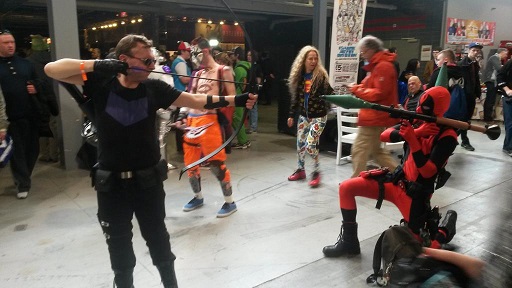
Hawkeye and one of the numerous Deadpools squaring off

Coming back from Imagicon last week I was sat with some cosplayers discussing rumours about the Dutch Comic Con, being held this weekend. Apparantly the organiser had run into money troubles, various guests had cancelled or were supposed to threaten to cancel and it was all a shambles. Worrying news, as I’d just bought tickets for it, but on the other hand most of the guests were of little to no interest for me, various actors and such, some coasting on their appearances in a fondly remembered decades old SF classic, some being supporting actors in a current telvision fantasy hit. All great for those who like that sort of thing, but it’s not my fandom. For me therefore I didn’t matter too much as long as the con went ahead: worst case scenario it would just be another comics con, where the main attraction is the opportunity to buy loads of shit at reduced prices. Best case scenario it would be something special, more in line with English or American comic cons.

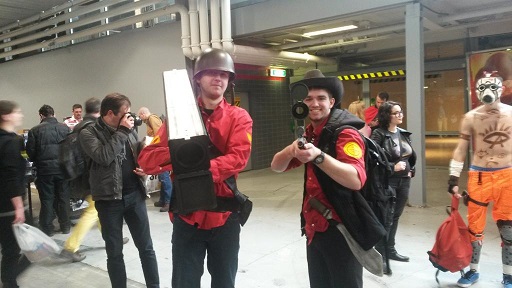
Red off Team Fortress 2 represents, but where was Blue?

The end result turned out to be somewhere in the middle. The con seems to have consciously modelled itself on the San Diego Comic Con and similar, with the main attraction being the media stars and the comics reduced to a supporting role. The disadvantage there being that if you’re not quite as interested in that sort of stuff, there was indeed little else to do but walk around and look at the various merchandise and retailing stands. Unlike Imagicon, there was no real programme other than the various Q&A sessions with the guests and the movie programme running in the cinema, no real room to sit down for a while otherwise. After a few hours of this, I really felt it.

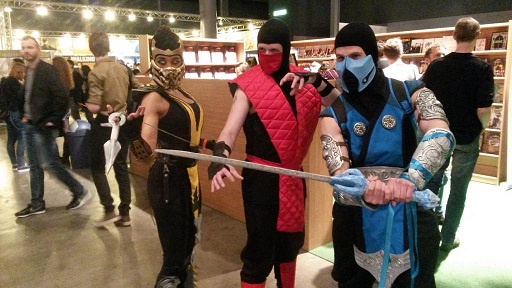
Mortal Kombat cosplay courtesy of InuNeko Cosplay

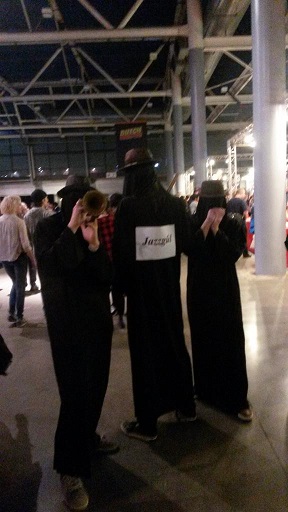
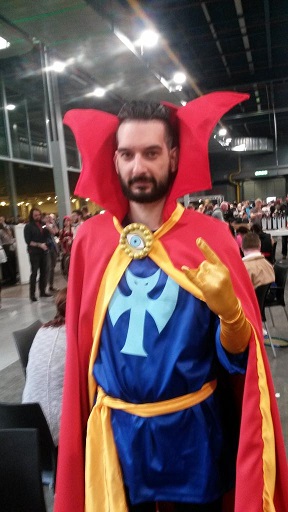
What made this more than just another “stripbeurs” was the audience, which like at Imagicon was young and very much into cosplay, as the pictures here show. Jazzgul Some indeed, like Hawkeye in the first pic there, were at both cons. What I liked about the cosplayers was their enthusiasm, skill and generousity. People were more than happy to pose and some groups and people were very popular. There was some real creativity there as well: not just your Deadpools, Storm Troopers, Black Widows, Lokis and Thors (this time both in male and female versions), but I also saw a captain Haddock, a trio of Giffen era-JLA cosplayers doing Guy Gardner, Fire & Ice and an absolutely adorable father/baby combination dressed up as Where’s Wally. As always the cosplaying seemed to be roughly equally divided between immediately recognisable movie/tv superheroes, obscure to me but apparantly massively popular figures from anime/manga/videogames and the occassional sui generis character, like the frog man from Fables I saw.
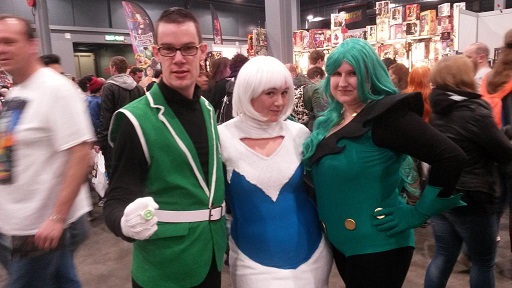
Guy Gardner, Ice & Fire from the Giffen era JLA

Now I could’ve taken many more pictures of cosplayers, were it not for the pressures of the crowds. I’ve heard reports that at its peak the con had some 16,000 visitors and I can well believe it. At times getting through the crowd was … difficult… Doctor StrangeThe layout of the con didn’t help. There was a huge, largely empty hall for the Q&A/music sessions, there was the main hall where you came through which was badly lit and confusingly laid out with the main sponsors and retailers, as well as the space for the autograph sessions, which took up a huge chunk on the side of the hall with crowd barriers and such but where you could only see which person was signing once you skipped the barriers and walked to their table. The secondary hall, where all the smaller retailers and standholders were located, also had a lot of wasted space at the edges and at least one lane that was too narrow, leading to huge traffic jams. It didn’t help one of the ways to reach it was through one of the con center’s food outlets. What happened to the artist alley was even worse, a few picnic tables put together in a corner inbetween the main and secondary halls, easily overlooked. Not helping matters was the lack of sign posting everywhere.
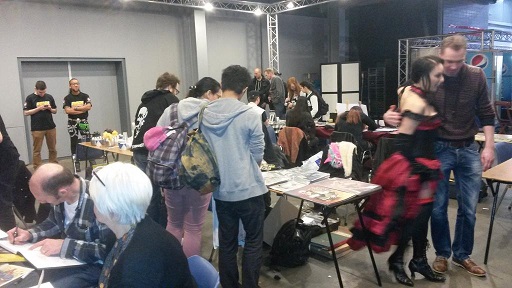
artist alley, in a forgotten corner of the con

These are all typical first con growning pains and if the con is repeated next year, I hope they’ll go for a different layout. For my part, I had a blast visiting and talking to the people manning some of the smaller stalls, like the people at the new comics artist collective Taus Art, your archetypical indie comics makers. I also spent half an hour talking to Eelco Koper, whose Superhelden magazine is busy addicting a new generation of readers to the best of all ages superhero comics, including Paul Grist’s Mudman and Dave Sim’s Cerebus (!). And because the audience wasn’t quite in the Eppo range, I could also spent some time chatting to Eric Heuvel and Marissa Delbressine while they were sketching, which I’ll scan in and post separately.

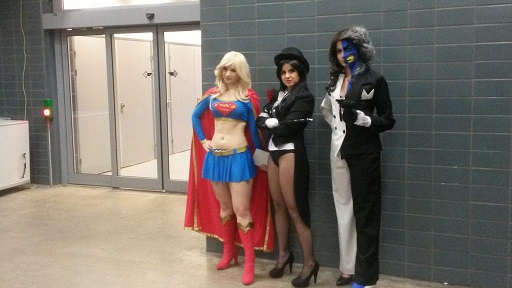
Supergirl, Two Face and annattaZ yalpsoc in the middle

Considering it seems the con has been a success and assuming it will be repeated last year, what would I like to see done differently?

  • A better layout, with less wasted space, room for people to just sit and hang out that’s not part of a food court, better lighting in places, more room for cosplay and photographing of same outside the main traffic
  • Much better signposting as well as more announcements of what’s going on
  • A proper artist alley, preferably combined with all the fan organisations and others now lost in the crowds amongst the stand retailing overpriced statues
  • Multi track programming with more to do than just listen to Q&A sessions with actors or getting your picture taken with the Batmobile and a larger emphasis on the comics part of the con.
  • Less perhaps of the traditional Dutch comics con stuff, more of a focus on US and Japanese comics/fan culture.

That should do it.

“Our protagonists, our characters, can be anyone.”

Elsinore with black Ophelia

Katie Chironis is the team lead and writer for Elsinore and for Gamasutra she wrote about how her team approached diversity in the game:

Elsinore is an adventure game set in the world of Shakespeare’s Hamlet – which places it, historically, in 16th century Denmark. Since we began work on the project a year or so ago, I’ve shown the playtest build to family, friends, and strangers alike. After they’re done playing, intermingled with their feedback on gameplay, they often point to Ophelia and ask: Why is she black?

My answer is always the same: Why shouldn’t she be?

Which to me at least is sufficient answer. If anything has shown its adaptability it’s Shakespeare after all, but there are always morons who want to argue the toss about the plausibility of a black woman in 16th century Europe. Hence Chironis’ focus on historical research, even though the game itself isn’t very historical. It’s easy to nitpick her argument in the context of her own game, (as seen in the MeFi thread here), but that misses the point she’s making. Games need to be more brave at embracing diversity and not whitewash history, not cling to a faux-historical perspective that can’t see anybody but white men be assassins or knights.

Sounds ominous…

Teresa Nielsen Hayden hears distant rumblings of discontent in fandom, possibly having to do with the Hugo Award nominations this year. It might just be that the Sad Puppies campaigners — happy to function as foot soldiers on another front in the right wing’s kulturkampf — has gotten its act together and managed to bulk vote its slate onto the ballots. The question is, given that this is true, is this a problem?

In the short term, yes, as it will mean other, more deserving candidates get excluded from the ballot, which in most categories is limited to five places, occassionally one or two more when multiple nominations get the same amount of votes. Slate voting like this, even if it can only get one or two candidates in each category and they have no real chance at the Hugo itself, means others will lose out on these places. And Hugo nominations can be important, especially for new writers, to establish a reputation as being worthwhile to pay attention to. Losing out on this because somebody thought making a political point is more important than actually rewarding good writers is bitter.

In the slightly longer term, if those who oppose the Sad Puppies are tempted to do the same as they, the damage may be greater. The Hugo Awards have been problematic for a long time, voted on by what you could uncharitably call a clique of ageing fans, but was starting to evolve away from this in recent years, the backlash against which erupted last year with the first Puppies slate. Remaking the Hugos into a popularity contest of warring politically motivated slates will put an end to this evolution. The same if we attempt to invent rules that makes this sort of slate pushing illegal.

Normally I’m not one to say we should just ignore the trolls, but perhaps in this instance we should. Voting in the Hugo costs money and to keep it up year after year in such a way as to be effective even more so. This campaign will run out of steam sooner or later but can do some real damage if we let them in the meantime. In this case what we need to do is to keep nominating and voting those writers and books we genuinely think are worthy of a Hugo, not engage the Puppies on their own level.