
That’s the weirdest, most awkward way to strangle somebody from behind I’ve ever seen. This is a fetish for somebody.
So it turns out Iain Banks asked Ken MacLeod to continue the Culture after his death:
MacLeod said: “He had an idea for the next Culture novel and what he said to me was that he would like me to pick it up and run with it in my own way.
“I was very reluctant to agree even though Iain was insistent that it was something I would write in my own way rather than in a pastiche of his.
“Unfortunately, Iain left not even notes I could work from. If he had managed to get through the summer, he hoped to leave enough notes for me to work from if I wanted to.
As you know Bob, the very first Culture novel was dedicated to Ken MacLeod, so there’s no better person than him who could’ve continued the series. I understand why he’s reluctant to do so, but in this case I’d rather liked to have seen it. But at least Kevin J. Anderson can’t get his hands on it.
The second week of my short sf marathon has just concluded:
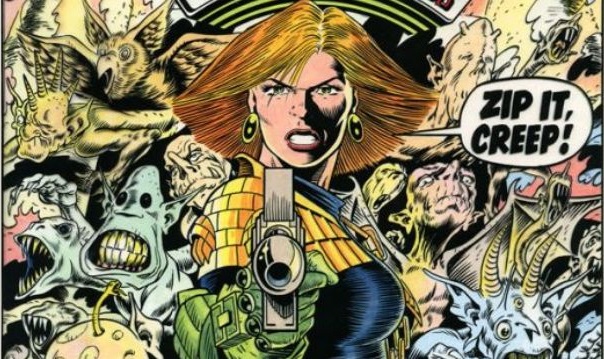
British comics Twitter this afternoon was rocked by the news that legendary 2000AD, Deadline, Johnny Nemo and Skreemer artist Brett Ewins had died. He had been one of those artists that never quite gotten the recognition they deserved but who was quietly influential to whole generations of artists, his influence noticable in people like Jamie Hewlett or Kieron Gillen. He was also one of the people responsible for what you might call the housestyle of 2000AD, a somewhat exagerrated, loose and kinetic style of cartooning that was like nothing seen in either American or British comics before. I personally first encountered his work on the “Universal Soldier” story from prog 750, during that glorious year or two I bought 2000AD weekly back in 1990-1992.
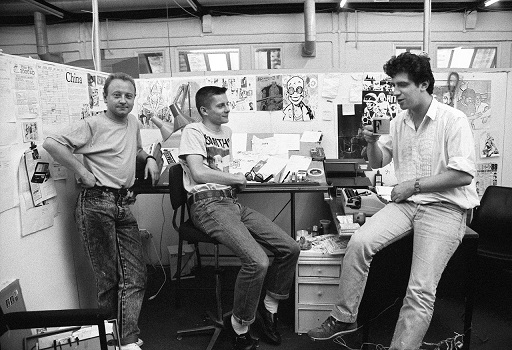 Brett Ewins, Jamie Hewlett, Steve Dillon (L-R) at the Deadline offices.
As Joe Gordon puts it in the Forbidden Planet blog, Ewins was an essential figure in the UK comics scene of the eighties and nineties:
An utterly seminal figure for readers, especially of my generation growing up with 2000 AD and then, perfectly timed for us as we got that bit older, Deadline and other works, experimenting, pushing, improving, changing, pushing the nature of comics artwork and design (and in the case of Deadline, quite simply making comics cool – how well I remember my copies being borrowed by friends at college who hadn’t read a comic since they were kids, a perfect Cool Britannia mix of innovative comics, fresh, hip, hungry talent – being so nurtured by a generous Brett as many of them will tell you – and music and style, it was intoxicating, it was exciting).
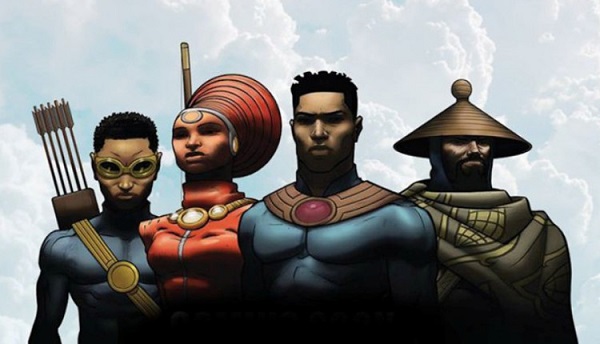
An interesting post on Afropunk.com, about a new South African superhero series, Kwezi:
Created by acclaimed artist Loyiso Mkize, the series is centered on 19 year old Kwezi, a typical South African youngster – immersed in popular youth culture – who develops a connection with his traditional roots,. Mkize says, “It is the journey of a young man. He starts off as an arrogant, opinionated anti-hero who discovers and appreciates his superpowers … the cultural aspect brings him back to his roots.”
Quite a difference from the late seventies Apartheid era Mighty Man, which as Nick Wood describes it, was basically propaganda for the Apartheid state, aimed at the inhabitants of the townships:
But Mighty Man (MM) never challenged any agencies or laws outside the township in which they were set – ostensibly Soweto. A black hero seemingly meant exclusively for black people, his enemies were township gangsters (‘tsotis’), drug Lords (‘dagga merchants’) and generally opponents of peace and ‘law and order’. As Bill Mantlo (1978) states, Mighty Man propounded subservience to laws, non-violence and an anti-gun message (for blacks). With readership targeted to the townships and perhaps priced to ensure affordability to a relatively impoverished community, it was evident Mighty Man was implicitly intent on ensuring compliance to laws – with the underlying message that opponents of ‘law and order’ were invariably gangsters, murderers and, in some instances, ‘communists’. (As Mantlo asserts, a thinly veiled allusion to the then banned African National Congress.)