Little ditty about Rob and Helen

I’m so glad I’m not the only one who tought Rob was grooming Helen for abuse in The Archers:

The only soap I follow now is The archers, the last soap which doesn’t seem to think a month is a long time for a story arc. It is currently portraying domestic violence, although I am sure some followers are unaware it is doing so. A slow, realistic story of coercive control, where Rob has slowly moulded Helen to be the stay at home mum he wants, using all the techniques of emotional and psychological manipulation that real life abusers use.

I only started listening to The Archers because it was part of Sandra’s Sunday ritual but although it’s so often ridiculous it’s also addictive to see the storylines work themselves out over weeks, months and years. It is after the longest still running soap opera in the world and has a huge history to draw from. At times it also has the unfortunate habit to want to be contemporary and edgy, which tends to come off as cackhanded or patronising. Not so for the Rob and Helen storyline though, as Rob is scarily believable as an abuser. Warning bells should’ve rung long ago for Helen, but she doesn’t hear them because she’s in love, while from the outside it must look as if Rob, who was a bit of an arsehole at first, has mellowed a lot. But that’s only because he has focused his attentions inwards, getting Helen to become a full time housewife rather than keep working, something that currently is a new source of tension as circumstances have convinced Helen to get back to work…

It’s all been done relatively subtle and realistic, as far as The Archers can be realistic and it’s utterly chilling to listen to.

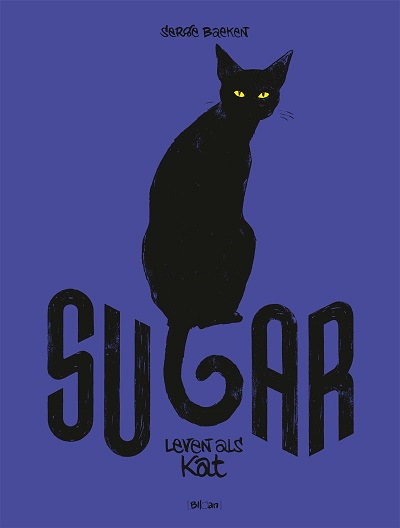
Sugar, Sugar — Serge Baeken

how Sugar got his name

One of the best comics published last year was Serge Baeken’s Sugar, a slice of life comic about the life of a cat and the family he’s adopted into. Cat comics are always problematic because they so easily dive into sentimentality; it’s so easy just to lose yourself in cute anecdotes. Baeken’s work on the other hand has a bite to it. Partially because he recognises the essential truth of having cats, that you have to get used to their death, you share your life with them for, if you’re lucky, ten-fifteen years and then have to get used to their absence.

But more than that, it’s the art that keeps it from being sentimental, in its formalism. Baeken keeps the same six by four panel grid throughout the book, but within these panels experiments with layout in a way you don’t see a lot in other comics, certainly not so consistently. So in the early page shown above, you basically have a big overview picture of the street and block of flats the family lives in, intercut in panels, with the narrative set on top of it. It’s hard to know how to read it at first, your eye drawn down the page following the line of the building first, then back up to the first text balloon. Or perhaps down the road in the middle of the picture?

Sugar learns to talk

Baeken uses a lot of, if I understand McCloud’s Understanding Comics correctly, “aspect to aspect” transitions between panels, where different aspects of one idea are shown, rather than the passage of time. Here used like a training montage in a movie to show Sugar learning how to “talk” with his humans. I like the way in which the people are drawn slightly more “realistic”, with more lines to their faces than the cats, sleek and stylised.

Sugar in action

The consistent six by four grid is also great at showing action, with Sugar breaking through the panel borders, background orientation shifting with his own. There’s a touch of Toth, of Hugo Pratt in Baeken’s use of black and white, of shadow. These are pictures you can keep looking at for hours.

Sugar cover

As Wim Lockefeer laments at the Forbidden Planet blog, Sugar hasn’t been translated into English yet, but it wouldn’t need much translation. If you’re even slightly comfortable with French or Dutch, pick this up at your favourite comic store.

The Black Cat teaches judo (3)

The Black Cat teaches judo tricks from Black Cat 8

Somebody has gotten worried about children imitating these “lessons”, considering the warnings to “use caution as you may injure your partner”. The Black Cat isn’t noticably softer on dames than she is on her male sparring partners. Great expression on her opponent’s face in the last panel.

All her Children Fought


Proof you can tell a science fiction story with only three actors and one, not entirely convincing special effect. Based on the story by Tobias Buckell, who has the story of how it came to be up on his blog. It’s an excellent example of how much you can convey with just a bit of subtle incluing, by working within genre expectations. I can’t be the only one to watch this and be reminded of Ender’s Game, can I?

Some comments: I wonder if the choice of accents for the three actors was deliberate or just a coincidence, but it works in contrasting the boy and his minder with the main character. I’m not sure the premisse of the movie is valid, the reason why it’s young boys/children being sent up there rather than adults, but it makes emotional sense.