Resident Evil: Afterlife

The infection hits Tokyo

If the Resident Evil movie series is good at anything, it’s at providing great looking images like this, set pieces that sacrifice logic for looks. Here we supposedly have patient zero infecting Tokyo with the T-virus, the first zombie to hit Japanese shores, but you would expect that after the destruction of Raccoon City and the subsequent spread of zombies over North America, Japan would be slightly more prepared for a similar outbreak, or that Umbrella would come clean about it. But no.

Alices attacking Umbrella

At the end of the last movie Alice promised Umbrella she’s visit them in Tokyo and she’d bring some friends. This is them. Alices and clones attack, loads of mooks die, not least from friendly fire as head baddie Wexler is not choosy in who he kills. It all ends with everybody from Umbrella and all the clones dead and Alice free to persue her quest for Arcadia.

That is a lot of the walking dead attacking that prison

Which turns out to be some sort of honeytrap, as she finds a lot of planes but no people, with the exception of a brainwashed Claire Redfield. They set off by plane along America’s west coast and come across a prison, surrounded by thousands of zombies, inhabited by a motly crew of survivors, most of whom won’t make it to the end of the movie.

you got to look good even after the zombie apocalypse

What struck me this time is how well groomed all these survivors are; Alice and Claire in full make up and pretty boy over there has kept his beard neatly trimmed. The Resident Evil movies always had a sense of style, but by now style has definately won out over substance. This is btw roughly were I first came in with the franchise, one late night after the football had finished. Back then I hadn’t realised how disjointed this movie was, one sequence stitched to another, or how much it was making up on the fly.

Knock knock

Case in point. This fucker. Suddenly there’s a supersized zombie king to make things interesting, a supernatural creature not seen in any of the other movies. This is something the movies have done before, when regular zombies are no longer enough, but it feels like cheating. Here it does what the run of the mill zombies couldn’t and break down the prison walls, functioning as catalyst to trigger our heroes frantic escape.

Surprise, surprise

They escape to the Arcadia, which Alice and co had learned was actually a ship sailing past the west coast, picking up survivors. It is of course a trap and of course it’s Wesker, who died in the first twenty minutes of the movie, who’s the mastermind, having infected himself with a new strain of the virus, keeping at bay with anti-serum and willpower. Cue massive boss fight including both the Redfields, Claire’s brother Chris having been introduced in the prison; a bit late, considering he’s once again an important character from the videogames not given his due in the movie series.

Jill Valentine working for Umbrella

A happy ending? Of course not. Umbrella, for all its incompetence in actually keeping a world worthy to rule over, are very good at having plots within plots and just as everybody is freed and the Arcadia is ready to become a haven for non-infected humans, up pop their gunships again. And who should lead the Umbrella forces but Jill Valentine, proving that a turn to evil always comes with a worsening taste in clothing, as she has her tits out and wears a not very comfortable looking leotard/fishnet combo.

This is what patriarchy looks like.

It’s no news that Anita Sarkeesian has had to deal with all sorts of horrible filth aimed at her, from rape threats to an unending stream of gendered insults, but seeing only a week’s sampling in the flesh so to speak, is still something else:

Ever since I began my Tropes vs Women in Video Games project, two and a half years ago, I’ve been harassed on a daily basis by irate gamers angry at my critiques of sexism in video games. It can sometimes be difficult to effectively communicate just how bad this sustained intimidation campaign really is. So I’ve taken the liberty of collecting a week’s worth of hateful messages sent to me on Twitter. The following tweets were directed at my @femfreq account between 1/20/15 and 1/26/15.

Which is followed up by tweet after tweet of abuse. It’s hard to read this stuff even as a bystander, somebody who this isn’t aimed at, how much more awful must it be for Sarkeesian and other women who are deliberately targeted by every odious little troll with a persecution complex. What makes it all that much worse is knowing that even men with a similar sort of visibility like Sarkeesian, somebody like John Scalzi say, also noticably outspoken on matters of feminism and privilege, seem far less likely to have to deal with shit like this.

Resident Evil: Extinction

a trench filled with dead Alice clones

You know, three movies into the franchise and I have to seriously wonder about how seriously the Umbrella Corp takes maximising shareholder value. So far, through their manipulative evil they’ve lost their super duper high sekrit research facility under Raccoon City, then Raccoon City, first overrun by zombies, then nuked to contain the outbreak and now at the start of Resident Evil: Exctinction we’re told the entire planet has been overrun. Society has collapsed, everybody but for a handful of survivors is undead and even the wildlife has been destroyed. So what is Umbrella doing? Staging elaborate tests for their Alice clones to run through and get killed. The end result is that trench full of dead clones. You do have to wonder about their priorities.

That is a flimsy fence to keep your secret headquarters safe

That danger room scenario wastes some seven minutes of an hour and a half long movie, only establishing that the bad guys’ base is in the middle of the desert, which is apparantly all of the US by now and that it’s surrounded by zombies kept at bay only by a flimsy metal chainlink fence. You’d think that the pressed mass of the zombies would’ve been enough to pull it down, but apparantly not. It also raises the question why and when Umbrella has been establishing all those super hight tech underground headquarters. This is in the arse end of nowhere, so they would’ve needed to bring in all sort of equipment and people to build it. For those of us living in cities with years overdue, far more expensive than budgeted metro upgrades, this seems unrealistic.

would you trust a diary you found at the feet of a suicide

Twenty minutes in, the macguffin driving the plot is introduced, a diary kept by somebody at the gas station that Alice stops at to refuel, after she escaped from the clutches of a hillbilly cannibal clan by introducing them to their zombie dogs. The diary talks about a safe zone in Alaska, free from infection, but the person who made it has hung themselves. Nevertheless, Alice is intriqued.

working for Umbrella is not the best career choice

So it turns out one of the things the bad guys are attempting is to find a (partial) cure for the zombie virus, giving the victims at least some of their intelligence back, curing their craving for flesh and making them into a docile work force for the Brave New World Umbrella wants to create. Needless to say it goes wrong. Needless to say yet another Umbrella scientist will find out first hand why working for Umbrella is a bad career move. It’s the casual psychopathery of the villains that makes you wonder why their mooks keep working for them, rather than just shoot the Umbrella board and lead scientists en masse.

Alice meets up with her friends from the previous movie

Meanwhile we’ve also been following Claire Renfield and her band of survivors scavenging for supplies, which includes some of the people we met in the second movie, including Carlos here. Alice comes back into their lives as their saviour from an attack by zombified crows, who’ve been feeding on the infected flesh of the dead. It’s the first and only time we see these crow attacks. This is the main weakness of this movie: it’s a series of set pieces that are supposed to overwhelm you with their awesomeness but fall short.

zombie party in downtown Las Vegas

What plot there is, is provided by Alice’s insistence they need to go to Alaska to look for Sanctuary, while the evil Dr Isaacs has become aware of her existence and wants to capture her for study. As the survivors go to Las Vegas for supplies, he sets a trap using his new, improved zombies. This seems wasteful but it’s Umbrella’s M.O. to kill off as many civilians as possible with each of their harebrained schemes. Here the plan is therefore to murder everybody including Alice and then take a blood sample. Things do not entirely go according to plan but it does allow some of the survivors to die a nicely heroic death.

Claire Renfield looking badass

It also allows Claire Renfield/Ali Larter to show off some of her badassery, which was badly needed. In the games she’s one of the more important characters of course and only introducing her in the third movie is a bit late. Interestingly she’s the third badass woman character to tag along with Alice in the movies, after Jill Valentine in the second and Rain Ocampo (Michelle Rodrigues) in the first. Which is I think one of the main virtues of the Resident Evil series in both games and movies, that there are so many strong female characters in it, without too much of the usual nonsense surrounding them.

Alice and friends

The climax of the movie has Claire and the remaining survivors escape to Alaska in an Umbrella helicopter as Alice fights off the now infected Dr Isaacs, killing him and warning the rest of Umbrella she’ll be paying them a visit. It’s a great image to end on, but it shows the absurdity of the whole series, the obsession it has with Alice. You’d think that after the apocalypse Umbrella would’ve lost some of its arrogance, but apparantly not.

Friday Funnies: Ms. Marvel

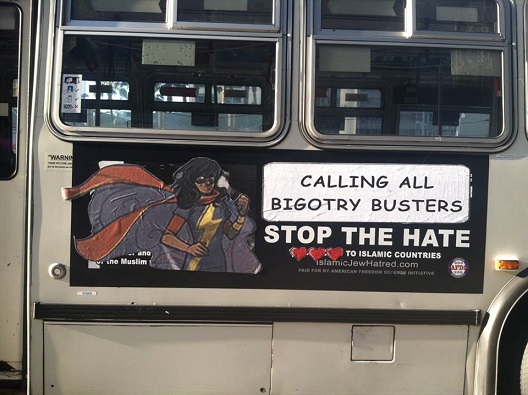
Ms Marvel used to deface Islamophobic bus ads in San Francisco

The buzz around Marvel’s new Ms. Marvel series, now a year old, from the start has been as much about what it represents as about the comic itself. Kamela Khan is after all the first American-Muslim superhero to get her own series and a decade and a half into the War on Terror this still matters. How much it matters you can see from the photo above, showing one of Pam Geller’s attempts to spread hate defaced with Kamela Khan’s likeness, spreading the opposite. If there ever was a comic designed to become part of the floating online culture wars, this was it.

And with its success and that of its Marvel stablemates, quirky titles like Hawkeye and Young Avengers, comes imitation, as DC has just announced its plans to make its line more diverse. (Which is a bit ironic, considering how much effort they put in purging it from any trace of diversity in the past five years or so…) Tom Ewing called this chasing the Tumblr audience, new, younger, more diverse comics fans lured into fandom by the movies or online culture:

It’s a question where the obvious answer is the right one – new audiences live there. Just as Tumblr is more diverse than the Internet as a whole, so comics fandom on Tumblr is more diverse than comics fandom on IGN or CBR or Newsarama. It’s younger, queerer, more racially diverse and most obviously a lot more female – and those voices lead the conversation, they don’t constantly have to fight to win a place on it. It’s also – perhaps anecdotally, perhaps not – newer to comics. I argued after the end of Young Avengers’ precursor series, Journey Into Mystery, that Marvel’s original strength was built on leapfrogging the kids to attract a new, smart, post-teenage audience back in the 60s, and that now they needed to do the same thing in reverse: leapfrog the long-term fans to win that same audience back. But that new audience looks very different now.

And if you buy into the cliche of Tumblr being all about “social justice and feels”, then Ms. Marvel fits that bill perfectly. Social justice, because in the post-9/11 political climate, even now, just having a superhero comic about a Pakistani Muslim-American is social justice, a political act. Her writer, G. Willow Wilson, is of course herself a Muslim convert, something again that many can’t help but see as a political act. Feels, because so much of the first volume at least is about Kamela and her family, what it feels like to be the only Muslim in the village so to speak, but also about her feelings about superheroes. She’s a geek, a superhero nerd whose favourite hero is Captain Marvel/Carol Danvers, which is why she takes Ms. Marvel as her own superhero name.

Kamala Khan first outing

So what we have now therefore is a spinoff of what was originally herself a spinoff of a male hero, the original Marvel Captain Marvel, if not the original Captain Marvel (it’s a long story). There’s no real reason why Kamala should’ve taken this name but brand recognition, but it is sort of fitting, plays to Marvel’s seventies history of extending who can be a superhero through creating distaff counterparts of male heroes (She-Hulk, Spider-Woman, Ms Marvel etc).

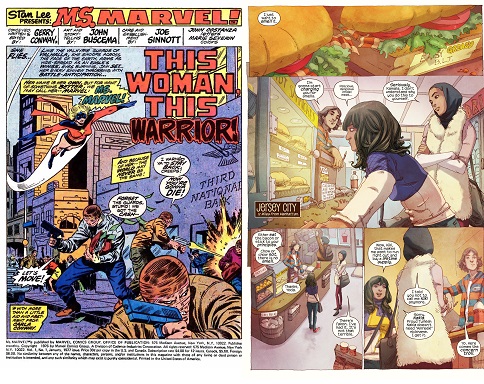
comparing the first pages of Ms Marvel v1 and Ms Marvel v3

It’s interesting to compare that first Ms. Marvel series with the current one. That series started off in media res, with two of Marvel’s most dependable Bronze Age creators working on it, Gerry Conway and John Buscema. Ms Marvel flies in from the left as a robbery is in progress; there’s almost as much text here on one page as there is in any single issue of the new series. G. Willow Wilson on the other hand starts the series as mundanely as possible, at a corner store somewhere in a Jersey City neighbourhood. In this it reminds me of that other Marvel series about an misunderstood teenager becoming a superhero, but Spider-Man only needed one issue of Amazing Fantasy to have his origin, first adventure and fight his first crook. It takes Kamala five issues. This is very much a product of the decompressed era of superhero comics storytelling.

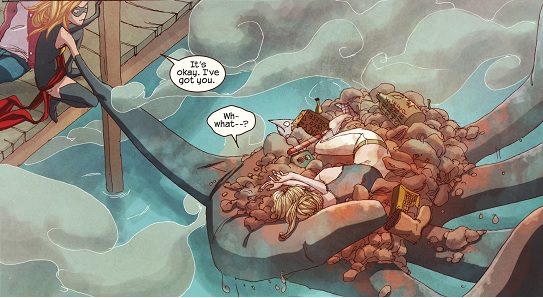
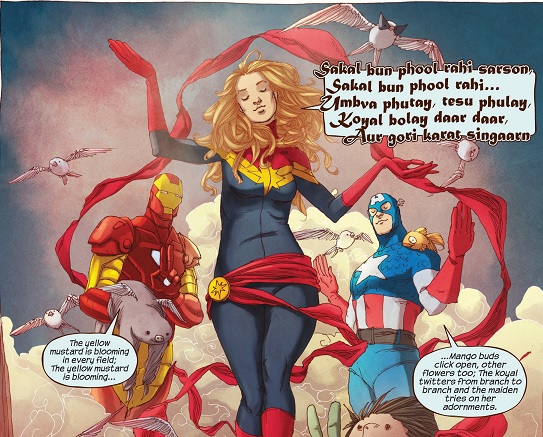
Kamala Khan meets Captain Marvel sort off

I don’t very much like decompressed storytelling or anything else that’s a cheap imitation of cinema or an attempt to make comics look more grownup, but here it works because the focus isn’t on the action, it’s on Kamala’s interaction with her family, friends and wider environment. Even the big climax of the first issue, when she gets her powers and “meets” Captain Marvel, Iron Man and Captain America, they end up talking about her family.

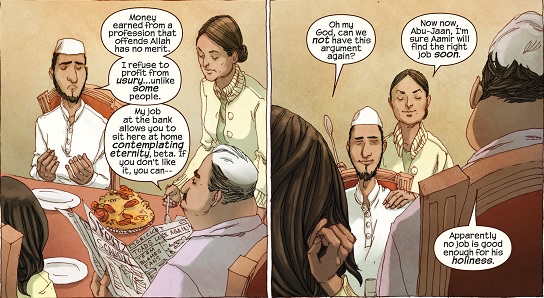
Kamala Khan and family at dinner

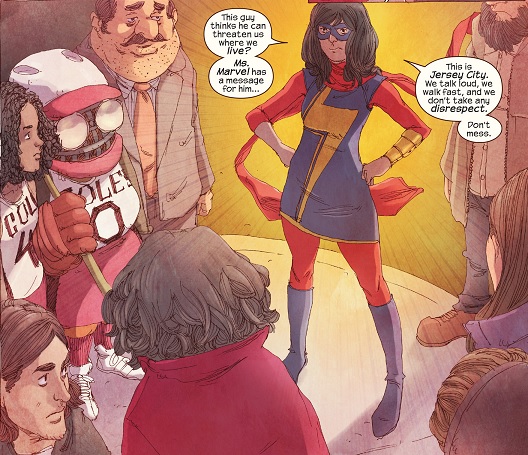
Adrian Alphona’s artwork fits the storytelling perfectly. His people are caricatures, not at all realistic, all elongated or squat in a way that codes cartoony. It gives his characters an expressiveness that even in quiet moments works well, far better than with a more “realistic” art style. It also helps with depicting Ms Marvel’s powers, all based in body deforming.

Kamala Khan and family at dinner

Put it all together and you have a comic that is a decent, well crafted superhero comic that puts its focus firmly on what Marvel has always done better than anybody else, showing their heroes’ complicated home lifes inbetween the battle royales. But the main significance of Ms. Marvel is who she is and that Marvel is comfortable publishing a Muslim written comic starring a Muslim superhero, that’s respectable about the culture Kamala Khan comes from and represents, but not afraid to show conflict either. It doesn’t devolve into cliches about oppression and Islam and all that while still showing a teenager chafing at the rules laid on her by authority figures — parents, teachers, religious leaders. It is essential Marvel teen hero stuff, reinvented for the 21st century.

Kill Me (Ce Soir) — Golden Earring


As a kid growing up in the eighties Golden Earring was just one of those old pop bands that had been around forever, who had a couple of hits everybody knew and of course there was that deeply scary video they did in 1984. It’s only later I knew how influential they could’ve been had they been British or American rather than Dutch. Even so, no one other than Iron Maiden covered this song; it turns out Steve Harris is a fan.