- We Need Diverse Books Authors Take on Publishing, Reader Prejudice – Flavorwire – A few weeks later We Need Diverse Books, the social media movement that has grown into a well-regarded nonprofit in a matter of months, was born. The founders had already started planning their campaign when, not for the last time, an incident of industry racism gave them momentum. In April, BookCon — a subsidiary of New York-based publishing mega-conference BookExpo — announced a panel of superstar children’s authors that consisted of all white men, while the overall conference lineup was all white people, aside from Grumpy Cat.
- GUEST POST: Elizabeth Bear on “Strong Female Characters” « Intellectus Speculativus – Specifically, my problem is that the idea that a female lead must be a “strong female character” leads to a whole complex of other problems. So here’s an inexhaustive survey of some of them, and some suggestions on how to avoid the traps.
- Conventional Wisdom by Arthur Drooker – Cool Hunting – This time, people are the focus of his lens for "Conventional Wisdom." Drooker plans on attending conventions across the United States to capture the inner-workings of dedicated, passionate and sometimes surprising, communities, all in service to his next proposed book. We're excited to share exclusive sneak peeks from his explorations, as the "Conventional Wisdom" trek unfolds.
- Borderlands Books : Used&New Science Fiction, Fantasy&Horror – In November, San Francisco voters overwhelmingly passed a measure that will increase the minimum wage within the city to $15 per hour by 2018. Although all of us at Borderlands support the concept of a living wage in principal and we believe that it's possible that the new law will be good for San Francisco — Borderlands Books as it exists is not a financially viable business if subject to that minimum wage. Consequently we will be closing our doors no later than March 31st.
- Locus Online – posts from Locus Magazine » 2014 Locus Recommended Reading List – This Recommended Reading List, published in Locus Magazine’s February 2015 issue, is a consensus by Locus editors and reviewers — Liza Groen Trombi, Gary K. Wolfe, Jonathan Strahan, Faren Miller, Russell Letson, Graham Sleight, Adrienne Martini, Carolyn Cushman, Tim Pratt, Karen Burnham, Gardner Dozois, Rich Horton, Paul Kincaid, and others — with inputs from outside reviewers, other professional critics, other lists, etc. Short fiction selections are based on material from Jonathan Strahan, Gardner Dozois, Rich Horton, Lois Tilton, Ellen Datlow, Alisa Krasnostein, and Paula Guran with some assistance from Karen Burnham, Nisi Shawl, and Mark Kelly.
- Seanan’s Tumblr | Do you get royalties on used books, or are they… – Let’s return to the used book ecosystem for a moment. When you buy a used book from my local Half-Price Books, no, I don’t get royalties. But the store pays its rent. People are employed. The lights stay on. People who need money can sell their books to the store to be sold to other people looking for a little joy. A used book is joy magnified. It is something paid forward into the world. A pirated book is a dead end.
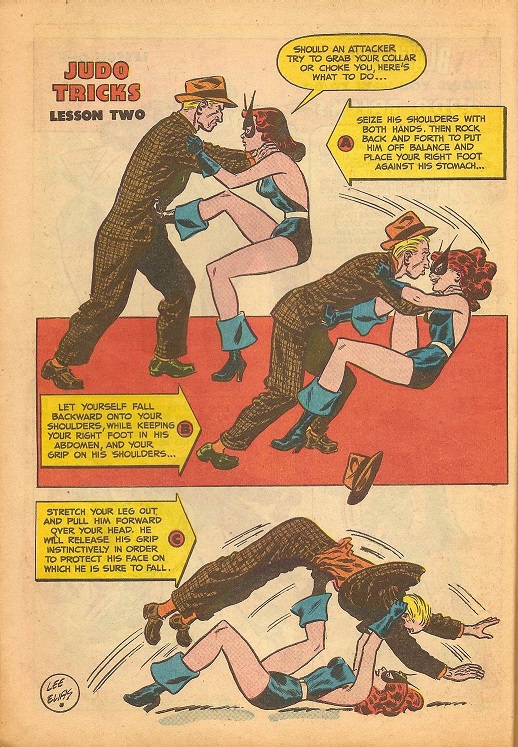
The Black Cat teaches judo (2)
Legend of the Bore Knight
I didn’t know this about Legends of the Dark Knight:
Legends of the Dark Knight was, at the time, an altogether different kind of monthly comic. Instead of launching with a stable creative team, the book was conceived from the get-go as an anthology, with rotating creators switching arcs. Additionally, the book was not set in the present of the DCU, but in the past – specifically, the “Year One” period popularized by Frank Miller in his work (with David Mazzucchelli) of the same name, which had also served as one of the stylistic influences for Tim Burton’s movie. So while LotDK was designed to fit into the then-modern post-Crisis continuity, filling in the gaps of Batman’s early years, it was still, like “Year One,” at a distance from contemporary goings-on. What this meant in practice – although this mandate loosened as time wore on and the “Year One” period became increasingly crowded – was: no yellow Bat-symbol, no other superheroes, and especially no Robin. Oh yeah, the Comics Code was conspicuously missing as well – although, at least for this first arc, the lack was often academic.
I always thought LotDK was supposed to be out of continuity stories, for a slightly more “mature” audience who didn’t want to sully their hands with the real thing. Whenever I read it, the stories were always vaguely disappointing, despite the talent involved. It always felt like trying too hard to imitate Year One or The Dark Knight Returns. To be honest, that was the case with most of the Batman and other DC “prestige” projects post-Watchmen/Dark Knight and to add insult to injury, mostly the “mature readers” labels on them didn’t even mean decent T&A, just more dreary superheroics with a bit of mock swearing.
Alternate History
That sometime in 1970: The Beatles fired Allen Klein and somehow came upon an agreement of how to run Apple Records, allowing the band members to separate the music from the business, the chief destruction of the band being averted; with the success of “Here Comes The Sun” and “Something” and an amazing back-catalog of unused and new songs, George successfully campaigns for an equal share of his own songs to be featured alongside the Lennon/McCartney originals (with the compromise that Linda and Yoko are allowed in the Beatles’ inner circle if need be); pleased with Phil Spector’s work remixing Let It Be, The Beatles opt to have him produce the bulk of their recordings throughout the 1970s (despite McCartney’s reluctance); John agrees but wants to elaborate on the stripped-down and live-band-sounding arrangements, as revisited in the Get Back sessions from the previous year, but at least for his own compositions written from his Primal Scream therapy sessions; Ringo was, as always, just happy to be there.
One of the things that distinguishes the serious music nerd from the serious music nerd is that the former spends a lot of time and energy not just imagining what if the Beatles hadn’t split up, or what if Syd Barrett hadn’t had his breakdown, but actually create imaginary albums from timelines in which these things did happen. I’ve only discovered this blog the other week, thanks to MeFi, but I’m seriously considering whether it would be eligible for a fan Hugo, because does seems to be the purest form of fannish alternate history making.
GamerGate will get somebody killed someday soon
Game developer Brianna Wu has been stalked, tormented, and harassed by GamerGate—the amorphous reactionary movement centered around video game journalism—for months now. But it’s never been as frightening as it was this weekend—when she watched a terrifying video made by a deranged fanatic who claims he crashed his car on the way to her home. “I’m worried my husband and I are going to die,” she tells me.
On the one hand it’s tempting to laugh at a wanker like “Jace Connors”, who embody all the stereotypes of the Internet Hard Man, up to and including saying was in the navy SEALS but still has to drive his mom’s car, but it becomes less funny if you’re the intended victim of this wackadoodle. A bit like ISIS has done in the Middle East, GamerGate is providing angry losers with an “ideal” to harass, threaten and possibly kill for, a direction for their rage. Most of it is sound and fury signifying nothing, but there only needs to be one loon who’s slightly better organised than “Connors” to create a tragedy.
And judging from this incident, it is not an idle worry. These people are tapping out of the same reservoir of rightwing anger that e.g. anti-abortion activists are drawing from. There are a lot of angry, confused young men who’ve latched on to GamerGate or similar causes in other parts of nerddom *cough* Sad Puppies *cough*, who are clearly comfortable with harassing women on Twitter in the worst possible ways and who are only one step away from continuing that harassment offline.